Showing posts with label Nature. Show all posts

Sunday, May 16, 2021

Review Bomb | Getting To Be That Time Of Year...


Since summer is nearly upon us I thought this would be a good time to remind everyone that no matter what we as humans try to do to control Mother Nature, she will never be tamed.

(Side note: while these are natural disasters, I consider the Galveston Hurricane to be a man-made disaster as well, seeing as how weather reports from Cuba were completely ignored by the US, due to us thinking we know more than everyone else.)

 ⭐⭐⭐⭐⭐

Any book by Erik Larson is a must-read for me. I started years ago with Devil in the White City and haven't stopped yet. Dead Wake rivals White City as my favorite, but you can't miss when picking up any of his books.

Isaac's Storm is Larson's first book and I loved it every bit as much as his most recent works - though I still have to get to Thunderstruck (which I own) and The Splendid and the Vile, which I have literally just checked out in ebook form from the library - 'Currently Reading' shelf and overdue ARCs be damned!

I have read several books about the Galveston Hurricane and this is the best. Larson uses much of Cline's own words to paint the picture of a man who, despite his experience, had no idea what he was truly up against that early September day. Through Cline's reports, letters, and telegrams we are given a look into his mind to see what he was thinking.

Cline and his family lived in Galveston where he was the resident meteorologist for the US Weather Bureau. As he observed the unusual weather phenomena the morning of September 8th, 1900, he failed to see what was coming even as the winds and sea swells gave warning. The hurricane barreling down on Galveston would become the greatest natural disaster in the history of the US, with at least 6,000 lives lost and the entire city nearly obliterated.

Larson masterfully blends science and history together, telling the story mostly from Cline's perspective. Cline was sure, based on his experience and knowledge, that no hurricane could really do damage to the city. This alone might be the worst thing about the whole tragedy, except there's more. the US Weather Bureau received warnings from Cuba that the massive storm as on its way, but Americans did what Americans do, and dismissed the warnings because we obviously know everything and what are the chances that someone else might be correct?

It wasn't until late afternoon into the evening that Cline realized something was wrong. In his defense, despite the winds and swells, there were other factors that indicated there was no storm coming - the barometer rose throughout the day. Yet the swells grew bigger and by nightfall they were so huge that structures near the beach were rapidly being demolished. But even before this, the city began to flood in the afternoon.

Yet Cline alone is not to blame, so I do not want my words misconstrued. As we know, bureaucracy is a bitch and it reared its ugly head here just as it does in disasters of our time. Even as the Weather Bureau was ignoring hurricane warnings from Cuba, they were also hamstrung by rivalries within about whether or not to even send out storm warnings. With no warnings issued, no calls to evacuate were ever given. The city was completely blindsided when the rage of the hurricane was suddenly upon them after nightfall. Not a single other person in the city aside from those who worked at the weather station even knew a storm as coming, let alone a hurricane.

As I have read books about this storm, I have wondered if the death toll might have been lower had it occurred during the day and honestly, I am not sure. No doubt that trying to find one's way in complete darkness contributed to many deaths, but the majority seem to have come from people struck by debris or their shelters collapsing on them. That would have happened no matter the time of day. But perhaps some who drowned would have avoided this fate had they been able to see how quickly the water was rising, and made it to higher crowd? This supposes a lot, I know, but I have spent a lot of time thinking about this particular hurricane and thoughts like this continue to pop up in my mind.

Like all of Larson's books, this reads as a novel and the pace is quick as we are taken along on the collision course with the storm. The lead-up is intense because you know what is coming, you have all kinds of information that the citizens did not, and know that many of them will not survive. Through the storm's arrival and its aftermath, you feel as though you are there in the midst of it, there among the remains of once-stately homes, businesses, churches, schools. You witness the desperate search for missing loved ones, and joy when reunions occur and the overwhelming grief and agony when they do not.

Highly. highly recommended.

 ⭐⭐⭐⭐

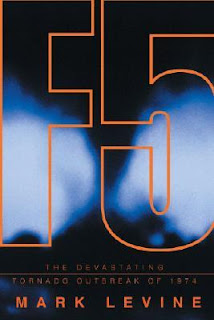
In the terrifying hours that began on April 3rd, 1974 and ended on the 4th, a total of 148 massive tornados would wreak havoc in North America, from southern Ontario down to Alabama, Illinois to Virginia. It is surprising that more were not killed in the fury, given the devastation. In total over 300 lives were lost, but that is still 300+ too many. This "perfect storm" so-called by experts, will happen every 500 years or so, according to their estimates.

Here the author focuses on Limestone County, Alabama. We are given a history of the area and he introduces the people going about their lives until suddenly they aren't anymore because their whole world has changed. Levine focuses here because it is in this county that eight of the tornados touch down. One of the eight is an F5 and another is either an F4 or F5, though it was never fully determined which.

I appreciate the author's use of the science behind what makes a tornado happen and I feel like he explained it in a way that those with less knowledge than weather nerds like me have can still understand. The tornados come, lives change forever, and all the survivors can do is bury the victims and try to move on. It is as heartbreaking as it is compulsive to read. He makes the survivors so real as he sets their lives on these two days against the backdrop of the US at the time. Think of 1974 and all that the US was dealing with, as well as Alabama specifically. He paints quite a picture of figurative upheaval coupled with literal upheaval, and does so with the utmost compassion. There is nothing voyeuristic here as he relates the stories of the people who survived, and what they went through in order to do so.

Highly recommended.

 ⭐⭐⭐⭐

Perhaps the best account of the absolute clusterfuck that was Superstorm Sandy. The storm was so massive, even scientists aboard the International Space Station were singularly focused on it as is stretch for literally hundreds of thousands of square miles. No one knew what to call it after it morphed from a tropical storm into the monster it became and absolutely no one knew how to prepare for it because they could not decide what it was, until it was too late to make any meaningful decisions. NOAA, the NWS, and the Coast Guard were constantly stumbling over themselves in regards to warnings and reports because the storm was so unprecedented.

The author does a fantastic job here of weaving together multiple points of view as those in power grappled with decisions they could not confidently make because the storm was constantly changing and morphing into something no one had ever seen before. As always there are heroes and villains, and everyone in between. The story specifically touches on the crew of the Bounty, a replica of the HMS Bounty that was not completely seaworthy even after some much-needed repairs, yet her captain took her straight toward the hurricane anyway. Some crew survived, bodies were recovered, though his was never found (this story is touched on in A Furious Sky, which I am also reviewing in this post, but much more information was included in this book than that one).

Overall I found this to be a very engaging read, though it was a bit dry in places when I was bombarded with acronyms and some technical aspects. I love weather stories but even I was a little bleary-eyed in parts where I was not sure what was actually being discussed. This is a thorough look at an absolutely devastating storm. I recall feeling that after reading this book there must be a better system put in place, so many lives could have been saved. But after reading A Furious Sky and seeing how many times we have said that exact phrase with each new kind of storm, I don't know that we will ever have a perfect system. Our world is changing rapidly due to climate change and these storms will always get worse. There is always a new big one coming and we honestly have no way to be 100% prepared for any of them that will most certainly follow. However, the author does well to point out that with better funding and better policies, those future situations could at least potentially result in better outcomes for the majority of people impacted. If everyone could just let NOAA do its job and give them the funding and technology to do so, we could be in a bit better shape at least.


 ⭐⭐⭐

This one tells the story of Moore, Oklahoma's complete devastation in May of 2013. The author grew up in Moore and as a child of Oklahoma it makes sense that she wanted to be a storm chaser. Instead, she became a journalist and returned home in the wake of the worst tornado ever recorded to find what was left.

Even as a journalist, certain choices in her writing style bothered me throughout, otherwise this would have easily been a four star read. She's a good writer and journalist, her reporting on the actual facts of surviving this monster are fantastic. Yet there was so much repetition on certain points that it became a chore at times to read. Everyone who has a fascination with tornadoes knows who Gary England is and it was unnecessary to constantly remind us of who he is and what he does. I understand doing so the first time for those who might be unfamiliar with him, but seriously. He's pretty much achieved worship status in Oklahoma.

The most frustrating part of the constant repetition though had to do with the children who were in school when the tornado struck. Everything was tiny.  Tiny tiny tiny. Tiny chairs and tables, tiny bodies, tiny faces, tiny bathrooms. Tiny tiny tiny. This was so unnecessary to convey the complete vulnerability of these children and bordered on ridiculous. Even use of a different word would have been helpful because, GOOD LORD!

The majority of the book, however, is a good read and at times you feel like you are there in the midst of this monster, trying to survive. The lead-up itself was a bit slow but once we are in it, the pace moves quickly and you are whisked from location to location to survey the damage.

Recommended.

 ⭐⭐⭐⭐

Just finished this one yesterday afternoon, could not put it down!

The author dives deep in the US history of hurricanes, going back through historical records to see how these monstrosities were written about, what progress was made along the way and by whom, and with what tools and instruments, and so on.

It is kind of embarrassing to admit that I've never really given a thought to how people hundreds of years ago dealt with this kind of weather phenomenon and how they viewed these storms. I learned much about these early hurricanes that remained nameless - and of the how the naming system we have today functions. I knew previously that lists are drawn up a couple years in advance, containing male and female names. I had no idea that prior to this, hurricanes were given strictly female names - and in that era the headlines about said hurricanes were as gross as one can imagine as misogyny gleeful abounded in the form of all sorts of ridiculous adjectives.

Dolin opened my eyes to just how impactful these storms were in the early days of our country - and the time before we were even that. As a result of hurricanes striking, it seems that this is one of the reasons Spain was unable to get a foothold in any farther than Florida. Not to mention the fact that these storms also played major roles in helping us win the Revolutionary War.

The author does a masterful job tracing the developments of scientists as they worked to understand these live-altering events. So many men who I had never heard of (so you know that there are women involved whose names we will never know as a result) contributed greatly to the field of hurricane study. It will surprise no one that Benjamin Franklin was in on the action as well.

Yet even for all the progress we have made in predicting and tracking hurricanes, we will be our own downfall.

Much like I mentioned in the Hurricane Sandy review, we will never have a perfect system because of our own impact on our planet. Climate change is making these storms deadlier and deadlier each year. If we do not make changes NOW, and some scientists warn we are already past the point of no return, then things will get worse - something likely unimaginable to those who survived the Galveston Hurricane in 1900. The official count remains around 6,000 killed, though given the timing and the fact that Galveston was a perfect summer vacation spot, we will never know how many truly died in what remains the worst natural disaster in our history.

Despite being such a massive undertaking to succinctly lay out our five-hundred year history in relation to hurricanes, I feel Dolin has done a fantastic job with what must have been an overwhelming amount information to work with. With recovery after these major events, there are many societal issues raised as it quickly becomes obvious that there is inequality in the way resources are dispersed among various communities all devastated by the same storm. One must only look to Katrina to see this is full view.

Highly recommended.

Saturday, April 4, 2020

Mini Reviews | Natural Disasters


Much like my most recent post discussing books about man-made disasters, I think I am devouring books on natural disasters for some of the same reasons. We have to be hopeful, we have pray, and we have to do the things we are required to do in order to keep ourselves, our families, and our communities safe. 


25634151. sy475  ⭐⭐⭐

This was a brief account of a devastating hurricane that struck the Cedar Keys at the end of the 19th century. I always find it interesting how natural disasters were watched and communities recovered from them long before technology came along that could help either process. In the time before hurricanes were given names, they were simply numbered, and Hurricane Number 4 did quite a number on Cedar Keys. The destruction crippled the island. Buildings and people were washed away with ease.

This is another factual account, written as such without a narrative style that many seem to prefer when reading non-fiction. The author uses many firsthand accounts to describe what happened to the people that early morning, and many photos as well. The book is fairly short, and I feel like this is because there is simply not as much information about this event than there are of those that came later, even by a few years. Still, it is a decent introduction into the disaster.
Recommended.

40682437. sy475  ⭐⭐

This book started off really strong and I was impressed by the wealth of information that the author had access to. She weaves an incredible story of a town that expected rain and instead were confronted with a massive F5 tornado that claimed dozens of victims by the time it was over. The town of Rocksprings was small, less than one thousands people. Many had plans that evening to attend a show that evening at the school. Instead, their plans changed the moment hail began raining down on them, smashing windows and roofs. It took less than ten minutes to flatten nearly the entire town, kill nearly 80 people, and injure more than 150. What makes this all the more worse is that some of the victims were never found, and I can't imagine dealing with that kind of pain, knowing that you were not able to protect your loved ones, and had to live the rest of your life never knowing where they came to rest.

Those who were not injured sought to help immediately, however they could. There was a story of two men leaving town to get help. Due to the heavy rains, roads were very slick. They told how the car slid, ended up rolling twice before landing right side up again, and off they went to get helped for their community.

The author told the actual story of the tornado and its destruction so well, using so many sources - historical records, newspaper accounts, personal accounts - that is was deeply disappointing in the way the rest of the information was laid out. The story was told in chronological order, so naturally the most content was devoted to that date and the events that occurred then. Eventually the dated sections became brief statements of how people died, or other connected events as we moved further away from April 12th, 1927. The final section was the dedicated to each of the families impacted and conveyed so much of the same information already found elsewhere in the text. The only additional facts provided were what, if anything, was known about those families long after the tornado.

Recommended with caution, due to repetitive information in final section of book.

Thursday, March 26, 2020

Review Bomb | The Best Kind of Reality Shows


905656. sy475  ⭐⭐⭐⭐

If you are unfamiliar with this first show, allow me to give a little background. Ghost Hunters (not to be confused with the trash that is Ghost Adventures, don't even get me started) came to be because of Jason Hawes and Grant Wilson. They founded T.A.P.S. - The Atlantic Paranormal Society and conducted investigations on public properties and in private residences at the request of the owners, and filmed many such investigations. Something I have always appreciated about this team is that they did not go into every case assuming the activity was paranormal. It was their priority to first make their clients feel safe - especially if they were investigating a private residence where there were children involved. The team would debunk everything they could, and even if they could not explain something away, they still hesitated to call it paranormal more often than not. Unfortunately the team is no longer together and only bits and pieces of info are available here and there. Though, I think it is quite telling that Grant Wilson is using the Ghost Hunters show title with a completely new team, while Jason Hawes, Dave Tango, and Steve Gonsalves have gone on to create a new show called Ghost Nation. Tango and Gonsalves were also on the original Ghost Hunters (and are hilarious; great comic relief!).

I liked this trip down memory lane for two reasons, first being that it included cases I loved that aired on television, second being that it included cases that occurred before the series began and so were brand new to me.

Some of my most favorite investigations were here, which was delightful. If you can catch a rerun of the St. Augustine Lighthouse, DO IT. If that episode does not make you believe in the paranormal, that at least there is SOMETHING out there, nothing will. The same could be said for their investigation of the Stanley Hotel in Estes Park, Colorado.

Side Note: The Stanley is DEFINITELY haunted. I don't want to make this post any longer than it is already going to be, but Eleanor's dad and I stayed there on a trip eight years ago. We did one of the ghost tours, and then investigated on our own after that was done. We heard the children up on the 4th floor say hello after Chase asked if there was anyone there who wanted to play a game of hide and seek. As we left that hallway I heard the sound behind me of a hand dragging along the wall; every time I stopped, it stopped a moment later. I also got a photo where you can see the outline of a child in the reflection off the patio door. Additionally, both Chase and I are incredibly heavy sleepers, but both nights I was woken up by sound coming from the room above us, of what sounded like furniture or something being dragged across a hardwood floor, and of very loud stomping around in what sounded like boots or some other thick-soled show. When I asked at the front desk the morning of check-out, I was informed that when the hotel was the private residence of the Stanley family, the 4th floor had hardwood floors, but as a hotel all the floors had had carpet for many decades now. During the time the Stanleys lived there, the 4th floor had been the nursey and place where the children and nannies played and slept, as well as the maids and their children, I believe. This was such a cool experience, nothing felt malicious. It was so peaceful.

Back to the book though, otherwise I will be telling ghost stories all night.

We do get some backstory on the show regulars, but the main focus remained on the cases that came their way. I can appreciate this on one level, because they are professionals and want to remain recognized as such. We saw their personalities come out on the show, but I was hoping for a bit more in-depth look at how/why they got into the business and what keeps them going. I believe Jason wrote the bulk of the material, as it is written very much the same way that he speaks. Jason is very matter-of-fact and strict, while Grant is a bit more easy going but not totally (especially when a crew member messes up big-time in a way they should not have because they should know better).

You would not necessarily have to be a fan of the show to find this book interesting. They are very thorough and professional, explaining things that one with an interest in the paranormal would already know, such as the equipment most of often used, what it does, etc. The cases are presented in short chapters so you could read quite a few at once if you were interested. You wouldn't even have to read the cases in order, but could find the ones most interesting to you first. I personally wish the chapters would have been a bit longer, with a bit more depth to each case; there is only so much you can see in an hour of television after all, and less than that when you take into account commercials, the lead-up to the investigation, the walk-through, and the final analysis. That leaves you with maybe 20-25 minutes of actual investigation shown, when they record hours, and sometimes on multiple nights.

⭐⭐⭐⭐⭐8013682

I adore Josh Gates. He is exactly the person you would want to travel with because first of all, he is a riot; sarcastic and snarky and witty and intelligent. Even if something really shitty happened on your travels, you could count on Josh to at least make you laugh your ass off about it. His current show is Expedition Unknown, but this book deals exclusively with his first series, Destination Truth.

The premise of this show involved Josh and his team investigating various legends (Bigfoot, the Ri, Chupacabra, etc) and various location deemed haunted (holy shit, the episode filmed at The Great Wall of China was fucking lit and I would never in a million years want to be there after dark) to try to come sort of conclusion. This involves the team researching information, heading out, Josh trying all the disgusting food each locale has to offer, the team getting some sort of vehicle that definitely looks like it could explode or break down or both, and some really great footage of beautiful countries that most people will never see in-person in their lifetime. My only complaint is actually about the show, not the book, in that the team did two locations per show. I wanted so much more time at the haunted locations!

So, obviously, the paranormal action was my favorite. I didn't mind the other stuff, but I am always down for a good ghost hunt. There are several episodes where I was not disappointed. The first is the episode at The Great Wall, which I already mentioned. Other great investigations include spending the night in the tomb of King Tut in the Valley of the Kings (Josh totally hates camels and it is hilarious whenever he has to ride one), the ruins of Petra, ruins of once-mighty Incan cities, Easter Island, Angkor Wat, and my most most most favorites: investigations at Masada, Pompeii, and Chernobyl.

What I love most about this book, besides the behind-the-scenes glimpses, the in-depth information on the locations/legends, and the great photos, was Josh himself. It felt like having a conversation with an old friend and as I was reading I could hear him speaking the words, and not my own internal voice going. That is the mark of an exceptional writer, which Josh proved to be. I was a bit cautious at first; just because one is witty and intelligent on camera, does not guarantee the same result in a different medium. Luckily, the book is just as great as any episode. Josh is incredibly articulate and knowledgeable (something obvious if you watch the show for two seconds), and I found myself laughing out loud constantly at his narration of all the things we didn't see when filming, because they are actually on location for days and sometimes week. Yet everything gets condensed down into one twenty-minute segment, two segments per hour-long episode. There were definitely times I was grossed out (same as on the show; the team ate some pretty yucky stuff), and also time a chill ran down my spine remembering some of the spookier investigations.

For Josh, the 'traveler' part is as important as any part of the investigation. He is a world traveler in every sense of the word and stresses the importance of this throughout the text. It is not enough to take in famous tourist traps wherever you happen to be (but I'll be damned if I am not going to the Tower of London on my next trip to the UK), but to truly become a traveler. When it is safe to do so, leave the beaten path and find the hidden gems. It will always be worth it and the memories will last a lifetime.

I was pleasantly surprised to find that this was not simply a rehashing of every single investigation. Josh shares plenty of information about the locations his teams went to, but he is also constantly encouraging people to go out an explore. This does not mean you have to get lost in a jungle looking for velociraptor-like creature; it simply means get out of your comfort zone and find something new about the world you didn't know before. Josh gives tons of advice on how to do this, and perhaps one of my favorite parts of the book is the point where Josh gives the reader a lesson in how to not be a total d-bag when you travel internationally (I would say this is a great lesson for Americans, but those of us who feel the need to travel so desperately would probably not insist everyone speak English to us to begin with, so...)

There are so many one-liners throughout the book, much like on the show, that I wanted to share dozens and dozens. This mini-review has rapidly turned into a regular-sized review, so I will share only this one, which came from their Egyptian adventures:

"To make matters worse, the entire country is an infrastructural disaster. After they erected the greatest civilization in the history of the planet, it's as though the Egyptians said, 'Okay. That's enough. Let's just call it a day for the next 5,000 years'" (page 198).

So perfectly Josh, and I am here for it. I love his dry humor and that is part of what made me love the show so much. Even when I was less interested in whatever monster they were looking for, I could always count on his narration of events to keep me hooked.

Perhaps my biggest take away from all this though is that, despite all the adventures he has had, all the evidence he and his team have captured at dozens of locations all around the world, Josh still can not say for sure where or not he believes in ghosts. The things he has seen and done would make a believer out of me in an instant, and I think this gives him even more credibility. All of that, and he still says he is not sure.

Though it would help to understand some of the stories, and to appreciate his wry and sarcastic humor, it is not necessary to have seen the show. This is as much a travelogue as it is a memoir, and it is deliciously perfect.

9267564. sy475  ⭐⭐⭐⭐⭐
The first time I saw an episode of River Monsters was a night that Eleanor's dad was sitting on my couch with Eleanor in his lap while I got in a shower and pumping and everything else I could not do before he came over after work, because I literally held my baby all day and it was glorious.

I took one look, said, "This guy is crazy," and went back to whatever I was doing.

Little did I know, Jeremy Wade would soon become a very important member of our household and I would see the episodes on Netflix so often, I would have them memorized. More on that in a bit.

If you are unfamiliar with Jeremy Wade, I can give you some quick backstory. He is a biologist and basically travels the world in much the same fashion as Josh Gates, looking for monsters of a different kind. He is searching for monster-sized fish, and most of the time he finds them. No location is too remote, not legend or story too dangerous to deter him from catching his fish. This book goes even deeper, and we get great insight into Jeremy's life and career and we see the work that goes into tracking down information, speaking to locals about the specific species, and then how he goes about planning to catch (and release) these mighty beasts. I am not by any stretch of the imagination what you would call an "outdoor girl", so the fact that I could not only watch episode after episode, but read a book on the very same subject, should be pretty telling about Jeremy's ability to tell a great story and keep you coming back for more.

One of the things I appreciate most about Jeremy Wade is that he truly cares about the natural world and these fish he is seeking out. He never sought them out to catch them and kill them or keep them; it was solely to see if there was truth to the legends or myths he had discovered, and to find what creature could be behind such stories. He is a conservationist above all else and he speaks - both on the show and in the book - of these fish in such a way that you can tell he feels this is deeply important. This is his mission, his life's work, to bring attention to these beautiful, deadly, fascinating wonders and show how humans are impacting even those who live in the most out-of-the-way locations. Fish populations are dwindling rapidly and we are 100% the cause. This is not something Jeremy can abide and his passion for his career shines both in the show and on the page.

With this one, like the others, it is not terribly necessary that you see the shows before you read the book. I think anyone who has an interest in travel and remote locations would find Jeremy's stories of interest, even if you are not necessarily into the actual fishing aspect of the show, as was my case. It was so fascinating to watch him collect information, interact with local populations in his pursuit, and - more often than not - come away with footage of the elusive fish he was after that day.

Now, going back to the quick story of how Jeremy Wade and River Monsters became a staple in our household. As I said, Chase would watch it sometimes when he would come over after work in those early days after Eleanor was born. Eleanor was never a fussy baby, there was no time when she would just scream her head of for no reason. She would get restless sometimes, I guess is the best way to describe it? When it happened, she would get very wiggly and honest to God, the only thing that would settle her was River Monsters. It was not just the sound of Jeremy's voice, but also his British accent (she truly is her mother's daughter, I am a total sucker for a beautiful boy with a British accent). I would turn on River Monsters and as soon as she would hear him speak she would become still and listen. She would try to look in the direction that his voice was coming from, and it never failed, BOOM. Calm baby.

I thought it would be really cool if I could somehow contact Jeremy Wade to share my story about Eleanor, maybe even get him to sign a birthday card for her first birthday (I thought of this sometime in the spring; she is a July baby). I scoured the Internet and found an email address for him, but the website did not look like it had been updated in quite a while, so I thought chances were slim that the email would reach him.

Except, IT DID!!!

I had asked if he would be able to sign a birthday card and explained how we called him 'Uncle Jeremy' because it was like he was part of our family, and how he was always be able to calm my restless baby girl. I even sent him a few photos of Eleanor, and a disc with a couple short clips of her watching the show; as she got older and was no longer a restless newborn, she would still drop everything the moment she heard his voice. He responded that this was perfect timing, because he was back in the production office for a very short time before heading back out again to film. I sent off the small package right away and hoped it would arrive before he departed. Within just two short weeks, I received a package back; not only had Jeremy signed the card as well as some smaller promotional photos, he specifically signed the card 'from your Uncle Jeremy', I am forever grateful, because that is a keepsake that Eleanor will cherish forever.

Fish on!

Friday, May 10, 2019

Book Review: Into the Storm: Violent Tornadoes, Killer Hurricanes, and Death-Defying Adventures in Extreme Weather

9563548

Rating: ⭐⭐⭐

Just an aside before we get started, I find it rather fitting that I am writing this review today, of all days, when one of my favorite movies of all time premiered in theatres:


I used to think Reed Timmer was just another egotistical boneheaded adrenaline junkie. Turns out he still is, but he is also far more intelligent than I have previously given him credit for and I ended up not being completely put-off by his book.

I used to love watching Storm Chasers, though Reed drove me crazy (and Sean Casey, don't even get me started!) because he would take such huge risks that always seemed in the end not quite worth it. Almost dying one hundred times just to get the closest shot possible is just not a risk I want to take. Timmer is free to do that of course, and I don't think for him it is a matter of wanting to, but needing to. he makes it clear in his book that he HAS TO chase every storm he possibly can. And that's fine for him. But there were a couple stories he recounted in his book where he made that decision not only for himself, but for the people chasing with him and that was unfair. Putting yourself in danger is one thing, but making that choice for others is not cool, especially when they have made it clear they do not want to be put in that position.

There is no denying that Reed Timmer is intelligent about how the weather all works. The book is an easy read and he pretty clearly explains the basics so readers understand how tornadoes and hurricanes come into being. He also includes a glossary at the end of the book that readers might find helpful if they forget what something means.

Prior to this, I knew nothing of Timmer besides the antics I saw on the show - and also that he now has himself a nice little weather-related empire after starting his website tornadovideos.net so many years ago. It really worked out for Timmer that he was just getting into the weather video game so to speak, as YouTube was a little fledgling thing; that timing could not have been more perfect. While that's all well and good now, in the book Timmer (or, his 'co-author') recounts how this all came to be. He was a freshman at OU and was bored by the basics in his intro classes because it was stuff he already knew. Despite this kind of statement, I did not interpret that as any kind of bragging. It's pretty obvious in any field that if you are really, really interested in something, an intro course will not be a whole lot of fun for you. That would be like expecting me to sit through a semester of an Intro to Medieval History class - I'd want to be up there teaching the class for myself. But, anyway, Reed didn't want to be up there teaching, he wanted to be out in the field, chasing storms. He did so throughout his undergraduate and graduate days, dragging along a variety of friends and acquaintances. Some knew what they were getting into, some did not, and some probably would never go back out with him again. Throughout this time Timmer scrapes together money selling videos, quickly learning how many times he can sell footage, and how to make the most of the film he's got. 

One topic Timmer does not shy away from is that of his relationship to others in the same field, those who felt and may still feel that Timmer's recklessness are a detriment to what they do. He's been accused more time than anyone can count of taking risks he does not need to, nor should not take. I never got the impression that Timmer felt like he was above this criticism. He is very honest about this and that he understands why they are concerned, but also that he is doing things his way. I think he does want to be accepted, or at least did in those early days, by the more traditional storm-chasing community, and it wasn't as though he did not listen to what they were saying. Even so, he has this almost uncontrollable impulse to go farther and deeper into a storm every single time, which will always put him at odds with much of the rest of his field.

Timmer is passionate about what he does and that comes through on pretty much every page. It would be interesting to read new material about his more recent adventures in the last nine years or so since this was published.

Recommended.

Wednesday, December 12, 2018

Close to Shore: The Terrifying Shark Attacks of 1916

9367555

Rating: 3 Stars

Goodness, half this book was so SILLY.

A very academic way to start off the review, no?

Well then, let me explain. I firmly stand behind the use of the word 'silly', because half of this book is told from the imagined perspective of THE SHARK.

Silly.

I will at least say that what I appreciated from those chapters was the biological information about the shark. But the supposition about what the shark might have been THINKING was weird, what path it took (how would the author even know?), and I skimmed a bit because, come on.

Still, I persevered because I LOVE sharks. Shark Week (when it was about real sharks) was once one of my favorite times of year. And I'm not even sorry that I love the Sharknado franchise and have watched the movies multiple times. Jaws is also one of my favorite movies and it makes sense that I would find this book, as Peter Benchley based his book on these attacks. I also really love reading these kinds of books the look at how a specific place was impacted by a specific thing or event. So, to read another book about the shark attacks of 1916 was certainly something I thought I would enjoy, and I did - at least, the half the book that actually was factual and from the humans' point of view...

Well, I think we will actually have to say "mostly factual". After reading this book, as well as other books and articles and information, I do not necessarily think that one shark is responsible for all the attacks. As has been pointed out I am sure by others, the Great White can not survive long, if at all, in freshwater. It would not be able to maintain its salinity for very long. On the other hand, if we were to seriously entertain the idea that it really was only one shark that attacked multiple times in the area, the bull shark would be the most likely culprit, as it is the only shark (of the apex predator variety) to my knowledge (and a Google search to verify) that can survive in both fresh and saltwater.

Whether or not the shark was a Great White, a bull, or something else, the author does give some rather interesting quotes that I found to pique my interest, as well as provide some new information I did not previously know. His bias is obviously in favor of the Great White being the single culprit, but I still found more than a few quotes worthy of sharing. Some are more factual or scientific, and some I are just quotes I found interesting.

"In the spring of 1916, the great white swam on the surface of a world that perhaps knew less about its nature than it had in several centuries. Even in the twenty-first century, the white shark remains largely a mystery. The force of its bite has never been measured. The bite of a six-foot lemon shark has been calculated at seven tons per square inch. The great white, at nearly twenty feet, three hundred pounds, will not submit to dental examinations, and will not accept confinement. The fish is too big, too violent, beyond control. Man has never been able to keep the great white in captivity. When this has been attempted, the giant shark batters its head against its prison, unable to accept boundaries, hammering at the metal stays in the concrete that it sense electromagnetically. All that is know about the jaw power of the great white is that it must be immeasurably stronger than a small lemon shark's" (10%). Quite the introduction, isn't it? Basically, great whites are the baddest and no one can control them. This reputation is exactly why when shark attacks occur, people just assume it must be a Great White.

Fun Fact: "Every two weeks or so, the entire row of fifty functional teeth simply rolled over the jaw and fell out, and a completely new set of fifty rose in its place. White and new, strong and serrated. Broken or worn teeth were not and issue for the apex predator" (18%). But how do we know, if the shark has never submitted to a dental exam?! Okay, so that is mostly a joke from the previous quite, but come on. I did find this interesting though, as I did not realize that the entire set of teeth would fall out together. I thought if a tooth broke or something, a new one would replace it. I had no idea it was a new set every two weeks, that is pretty amazing. Mother Nature truly is awe-inspiring.

Buuuuuut...the whole 'shark point of view' thing got really weird and annoying, really fast. "Along the bottom of the night sea, the shark moved in cold thirty-foot indigo depths unilluminated by the light of the moon. Careful to avoid big predators, it dipped low in the water column while hugging the shore, the home of living things. The shark had killed and failed to feed, and discipline and wariness ruled its every movement. The spoiled attack on a large mammal, the noisome counterattack by many other mammals, deepened its preternatural caution" (36%). Did it really though? Like, how do you KNOW? And maybe it did know that things were not going its way in that attack, because it did not get to feed. But the shark would not think about it that way, the way we as humans would. Applying the human thinking/reasoning process to a fellow apex predator, no matter how intelligent it might be, doesn't make sense.

Fun Fact: The word shark possibly comes from the German word shurk or schurke, which means scoundrel or villain (36%).

At 65%, the author does address the issue of the shark moving from salt water to freshwater, and discusses the bull shark as being the only large predator of that species that can do so. But this is is not explored as fully as it could have been, as the author and so many others have concluded that this could ONLY be the work of a great white. I'm not saying that it was not a great white in some of the attacks, but I don't know that I even believe it was the same shark for every single attack recorded in that period.

Fun Fact: In the past carpenters have used the abrasive skin (called shagreen) of sharks to smooth the very hardest and toughest wood. So, when that shark goes in for the first bump against its prey, it is testing to see how big and/or strong it is and to cause convenient gashes so the prey will start to bleed out (68%).

As one might expect, these pesky little shark attacks were bad for business all along the shores of Jersey. All it would have taken to prevent further attacks was to close the beaches while all the would-be hunters patrolled the waters, seeking out any shark they could find and butchering without discretion (but to be fair, sharks were kind of a mystery to people at that time and everyone thought this was the work of an orca - at the time no one really believed sharks were dangerous creatures. Um hello...). But when there is money to be made, we can't have a little blood and death getting in the way of the almighty dollar, right? So for a while the beaches stayed open, until tourists started fleeing from the water and returning home, or finding an elsewhere to be for their vacation. The author states, "During the second week of July, the grand hotels, cottages, and guest houses from Cape May north to Spring Lake reported an average of 75% vacancies on some of the best beach days of the year. The threat of the shark prowling offshore cost Jersey hoteliers a quarter of a million dollars of lost reservations in a week" (83%). To that I say, oh well, seeing as how none of them bothered to be worried about people being killed. On the other hand, humans are pretty much invading the home of wild animals, so enter at your own risk and don't be surprised if a predator can't tell the difference between you and its regular dinner.

There is something that truly bothered me throughout the book, and that was the idea of the shark possibly 'developing a taste for human flesh'. It was not a constant from page to page, but was certainly used as a kind of sensational question at times and I found that to be rather ridiculous. The shark (assuming for the moment there was just one) was out of its normal element, yes, and we don't know why or how that happened. But it is not as though the shark ate someone and decided, "Wow, that human tasted great. I'm going to find more humans." She was not hunting us, she had no way of knowing that her path would continue to take her to further populated areas. And if the general consensus is correct that scientists believe sharks attack humans when they mistake them for their normal prey, then it completely makes sense that she continued attacking, without specifically looking for humans. Seriously, come on.

Speaking of 'she', yes the Great White hauled to shore one summer day that they believed had done all the maiming and killing, still had one more surprise for the men who inspected her: she was female. The fishermen apparently realized this when the saw the shark had no claspers - an anatomical characteristic of male sharks used in mating to deliver sperm into the female. The fishermen also determined that though she was female, she was too young to be pregnant. Apparently these guys thought that only male sharks would eat people, though it seems rather obvious to anyone with half a brain not filled with misogynistic ideas that there would be nothing prohibiting either gender from eating humans. The author goes on to say that, "...females are in some respects more formidable. Equipped with extra girth to sustain and protect its eggs, the female white shark grows even larger than the male" (86%).

It would be really interesting to still have the skeleton of the shark, but alas, we are out of luck. The author tells us that any trace evidence of the shark is gone, and that the carcass disappeared not long after it was killed. At one point the jaw had been seen by a scientist "hanging in a window of a Manhattan shop at 86th and Broadway, before it disappeared forever" (90%). I do wonder how this random scientist knew it belonged to the shark from 1916, but at this point I was really rather ready to be done with the book and did not check the notes.

Okay, so I know I have been ind of negative about the book, even though I gave it three stars. But really, the whole 'shark perspective' thing was weird and completely unscientific. I realize that if the author simply told the story from the human point of view, the book would have been much shorter. That would have been okay, because at least it would have been completely factual. I do not understand the point of these, other than for dramatic effect. The actual shark information would have fit just as well within the other contextual history provided, something I feel the author did very well all-around. The author did do a decent job re-creating the feel of 1916, and how these attacks were viewed and treated, in addition to information of the period itself. We are given tidbits about what was going on in the world, both their small world of the Jersey shore, and the wider world, the rumblings in Europe as WWI raged on, and plenty of info about bathing suits that were and were not appropriate. Since all the that information was provided in a well-researched way, I think the author would have been better off staying within that human perspective because there is simply no way to know exactly when and where the shark did what. Scientists still can't even explain what would have caused a Great White to  deviate from its normal hunting grounds far from shore. Theories have suggested the shark was injured or sick but those will remain theories. Whenever the author started to provide a motivation or thought process for the shark, I found myself rolling my eyes a bit. It would have been something to easily ignore, except it happened in every other chapter as perspectives shifted back and forth. The author also gave very detailed accounts of the shark's path as she terrorized the upper East Coast. I am fairly certain there is literally no way to know the shark's exact movements unless he was following right behind her with a little water-proof video recorder, or whether or not it ate other things besides humans in the two weeks it was chomping on people.

In addition to providing a thorough context of the time period, the author did get me to care about those involved, and those lucky enough to escape an encounter. Those parts were the most suspenseful, when we would be introduced to new potential victims, only to find out that so-and-so managed to escape, or so-and-so became another victim. I thought that made for far better drama than pretending to trail this crazy shark around and detailing its route. The only issue I had with getting to know those impacted by these horrifying days is that we never found out anything else about them once their encounters were over. It would have been noteworthy to discuss those who survived, or the families of those who did not. If there was no information to be found regarding specific families or individuals, a statement about that would have sufficed. I was genuinely interested in the people, and it kind of felt like the ending wasn't complete without something of their lives after 1916.

Whether or not the female shark brought to shore that day in the summer of 1916 was the sole killer, or one of many, we will never know. It is interesting to note that the attacks did stop, but there were so many sharks slaughtered in the frenzy to stop the "man-eater", that it is almost impossible to say which one/ones were responsible. I can recommend this book with some caution, for the reason outlined above. Definitely a library borrow, not a purchase.