Showing posts with label Wessex Kings. Show all posts

Saturday, October 17, 2015

Foundation: The History of England from its Earliest Beginnings to the Tudors

13539185

Rating: 1.5 Stars

Review:

I don't even.

I can't even begin to explain how disappointed I am in this book and Ackroyd's work here. I am actually kind of angry about this book. Normally he is an author I enjoy, having read several of his other titles (The Thames, Chaucer, etc). I so looked forward to this one as this book literally covered almost my entire interest in England.

What makes this disappointment even worse is how promising it even starts out. It begins with a delightful romp through Roman Britain and Boudicca's destructive power (again I say, Eleanor is so lucky I discovered Eleanor of Aquitaine before Boudicca, and the latter is just a nickname). I even enjoyed most of the bits about those nasty Angles and Saxons who were terribly destructive themselves, but eventually manage to evolve into my dear Anglo-Saxons.

When Ackroyd gets specifically to Alfred, king of Wessex, the Angles and the Saxons - Alfred the Great, my first issue comes to light. While it is generally acknowledged that yes, Alfred's grandson Athelstan is the first king of England (England as a whole, not an island of individual kingdoms - Wessex, Mercia, Northumbria, etc), Alfred's accomplishments can not be overlooked. I mean, come on, he remains the only king to ever be referred to as 'the Great'. Alfred set up the kingdom to become successful and united; had he not beaten back the Danes, encouraged reading, writing and education in general, or written down the laws of the land, England could have taken a very different course. Let's give him a little more credit here. There would be no England without Alfred.

The next big flag came when the death of Edmund Ironside was completely glossed over. When Edmund and Cnut were basically co-kings, and then within a few months Edmund was dead, it is generally thought that he was murdered so Cnut could rule alone. Edmund's two sons, Edward and Edmund, were spirited out of the country and Cnut's reach. While the son Edmund also died, sometime in exile in Hungary, Edward eventually returned to England, the potential successor of Edward the Confessor. However, within a few days of his landing in England, he was murdered, which set the course for the invasion of the Normans and The Conquest by William I. I have always felt like this is an important piece of the puzzle, as at this point England's history could have been drastically altered and the Anglo-Saxon line (albeit with a strong injection of Hungarian, due to Edward the Exile's decades away from home) might have continued for a long time. No Normans would mean no Plantagenets, which in itself would also have been tragic. But that is another story. It confuses me as to why Ackroyd would not present this information, but perhaps I view it as more important than it actually is.

Speaking of Edward the Confessor now, Ackroyd makes a statement to the effect of Edward choosing his successor as he neared death. The king did not choose his successor though, the next king was chosen and anointed by the Witan, so Edward could not leave his crown to anyone as was stated. The Witan chose Harold, so it would not have mattered if Edward has promised William and/or that Harold might have sworn an oath to uphold William's claim.

As we move through the beginnings of the Norman kings right before the Plantagenet dynasty dawns, there is another slew of missing and/or mis-information. Ackroyd seems to accept almost unequivocally that William II's death was an accident, despite his own brother's actions after his death - and that fact that his hunting companion who 'accidentally' shot him reportedly immediately left the scene. Upon learning his brother had been shot on their hunting outing, Henry immediately rode off to secure the treasury - surely a sign that he might have known something? The mishandling of the Norman kings continues with Stephen. Stephen was nephew to Henry I. Henry I had made his nobles swear an oath to support his daughter Matilda as queen, as his only legitimate son had died when The White Ship sank years earlier. Naturally when Henry I died and Stephen claimed the throne, no one argued because England had never had a queen rule and were not about to start. Ackroyd states that Stephen was crowned in 1135 but that it was not until 1139 that Matilda arrived to "claim her country". That is by and far one of the biggest issues with this book - there is no detail or support as to WHY it took so long for Matilda to land on English shores. She was married to Geoffrey, duke of Anjou. It was not as though she was thousands of miles away, she was across the Channel. Some kind of explanation for her actions would have been welcome, instead of just glossing over it as was done with Ironside's death a few centuries earlier. Ackroyd also fails to mention that Stephen had a son, who was passed over in the line of succession for Matilda's son (Henry II) to bring an end to their brutal civil war.

I was tempted to quit when Eleanor of Aquitaine was almost completely whitewashed from England's history. I mean, seriously. She was important, despite Ackroyd's statement of Eleanor "severing herself from the king". In truth she retreated to her own estates as the king became involved with his beloved mistress Rosamund Clifford, then was imprisoned for fifteen years for inciting their sons into rebellion. More than once. As we continue along with the Plantagenets, Ackroyd seems baffled by the fact that King John and Richard III are often associated. My guess would be they are associated often in peoples' minds because they both murdered children to get their thrones. Ackroyd does address the fact that Arthur (Geoffrey's son), John's nephew, was actively campaigning against him and actually besieging Eleanor at Mirebeau when he was captured. At the time Arthur was fifteen, and seeing as how he was active in the battle I see Ackroyd's claim that he essentially became a prisoner of war so to speak when John captured him. The fact remains however, that Richard I had named Arthur as his heir to the throne, seeing as how their deceased brother Geoffrey was older than John (the spoiled baby of the family), and thus had a better claim. Not to mention John was super shady and cruel and not at all fit to be king. So yeah, killing the rightful kings who happened to also be children is what will always link them, no matter how Ackroyd wants to say this was not true in John's case.

I seriously considered quitting a second time when I realized I had made it all the way to the reign of Henry III (John's son) and had not even caught a swift glimpse of William Marshal, the greatest knight in the history of England. I double checked the index just to make sure my eyes were not deceiving me, but sure enough, he is no where to be found.

I am almost tempted to not even bother with reviewing the chapters relating to Richard III. This book was published in 2011, so it is no fault of Ackroyd's that Richard's remains had not yet been discovered (Phillipa Langley wouldn't be bawling her eyes out on national television for a while yet, upon discovering that he did in fact have a crooked spine). However, the problem is he claims such authority, so sure that Richard's remains had been scattered or thrown in the river. He states this as fact, not the speculation they need to appropriately be described as. For example, on page 416 Ackroyd says, "The king, for example, was not a hunchback. As a result of strenuous martial training one arm and shoulder were overdeveloped, thus leading to a slight unbalance but nothing more." Again, while the author could not have known that within a short time the world would know that, in fact, Richard did have a significant curvature of the spine, he certainly could have addressed this more responsibly.

There are some positives here. Despite everything I have said thus far, though overall I was greatly disappointed, there is still some good. While the longer chapters detail what Ackroyd wants the reader to know with his take on England's history, he also includes shorter chapters throughout that deal with daily life on the island, from food, to religion, to dwellings, etc. At first these chapters annoyed me because it made the book feel a bit disjointed, going back and forth from general to specific history. But the more I read, the more I began to enjoy them. However if I had to choose between more details on the kings and queens, or these little chapters, hands-down I would opt for the former. I believe this is the first of four books. If Ackroyd wanted to present a clearer picture of England by including these chapters, perhaps he should have planned to write five books in the series then to make room for all the facts and information he left out.

I feel like I have made my point here with some of the biggest issues with the book. Basically, Ackroyd has taken some of the most interesting pieces of history and condensed them down into little bite sized morsels for popular consumption. The problem with that is that many of these stories are so complex and deserve to be fleshed out to explore all facets. That is how you really get the big picture, really understand how England became England. This is at times sensational and gossipy, ignoring more plausible theories for wild claims (hello, Edward II). It is as though this is a completely different author than I am used to reading. It is disheartening, because I was looking forward to the second book, which of course focuses on the Tudors, as this one concludes with Henry VII's reign. I can by no means recommend this as the first book for anyone to read who does not already have background knowledge, as I would hate for anyone to read this and think it is all accurate. There is a decent bibliography that I plan exploring further to see how Ackroyd came to some of the conclusions that he did. Perhaps then I will better understand his view, and then be able to move on to the second book with a little more ease.

Saturday, September 12, 2015

The Oxford Illustrated History of the Vikings

3355087
Edited by Peter Sawyer

Rating: 4 Stars

Review:

I really enjoyed this collections of essays for a number of reasons. My primary level of interest in is Anglo-Saxon England and the Wessex kings especially - Alfred the Great is great for a reason (and the only king of England with this descriptor!) I also enjoy learning about the Vikings, as so much of the history of Norway, Iceland, and Greenland was only passed down from one generation to the next by word of mouth. What we do have written is truly a treasure, as these people and cultures can come alive to us once again by these words.

The text is a series of essays. Each author focused on their own area of interest, ranging from the Vikings in England, the end of he Viking age, Vikings in Russia, the ships, and so on. While I am not really interested in the ships themselves, or learning about maritime travel, that essay still help valuable information. One essay I found especially interesting was 'Religions Old and New', which discusses the old religion of the Vikings and their gods and the advent of Christianity. Greenland and Iceland were of particular interest too, not only because it is amazing that the ships were able to travel that far, but even beyond to reach North America - long before Columbus and his germ warfare. I would love to see the settlement ruins someday, and it is definitely on my bucket list. The essay focusing on Ireland, etc. was of great interest as well, as I have been to Dublin. Upon my visit with Mom in 2010, I had no idea that the Vikings had ruled Dublin for so long and that it was an area of focus for them. When visiting Dublin Castle on one of our tours, we were able to go below street level to see what remained of not only the medieval castle from the 13th century, but the earthen bank/stone wall of the original Viking town. Photographs belong to me and were taking in Dublin in July of 2010.

Helpful info to start with (2010) Unfortunately I don't have a great shot of the remains of anything but the medieval castle.

Overall, while some of the essays were a bit more dry than others, I enjoyed this collection. Certainly recommended for those interested in various aspects of life as a Viking.

Saturday, August 1, 2015

London: A History

Author: Francis Sheppard

Rating: 3.5 Stars

Review:

Naturally I found the early sections of the book far more interesting, as they pertained to the periods in England's history that I know and love so well. Unfortunately those sections as a whole only made up the first roughly third of the book, so it took a little more willpower to continue after saying goodbye to my beloved Anglo-Saxons, Plantagenets, and Tudors in regards to their relationships with London. I generally enjoy city biographies but I think what made this one so different for me is that I am also highly interested in very specific time periods in England, so later chapters (mainly from the Stuarts after James I and beyond) felt much heavier and slower to me, despite of course the writing style changing not at all.

It is interesting to me to watch cities slowly evolve into the places we know them as today. Having been to London myself, albeit an incredibly short venture due to a long delay out of Edinburgh, I can't even imagine it being anything than the bustling city it is today. I can't wait to go back and spend the time there that the city deserves, to see all the places still standing where so many of these great and terrible leaders stood, worked, slept, etc.

While the Victorian and Edwardian eras were more than a bit sluggish for me, my interest was piqued at the transformation of the city during the German air raids of WWII. So much of my past study of WWII focused on Germany, I truly had no idea the devastation and loss of life inflicted on London. It amazes me that so many palaces and castles survived, while countless citizens were left homeless. I can't even imagine sleeping in a bunk bed in the subway. Like many, I might have just taken the risk of sleeping at home.

Overall, this is a highly researched, thus very academic, work. At times even the periods of most interest to me were dry. Still, it's very informative and I can say I do recommend it.

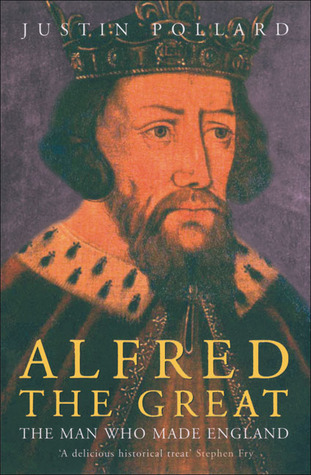
Alfred the Great: The Man Who Made England

118001

Rating: 5 Stars

Review:

Anglo-Saxon England might be the most intriguing period for me in the history of the country. I have often wondered how different the world might be had England remained in the hands of King Harold and the Norman invasion thwarted. The possibilities are interesting. This time period is also frustrating, as there is very little evidence left of these great people, particularly from Alfred's time and before. The scraps of information and rare objects we do have are precious; it saddens me to think that what is now left of the mortal remains of this great king, the man who united the warring kingdoms into what would become England and fought off the Vikings time and again, are scattered somewhere in the soil among the modern buildings of Winchester.

Now, onto the book itself...

Everyone knows the (highly likely untrue) story of England's King Alfred, deprived of his throne and set to wander his lands as a fugitive, taking refuge with a poor swineherd. Here he is either reading a book or lost in thought by the fire, only to be rebuked by the swineherd's wife for letting the cakes burn. Alfred accepts the scolding, unrecognized by his own subjects as their former, but true, king.

It's a highly romanticized story of Alfred's time away from his throne, but one the author touches on time and again when noting the importance of and connection to religion in this time period. Christians at this time still believed wholeheartedly in the daily miracles of God, in a time where men we now call saints were living, breathing people among them. I have not read extensively about Alfred yet, though I have read quite a bit about Anglo-Saxon England in general, so I am not yet sure if this is the author's own conclusion, or the conclusion reached by scholars before him, but he refers to this story as a kind of metaphor for England as a whole. Early in Alfred's reign, in the four years of relative peace before the Vikings again returned and betrayal within Alfred's own court enabled the witan to depose him, Alfred did not do all he might have in order to prepare for the repeated attacks that could only be held off with the Danegeld for so long. The conclusion is that this story is a metaphor for Alfred's reign in that time - he didn't pay attention like he should have so the cakes burned, much like he did not take care to fortify his fledgling kingdom, and so it too burned.

It is amazing to me how, though Alfred lived and died in what would be considered the end of the 'Dark Ages', a significant portion of his time and funds were directed toward learning and educating his people. He was a major supporter of translating great works for his people to read in their native tongue - English. He even sent an item (called an Ã¦stelwith these books when they were distributed to every bishopric - one of which was found in the late 1600s - which has today been concluded that its possible function was a pointer or a bookmark. 

File:Alfred Jewel Ashmolean 2014.JPG
(Property of the Ashmolean Museum in Oxford)

(Property of the Ashmolean Museum in Oxford; the inscription on the side reads: 'Alfred Ordered/Had Me Made' - I have read different translations using either word)

King Alfred felt that literature and education was imperative to the survival of his kingdom. I of course don't mean education as we know it today: all the good little boys and girls in there desks with pencils sharpened, ready to absorb knowledge. I mean in the sense that he felt it was important for the men governing the burhs in his name to be learned men so that they would be able to read his laws, to dispense justice correctly and appropriately, and for all people to have access to the great books. And while it is again highly unlikely that he actually learned Latin in a single day, Alfred did set about educating himself as well and learned the already-dead language.

Whether you have read about Alfred before or this is your first foray into the arena, this is a fantastic read. It is written in such a way that it is accessible both to the lay reader looking for a 'popular history', as well as those who have background knowledge already and would be considered more academic. It chronicles the years and events leading up to Alfred's birth and sets the stage for this king to become, well, great. There's everything you would expect from the time period - Vikings raids, the warring kingdoms of Wessex, Mercia, East Anglia, etc., betrayal, tragedy, and triumph. I highly recommend this one.

Friday, May 29, 2015

Kings and Queens of Great Britain: Every Question Answered

20578821

Rating: 4 Stars

Review:

Hugely comprehensive guide to the monarchy, starting with my favorites, the Wessex Kings, up through Elizabeth II. I find I'm not as interested in the monarchs to rule after James I, but it was still readable none the less.

There were facts here and there I'd not read before - such as Henry VII beating Henry VIII when he was angry - and I'm not sure are truly accurate. I've read more of the Tudors than any other dynasty, surely I'd remember a future tyrant getting his ears boxes by his increasingly conservative father?

All in all, there was nothing actually new to me, but I found it entertaining anyway. I especially enjoyed the end section that contained several governments going back to the time of Alfred. I love reading items like this in their original wording, the old old old English, so to speak. Recommended for anyone interested in the history of the English throne.

Additionally:

Whenever I read books like this that cover topics or people I know quite a bit about, I find it comforting. People have asked how I can read about the same people, places, and things over and over. Here is why: first, different authors have different perspectives, and may also have access to different sources (I guess if they want to be especially sneaky). The other reason might sound silly, but it is almost like catching up with an old friend who is retelling a story that I have already heard one hundred times. But still I listen (read), because it is a story I enjoy so much. This is exactly why I ca and will read every scrap of material I can get my hands on about Eleanor of Aquitaine.