Showing posts with label Anglo-Saxon England. Show all posts

Tuesday, December 28, 2021

NetGalley ARC | Castles of England

I received a free digital ARC from the publisher via NetGalley in exchange for an honest review.

Rating ⭐⭐⭐1/2

I love a good ghost story, but that is not what I was expecting here so it kind of threw me off. I was expecting a book about the history of castles in England, from their beginnings up to present day. We get that here, but we also gets tons of stories of mysteries - unsolved murders, deaths of prisoners, executions, and so on.

I was anticipating much more in regards to physical histories and family histories, and there really was so much more that was paranormal. You might think it is weird that I am so hung up on that part, but it's just not what I was looking for from this book, so I think that's why I was honestly kind of annoyed.

The origin of the castle, or castellum in Latin, is so deeply imbedded in the history of England. You can't discuss the country's history without an in-depth focus on these structures. Castles are part of the landscape, and have been for 1,000 years. To not see one is far more strange.

Luckily there are so many to choose from, and whether you prefer crumbling ruins or castles that transport you back to the middle ages into a still-functioning relic of the period, everyone will find some castles of interest here.

Even this review is hard to write and I am struggling with it. The book just wasn't what I expected, and had such a heavy focus on the myths and legends, usually paranormal. I wanted to know more about architecture, builders, etc. I would have also loved more photographs.

Saturday, November 13, 2021

NetGalley ARC | Usurpers: A New Look at Medieval Kings


I received a free digital ARC from the publisher via NetGalley in exchange for an honest review.

Rating ⭐⭐⭐

Short version: Yes they're all usurpers and you don't need to read this book to know that.

Long version: 

I really struggled for a bit with how to rate this one. The title is a bit misleading if you go into it thinking there will be new ideas or documents or things of that nature. However, if you take it at face value that this is simply a new book on a set of kings who were absolutely usurpers, then the title fits. Every single one of the kings discussed in the book took a throne that was not rightfully theirs. So, I appreciated another look at the people and periods, because those eras of history are most certainly my jam, but there is nothing new actually added to the conversation.

The author looks at six kings: William the Bastard, Stephen of Blois, Henry Bolingbroke (Henry IV), Edward IV, Richard III, and Henry Tudor (Henry VII). Anyone with knowledge of those periods can without a doubt say that yes, everyone single one of these men took a crown that was not theirs.

1. William took the crown from Harold II (Harold Godwinson), who had been chosen by the Witan upon the death of Edward the Confessor. Sorry, not sorry William; forcing people to swear oaths under duress makes them not binding, you big jerk.

2. Stephen of Blois took the crown from his cousin Empress Matilda, whose father Henry I had twice made his nobility swear to support her claim after the death of his only legitimate heir William Adelin aboard the White Ship - or rather, in the water when the White Ship sank and though he had initially survived, he attempted to rescue his half sister. His small boat was swamped and he drowned along with everyone else, save one cook.

3. Henry Bolingbroke, son of John of Gaunt, took the crown from his cousin Richard II when Richard II was deposed.

4. Edward IV took the crown from Henry VI, lost it to him, then took it back again and had Henry VI murdered in order to retain it for good. Major dick move, but not unsurprising for the times. Henry VI is the king I have always felt the most terribly for, having never done anything to warrant his murder.

5. Richard III, don't even get me started on this guy. He imprisoned his nephews, including the RIGHTFUL king, Edward V, and likely had them killed. Margaret Beaufort wasn't behind their deaths, fuck off with that nonsense.

6. Henry Tudor's army faced Richard III's and we all know how that turned out. Richard had it coming, but even after his death on the battlefield, Henry did not have a strong claim. The actual next in line who should have been crowned was Edward Plantagenet, Earl of Warwick. You know, the kid who had been imprisoned because his claim was stronger, who was eventually executed along with Lambert Simnel on Henry's orders. Warwick was the son of George, Duke of Clarence - brother of Edward IV and Richard III who was murdered, on his brothers' orders for plotting treason against Edward.

As you can see, there is a TON of history here, and a lot of it overlapping in the last three chapters of later years (Edward, Richard, Henry) because of how entwined their stories are. Yet the author never really digs too deeply in and the text did become repetitive at times because of how connected they were. But there is also no new insight or analysis either. It's a straight-forward history, but lacking depth.

For a book that was aiming in part to look at what chroniclers of the time said about each of these new kings seizing a throne, there was actually very little from any chroniclers, if at all. I find that very curious, seeing as how those who wrote of each court would certainly have had strong opinions whether they were in favor or not. Thomas More is a prime example of the propaganda machine at work for the Tudors - though again, let's be realistic: if it looks like a horse and sounds like a horse, Richard had the boys murdered. More certainly embellished quite a bit; Richard was a product of his time, but with the murders of his nephews he went too far. Rumors spread around London very quickly once the boys were no longer seen. There is no way Richard did not hear those rumors. All he would have had to do is produce the children in order to stop the gossip. He didn't, because he couldn't.

That was a tangent I realize, but true nonetheless. As for chroniclers in the previous eras, they all had opinions too, and were quite overlooked. I find this curious, and altogether odd. The men (always men) writing at the time produced much in the way of, well, chronicles. Not including passages is weird.

Overall, it is not a terrible read. It is one I think I would suggest to someone who doesn't have much knowledge of the periods and is looking for a starting point. Especially during the Wars of the Roses, things get quite complicated so who knows, the repetition of material might help sort things out. But for those like me who already have a firm background, this is a pass.

Friday, July 30, 2021

Author Gift | Women of Power in Anglo-Saxon England


I received a free digital copy of this text from the author, Annie Whitehead, in exchanged for an honest review.

Rating ⭐⭐⭐⭐⭐

I was first introduced to the work of Annie Whitehead and many other fantastic authors in a wonderful little volume called 1066 Turned Upside Down. This absolute gem of a book explored all sorts of outcomes of the entire year of 1066 and what possibilities could have come true besides William the Bastard's victory. Most were grounded in reality and some were quite fantastical but I loved every single one - especially the one that saw Harold successful at Hastings. But I also have to remind myself that if we are altering British history that greatly, Eleanor of Aquitaine might never have become who she was, so I have to accept what happened and be fine with it.

My second encounter with the author's work came with a reading of Mercia: The Rise and Fall of a Kingdom. You'll notice a theme here, in that when it comes to my beloved Anglo-Saxons, I will read any and everything I can get my hands on. This was another fantastic read for me and I eagerly awaited Whitehead's next offering.

I was NOT disappointed.

This text is incredibly well-researched, almost exhaustedly so. The author makes fantastic use of all the sources she is able to find - which was a surprising great number. I've read so much about the Anglo-Saxons, but never a book so wholly dedicated to restoring the women of the time back to their rightful places in history. And let's be realistic: when we do meet these women by chance or in passing, we usually don't get much information unless she was powerful or scandalous or both.

Yet here Whitehead is able to explore the lives of so many women in-depth, or at least as deep as we are able to go with what information exists. I was truly in awe of the number of primary sources that named so many women who, most often, I knew only scant facts about. To find that so many women were well-educated, literate, and powerful is thrilling. She uses a number of chronicles, annals, and charters to pull apart the many threads sometimes necessary to get to the truth. When necessary she also uses information from legends or gossip about certain figures that has come down to us through the ages. It was really interesting to see the comparisons of what chroniclers said about these women, vs. what records actually show. Such sniveling little men sometimes - something I know all to well in regards to my dear Eleanor of Aquitaine, centuries later.

Whitehead shows just how powerful some women became, and in a variety of roles: landowners, queens, consorts, dowager queens, abbesses, even a warrior (perhaps). Where she found contradictions in sources, Whitehead takes the best route possible in order to remain neutral and present her thoughts without stating that it is absolutely certain this way or that. I think that is was a good historian must do, choose what is most likely when considering the biases that many chroniclers held for women - especially powerful ones.

The book is divided by topic and each section within is mostly chronological, but not entirely. There is overlap from section to section but I feel that in a book like this that is helpful, as the reader is more able to place each woman in the proper context of her time and role. Some might find this bit repetitive, but I found it useful.

For dealing with these centuries when women were regularly written of only as footnotes in the lives of their fathers, sons, uncles, brothers, even cousins, Annie Whitehead has done a beautiful job restoring them to their rightful places in history.

Highly recommended.

Sunday, May 30, 2021

NetGalley ARC | Never Greater Slaughter: Brunanburh and the Birth of England


I received a free digital ARC from the publisher via NetGalley in exchange for an honest review.

Rating ⭐⭐⭐⭐

I'm not usually one for any kind of military history, but I will always make an exception for the Anglo-Saxons I love so much. Quite lucky, aren't they? Even the Plantagenets don't get that kind of treatment from me.

Part of the draw here though is that the book is so much more than the battle itself, but the archaeology behind finding out where the battle truly took place, as this information as been long lost to history.

The Battle of Brunanburh seems inevitable, once one knows the history leading up to it. The author does a fantastic job laying this history out in an easily readable way even for those with little background knowledge on the topic. He begins with the Celtic tribes who once called England home, even though they didn't call it England. Then come the Romans, then the Saxons. Slowly but surely England begins to take shape, though it will still not be called that for a couple more centuries. When we finally see Athelstan he is doing his thang, humbling kings, conquering their lands, demanding loyalty.

But this would not have been possible for him without the equally heavy lifting done by his grandfather decades earlier.

Not until my fave, Alfred the Great, came along would the stage even be set for this to happen. It was through his uniting of several of the individual kingdoms - Wessex, Mercia, East Anglia, etc. - that Athelstan could stand on his shoulders and after this terribly violent battle, truly declare himself the King of a united England.

So, why is this battle not more well-known?

After all, for generations to come, it was simply referred to as the "great battle". Everyone would know what you were talking about with this reference. Yet today, so many have no idea it ever occurred, or what its significance is.

Part of the problem is, the location of the battle is unknown, though great care has gone into locating it and the author makes an incredibly compelling case here for his theory. I do have to admit though that I have not read other books on the subject. Even so, the author spends time in the Appendix laying out why he disagrees with the theories of other historians. This is not done in a malicious kind of way, but he points out things that don't make sense with what we know, or don't fit the pattern of evidence. I appreciate how thorough he is with the material.

Once you learn about how truly massive this battle was, the logistics that must have been involved, it feels a bit overwhelming. We are talking about Athelstan and his army standing against his enemies - an alliance that would never have come together were it not for their mutual hatred of Athelstan. In fact, these allies had previously spent a good bit of time fighting one another in previous years at various times. But they figured that the only way to defeat Athelstan, to stop him from taking over every last inch of the island, was to band together. Leading the Vikings out of Dublin was their chief, the famous Analf. Coming from Scotland was King Constantine, and rounding out the trio was King Owain of Strathclyde. These men were seasoned leaders and accustomed to fierce fighting. it is no wonder they were confident that by teaming up, they could defeat Athelstan once and for all.

It might sound kind of cheesy, but just think about that for a moment. Seeing these armies come together to form one massive group, pouring from the ships that had to have carried at least two of them there. Seeing the equally massive shield-wall of Athelstan's own army ready for a fight. It's breathtaking.

Even more so when you start thinking about the possible locations this could have occurred, and can place the armies in their respective camps.

So many people are involved in seeking out this location, finding the sight of England's birth. Professional and amateur historians, linguists trying to work out all sorts of possible place-name matches, and of course archaeologists who seek whatever scraps they might find to finally be able to say, "Here, this is the place."

Not so easy to do though, when you consider that the battle took place at some point in 937 AD. The author argues for it occurring later in the year and again, given the evidence he presents, it makes sense.

The author starts where we always must in order to have a basis, and that is with research. He uses the Anglo-Saxon Chronicles and Egil's Saga, as well as the Annals of Ulster. He also makes references to other chronicles and documents as well and even if the details do not all line up 100%, they all agree on the fact that a major battle occurred in 937 AD and untold thousands died. Like any good historian, the author is aware of the biases that each of these sources carries and has to sift through to find what can be proven by other evidence. This is where those linguists come in VERY handy, breaking apart words and putting them back together, determining the meaning then vs now, and so on. I don't envy them in that job, just reading about it was enough for me.

The author determines after a good couple rounds with all the evidence that the most likely location for this all-important battle is on the Wirral Peninsula in North West England. At this time I am not inclined to disagree, though as I said before this is my first book on the subject. Even so, the passion Dr. Livingston feels for the subject, and the obvious time and thought he has poured into trying to find the site is nothing short of extraordinary. He presents his methodology for how he arrived at his conclusions regarding troop movements, likely encampments, the battle itself, and its aftermath.

My only complaint with the book has to do with formatting, something out of the author's control. Not one single numerical value was present, which sometimes made it difficult to assess parts of the author's argument. Every value, from troop numbers to the years being discussed, was represented with a ? and it was SUUUUUPER annoying.

Otherwise, this was one I enjoyed quite a bit. I have been lucky so far in that I can never really go wrong with a book about Anglo-Saxons. It is my favorite period of England's history and even after devouring so many books on the subject, I am still learning new things.

Highly recommended.

Friday, December 20, 2019

Review Bomb | Vikings


Oi! Two drastically different books on the same subject today. Who knew it was possible to make Vikings utterly BORING?!


6315929 Rating: ⭐⭐

I waited so long to finally get this, and it ended up taking me aaaaages to get through. I skimmed a lot. The author is supremely knowledgeable about the subject matter but the book is bone-dry. And that is coming from someone who reads non-fiction almost exclusively. I just could not get into this one, no matter how hard I tried - which is kind of ridiculous when you think about it, because the Vikings are not a boring subject matter at all. Yet, here we are. It did not help that the print was incredibly tiny. Normally that doesn't bother me, but if I am already borderline about picking it up once my boredom has set in, print size becomes an issue.

Ferguson can not be entirely to blame, I suppose, though it is his writing style that nearly had me asleep. A major issue with this kind of history is the lack of written records. The author even addresses this issue early on. We don't have contemporary sources because there are very few, if any, that could be called conclusive. That is why we have non fiction texts today that focus on what we can learn from other records, such as those who were conquered by these warriors. But, as we know, those sources themselves are biased against their enemy. Basically, this book is a snooze-fest and that makes me sad. Definitely NOT a starting point if you know nothing about the Vikings, their history, and/or their impact on the world.

At least the cover is pretty.

~~~~~~~~~~~~~~~~~~~~~~~~~~~~~~~~~~~~~~~

23796654. sy475  Rating: ⭐⭐⭐⭐

Despite having a more ridiculous cover, this book covers the topic in a far more engaging way. I am really just chalking this up to be the varying of writing styles. Maybe. My opinion might change in another thirty minutes, who knows.

Either way, this book was better and I read it much more quickly because I wanted to keep reading. That doesn't mean it is prize-worthy, but it is certainly attention-worthy.

What this book does rather well, as compared with the previous one above, is that it works WITH the material available, dealing in the provable and concrete. Though the Vikings are long gone, they left a lasting legacy that survives to this very day, all around us. The reach of the Vikings spanned half the globe and it shows. All the usual gang is here, Ragnar, Ivar, and Erik. But we also meet Vlad, Olga, and a cast of others who each contributed to this legacy. It is a given that we also hear quite a bit about my boy Alfred the Great, and his efforts to hold the Vikings back and retain/build up his kingdom.

Given the lack of primary sources, I appreciated how well the author used what we do have, both from the conquered and the conquerors. The book is told in chronological order, but then breaks down further by region. We see the mighty warriors as clusters of men in Norway, Denmark, and Sweden, and watch them spread out far and wide, testing the waters of Ireland, England, Spain, Iceland, Greenland, and finally North America to the west. But they went east as well, and from those journeys we get the Rus, the Balkans, Ukraine, and so many places in between. These warriors also travelled to the Middle East, leaving their mark there as well.

When one considers the lasting impact of the Vikings on our world today (such as days of the week named for their Gods, and my fave football team, to name a very very few - you might be surprised if you do a search to find out just how many of our words today come from the Vikings), it is easy to forget how short their era of exploration, raiding, and pillaging actually was. Less than 300 years, to be exact - from that fateful arrival at Lindisfarne in 793, to the felling of my fave berserker, Harald Hardrada, at Stamford Bridge in 1066.

Speaking of the last Viking warrior, I appreciated the attention given to Harald Hardrada. Though I am firmly on the side of the Anglo-Saxons in all matters of 1066 (don't even get me started on William the Bastard, though I recognize he was necessary in order for the rest of history to play out as it did), there is a special place in my heart for this guy. What a life he lived, and how lucky we are to even know anything about it. Before venturing on his ill-fated voyage with King Harold's seriously crazy brother Tostig, Hardrada spent much of his life journeying in the opposite direction. He spent several years in the east and found himself as a commander of the Varangian Guard, mercenaries of the Byzantine Empire. This was an elite group and it was a privilege to become a guardsman. The men in this infantry unit enjoyed great wealth as a result. Given his history, it makes his death at Stanford all the more surprising - his men were simply not prepared for what the other Harold was bringing to the battle.

Recommended.

Sunday, August 25, 2019

Book Review | Mercia: The Rise and Fall of a Kingdom

38243840. sy475

Rating: ⭐⭐⭐⭐⭐

I loved this book. The end.

Just kidding.

Before we get started, take a moment to admire that cover. So simple, but very powerful all the same. It's beautiful.

It took a long time for me to actually be able to read this one, and not because there was anything wrong with the writing, or my eyes. It is because sometimes technology is really stupid and makes life hard when it does not need to be.

In 2016 I read a collection of stories written to commemorate 1066, easily one of my most favorite (even though the outcome makes me so mad) periods. The book, 1066 Turned Upside Down, explores the various ways 1066 might have turned out differently, based on any number of variables. I loved it. It is still one of my favorite reads, because it contained such a variety of ways that England might have stayed Anglo-Saxon instead of becoming Norman (but then I remember we might not know who Eleanor of Aquitaine was, had 1066 gone differently, and it's all just very upsetting and confusing and I don't actually know what I would choose if I could have decided the battles myself). It was in this collection that I discovered the author, Annie Whitehead. I was very interested to find out in the following time that she was working on a book about Mercia, one of the kingdoms that existed prior to England becoming the country we know it as today.

I am absolutely enthralled by this early early 'England'. But due to the fact that education and writing wasn't exactly a big deal until my fave king Alfred came along, we have so little information to go on in any great details about these kingdoms - Wessex, Mercia, Northumbria, East Anglia, Essex, Sussex, and Kent. Sometimes what we do know of one kingdom comes to us from the viewpoint of the enemy, either being the conqueror or the conquered. Needless to say, I was pretty excited when the project came to my attention. I was even more excited to get an ARC of it from Amberley (seriously, so many fantastic titles, and tons of great sales. Can't be the $15 flat shipping rate to the US, either.)

But, then the problems began. I could only read the file from my laptop and this was problematic, as sitting at a computer, or sitting in general, for long periods of time is not great for my hip and knee. I love to read while I am exercising, so that was also another issue. It is not as though I could carry my laptop as I biked or walked. Philip from Amberley and I tried to make it work, he even tried sending the file directly to my Kindle and nothing worked. So, I kind of gave up on the idea of reading the book before everyone else and bragging about how good it was. I recommended it as a purchase for my public library and got my hands on it the very day it arrived for me.

Let me tell you, the wait was worth it, 100%. I loved this book.

There is always a danger when one writes about these people and places from long ago. With written records being somewhat sparse, history texts often get bogged down as basically just a list of names and dates and 'might haves' or 'probablys'.

Not so here, I am happy to report.

Whitehead has crafted a wonderful tapestry of words woven together to give the clearest possible picture we might get of this kingdom lost long ago. It is one of those books I wanted to climb inside and live in, just to be closer to the people and action. (If anyone ever invents a time machine, we all know which periods I will be taking trips to, right?)

The book begins with Penda, and is off and running from there. We are taken through the whole of Mercia's rise and fall as a powerful kingdom to be reckoned with. Whitehead uses all available sources to complete said tapestry, such as the work of Bede and the Anglo-Saxon Chronicle, which those with an interest in the time will already be familiar with. The author uses multiple sources though, drawing on other chronicles, documents, and annals that have survived at least in partial form. Mercia too, happens to be one of those cases I mentioned previously, in that much of what we know about Mercia comes from her enemies, and thus was written about with bias. Whitehead does an incredible job of looking at the sources and guiding the reader through those biases for an honest look at some great and not-so-great kings - so many of whom are largely unknown today. The love the author has for her subject is clear in the research and time she must have devoted to tracking down every possible scrap of information. Often times when the contemporary sources seem to contradict one another, Whitehead offers explanations of why those conflicting stories occur, and what the likely truth might be - while remaining impartial herself.

This is a must-read for anyone interested in the time period. Highly, highly recommended.

Friday, July 8, 2016

England: A History

25972972

Rating: 2 Stars

Ugh. This was a tough one to get through. The history of England is complicated to begin with. England as we know it didn't really exist until Athelstan, grandson of my buddy Alfred the Great. And even then, it wasn't exactly England yet. It kind of starts with the Norman Conquest of Anglo-Saxon England and then glosses over all the best parts of the island's history that I care about. There was no mention whatsoever of Eleanor of Aquitaine, a mere paragraph about Richard I, and a total whitewashing of John. While I am not a huge fan of ALL Plantagenets, they are highly intriguing and they did rule England for 300 years. Yet, by 40% of the book, we are already at the dawn of Stuart rule by James VI/I. This might seem like a lot at first being devoted to the Plantagenets and Tudors, but you must also consider the fact that the book ends after World War II. That's something else I can't understand but, whatever. It is hardly even worth delving into.

As an aside, it has never been lost on me that the Tudors are in fact, and always have been, Welsh - not English. yet the English seem to overlook this now? And then at the same time looked down on the Welsh? Another thing that has never made any sense to me. 

This quote I did appreciate, in regards to the execution of Mary, Queen of Scots: "...Elizabeth managed to look the other way until the deed was done, and like a true daughter of her house, she saw to it that her secretary, William Davison, took the blame for the execution of Mary's death warrant" (30%). Yep, exactly. Elizabeth is the WORST. The author did not justice to Mary Tudor either, but he seems to approve a bit more of Elizabeth. Either way, nothing he says is particularly positive about any of them.

Where he really lost me: at 48% he called Cromwell the 'greatest Englishman of his century'. Um. No.

Around 55%, the only things keeping me going were: 1) it was written so generally that it was still an incredibly breezy read. It was not terribly specific, and not very detailed either. 2) At the time I was also operating under the assumption that eventually we'd get to the House of Windsor, William, and Harry. Especially Harry. You can imagine my disappointment then when, as I mentioned earlier, the books ends after WWII.

89%: Blah Blah British Imperialism, snooooze.

So, I guess have at it but I can't say I really recommend this one. The history of England is far too vast and complicated for this slim a volume - even one that ends after WWII. Don't take this one too seriously if you do give it a shot.

Saturday, February 13, 2016

The Year 1000: What Life Was Like at the Turn of the First Millennium

55139

Rating: 5 Stars

Review:

The Anglo-Saxon world in England holds a special place in my heart and I am forever fascinated by the likes of Alfred and Aethelstan. It never ceases to amaze me how Engla-land is the same physical place that would in the future be ruled by the likes of Henry II, Edward IV and Henry VIII. This is a wonderful little gem of a book that did not disappoint, despite coming in at 200 pages. My concern with slim volumes such as this, especially when dealing with a topic near and dear to my heart, is the potential for lacking detail and misinformation - the gossip is always better than the actual story (at least according to the Dark History series, I suppose). I was pleasantly surprised by how much detail was included and the consistent referencing to contemporary sources provides further validity to the presentation. And of course, I was glad to see several appearances by Alfred, despite his death a century before.

The text begins with an explanation of the Julius Work Calendar - a calendar that has somehow, against all odds (and Henry VIII"s rage and ambition), come down to us from the year 1020. A photograph is also included of the January page, of which my only complaint is that it is in black and white and I'd very much like to see color photographs of the pages. The authors give a brief description of the calendar and its purpose - noting the abundance of holy days and high days marking the pages. They likely conclude this document was of most religious importance, and could have been an instructional manual for monks who had recently joined the order.

Following, the book is divided in twelve chapters, by month. The cover page for each chapter includes a reproduction of a drawing taken from the corresponding page of the original calendar. Again, in this instance I would have liked to have seen the actual page, to examine it in color. A particular instance I enjoyed in the January chapter included the discrepancies having to do with when Easter was to be celebrated and also the debate over dating the birth of Christ. It has never occurred to me before that idea of zero was not in use, as this was not needed in a world which still counted by Roman numerals. The authors point out that since zero was not an accepted concept, dating was off by a year due to missing that 12 months from 0-1. They the address how Dionysius then mis-dated Christ's birth, based on when Herod died, pointing out that Christ was likely born in at most 4 BC, perhaps further back. As a result, the so-called Christian calendar is slightly off, though I think at this point no one is terribly concerned about it anymore - can you imagine trying to change centuries of thinking? Quite simply, not possible. So we accept these inaccuracies while keeping the bigger picture in mind.

Something I have mentioned in previous books about this era include my interest in how words and names have evolved. This volume covers this as well, how Angla-lond/land evolved in to England, Angle-ish to English, etc. I also found this quote to be of interest:

"The Anglo-Saxons could swear to do something, or could swear by something, but there is no record of them swearing at anything at all" (page 31).

The author mentions with this that the curse words we know today likely came from Holland in the later Middle Ages - though I would like to know more about how this conclusion was reached and what documents might still exist to show this exchange of cultural information. He also says that no obscenities occur in Anglo-Saxon documents that survive. This is interesting to think about, but one must also consider the fact that of the documents that do survive, much of the material was written by scholars and monks. Curse would would likely have been at odds with the subjects they were writing about, though perhaps I am off the mark in my own conclusion? This is something I would like to learn more about and will be in search of information about this soon.

Another note on language - it was in this time period that all humans were referred to as menn and mann was the word for human. So, there are two conclusions we could draw from this. Either the Anglo-Saxons had a much better grip on gender-equality than we do today, or they were elevating the status of men over women and encompassing both genders into one term. It might be easy to dismiss this as the latter, were it not for the abundance of wills from this time period in which fathers time and again left money and property to maintain to eldest daughters. 

There are plenty of amusing details included here, such as the fact that even 1000 years ago, chicken soup was recommended for its "soothing and restorative powers." A-MEN! There's nothing I like more than homemade chicken noodle soup when I'm sick, how neat that this is something that has not changed since early times.

The authors also discuss life for the monks in the monasteries and daily life there. As monks were discouraged from speaking vocally throughout the day, they often communicated  during meals and such with a variety of some 127 gestures and signs. The monks are compared baseball coaches in our time, albeit asking to pass the salt instead of signaling to steal third. It is an amusing image to conjure, the men at their tables, hands waving about as they speak without speaking. I'd like to see the document containing all 127 signs, though many are described here in the text.

In all, this is neat month-by-month look at this far-away time that almost seems unreal now in its simplicity. I can't imagine living in a time without noise of a large city - though I would very much like to experience it. To have no traffic noise, no neighbors blaring televisions and music, no hum of a refrigerator. Life would certainly have been both easier and more difficult at the same time. Highly recommended read.

Wednesday, January 27, 2016

The Norman Conquest of England

2802217

Rating: 4 Stars

Review:

I grabbed this one for cheap at Half Price Books in the World History section a few months ago and finally got around to. It is a quick read about a subject very near and dear to my heart, so when I quickly realized it is geared toward a younger audience, I didn't even mind. Sometimes it is nice to read something quick and easy like this about a topic one is already well-acquainted with, it is like a catching-up conversation with an old friend.

There is certainly nothing new here in terms of the battles themselves. The author does a fantastic job covering this complex issue in an easy way for a younger audience to understand. Not easy, considering all parties involved.

A modern fact I was pleased to learn is that since 2003, King Harold has been celebrated with his own day at Waltham Abbey, where a yearly festival offers a variety of events for visitors, such as crafts, music, medieval food, and weapons displays. I find this especially important, given the  controversy surrounding the Norman Invasion. I do believe that even if Harold swore an allegiance to William while stranded in Normandy, what choice did he have? He surely would have been held captive if he did not. Whether or not King Edward (the Confessor) had chosen Harold as his successor, the Witan had to confirm the appointment and it seems that they did in fact approve of Harold becoming the next king of England. By all accounts that come down to us through the centuries, he was a strong leader and it is interesting to think often about how different England might look today had the invasion not been successful.

The book does go into some detail about this idea, and specifically looks at the Bayeux Tapestry and its importance after the battle. But because of the short length there is not room for any real in-depth exploration of the possibilities, and no mention at all of the Aethelings - Edmund Ironside's sons who were rightful heirs by blood.

In addition to chapters detailing life in Anglo-Saxon England, Kings of England, the Invasion, the aftermath, and so on, there is a plethora of resources in the index for young scholars who are interested in further research. There is information about primary source documents, sections of the Bayeux Tapestry in Latin and the translations for certain panels, a timeline of events from B.C. and the first people on the island, a glossary, and even a short section on some of our modern words and where in the old English that they came from. Word play like that is always interesting to me so I was glad to see something like that in a book geared toward a younger audience, as this is not something they might typically learn.

Overall, this is something that would be primarily aimed at middle or high schoolers, depending on their reading level. For anyone already familiar with this topic, and older readers, there won't be much in the way of new information. Still, I can recommend it for those with interest but little knowledge of the Invasion.

Thursday, January 21, 2016

The English and Their History

25893691

Rating: 3 Stars

Rating:

This book is exhausting. So exhausting, in fact, that I am not even sure I can review it properly. I have read more than my fair share of books. One might say reading is my 'thing'. I am especially fond of that little island now called England and its amazing history, going way back to the Iron Age people, through Roman Britain, the Anglo-Saxons, the Normans, the Plantagenets, and the Tudors. Beyond that, my interest starts to wane. In the past with books about the history of England, I have always given up a bit after James VI/I. Sometimes I make it through the execution of his son, Charles I, but rarely. I vowed this time, with this one, to make it through. And so I did. Barely.

So, this one began in what is typically still referred to as the Dark Ages, despite our knowledge of the time growing more clear all the time with new discoveries. The Anglo-Saxons and Alfred are possibly my most favorite of the eras in England's history, so it is always nice to see him given his due. Alfred is, after all, the only king in the country's history to be called 'the Great'.

My concerns with the book come very early on though, as I feel there were many aspects of England's history that were glossed over or not mentioned at all from those early years, in favor of much more material covering the last two hundred years. For example, while we see Edgar Aetheling mentioned, there is almost zilch about his grandfather Edmund Ironside and his brief co-reign with Cnut - it is generally thought that Edmund was murdered by or on Cnut's orders so he could assume complete power. Subsequently there is nothing about Ironside's sons who were spirited out of the country and Cnut's reach. That in itself is a fascinating story and deserved a place. The course of history might look very different for England had someone aside from William I become king. There were many other times that this lack of detail jumped out at me - perhaps because these are among the time periods I know best. The author calls the circumstances of William II's (William Rufus) death 'mysterious', but does not fully elaborate. It is considered mysterious for a number of reasons, considering he was shot in the chest with an arrow and the culprit left the scene immediately - while Henry I (his younger brother, the youngest son) headed straight for the treasury to secure it and the crown, effectively stealing it from Robert who was next in line. Further more, it was strange to me that the author considered Matilda (Henry I's daughter) the antagonist in the civil war between her and her cousin Stephen. When Matilda's brother Henry died on the White Ship, she became the only legitimate heir. At least twice Henry I made his nobles swear an oath to support Matilda's claim as queen, but given the fact that there had never been a queen who ruled in her own right, as soon as Henry I was dead they naturally (for the time period) looked elsewhere. Stephen was the usurper, the antagonist, though Matilda certainly did herself no favors by alienating some who she needed support from. In the end, Stephen agreed for Matilda's son to become king as Henry II, despite Stephen having a son of his own. So began the 300 year rule of the Plantagenets.

There was very little attention given to another of my favorites - Eleanor of Aquitaine. She is hardly mentioned, and only as Henry II's wife. We get a glimpse but that is it and no where does it say that without her gathering the ransom, her son Richard I would likely never have been released from prison. While Richard cared very little for England and preferred his lands in Aquitaine, or the Holy Land on Crusade, him being overthrown by John even earlier could have caused even more destruction.

By the time we get to Elizabeth, all of my favorite periods were covered. This amount to roughly 200 pages out of nearly 900 (1,000 if you count the end notes, index, etc). For the rest of the time it was pretty rough going for me, because it just does not hold my interest the way early England does. I truly don't even understand it myself, how I can be totally enthralled by the first 1,600 years and not care one iota about the last 400. But I was determined to slog on through. As a result, it took me a while and I frequently set it aside for something else. I have to be quite honest and admit I skimmed the Industrial Revolution. Glad it happened and all, but it is a terrible snooze to read about.

I found the Victorian era more interesting to read about this time around, so perhaps there is hope for that in the future. World War I and World War II were great reads from the English perspective, as anything I have read about them in the past have been strictly from an American viewpoint. Throughout the book there were tons of maps to aid the reader with the text, which I have always found especially helpful when discussing battles and troop movements. My only real complaint about WWI material involves the omission of Gavrilo Princip. You may not recognize the name, as so often he is simply referred to as 'the assassin of Archduke Franz Ferdinand'. I feel like it is a disservice to history that his name is routinely ignored. Like it or not, for better or worse, hi actions set of a chain of events that culminated in The Great War, which in turn lead directly to WWII.

I can't speak for the accuracy of the rest of the text due to my limited knowledge of those eras, but I at least found them somewhat engaging - enough to continue reading anyway. This is certainly not a book I would consider as my first if I knew nothing about England's history. It is quite the endeavor and not one to enter into lightly if you are looking for a quick read. On the other hand, if you are more interested in the time periods after the Tudors that are less interesting to me, then this may just be the book for you, as that is the bulk of the material.

Sunday, October 25, 2015

Thames: The Biography

2953096

Rating: 4 Stars

Review:

It is strange to be a little in love with a river? Maybe obsessed is a little more accurate, but there is something so lovely and melancholy and of course historic about this stretch of water, easily one of the most famous rivers in the world. Perhaps that is my bias, given my love of that little island where she flows. Ah well.

If you read my review of 'Foundation' by the same author earlier in the week, you can imagine by trepidation with beginning this one. Foundation was so terrible, not at all what I have come to know and enjoy from Peter Ackroyd, so I was nervous that he would somehow have screwed this one up too - though how can you really screw up a biography of A RIVER? Luckily, he did not. It was everything I expected and thought it would be.

Ackroyd offers up a whole slew of information, from the origin of the name 'Thames', through to where the Thames becomes the sea. I found many of the chapters highly informative, though naturally cared less for the information regarding the river in Victorian times and beyond. Not the river's fault of course, but I am just less interested in how the Victorian's used the river, because from then on it is not really new information. But to learn about the Iron Age, Bronze Age, etc settlements? That is something else entirely and always among my favorite topics.

My two favorite sections easily were 'Shadows and Depths' and 'The River of Death'. They were broken down further into sections, among the most interesting being 'Legends of the River'. Unfortunately it was just a few short pages and dealt with the paranormal element. Surely some of the more well-known stories could have been elaborated on, if Ackroyd could spend 80 pages talking about those who work on the river. Some of those chapters I skimmed, not going to lie. 'Offerings' was another chapter I found most interesting, as it dealt with the many hundreds of thousands of objects recovered from the Thames, constantly. From weapons and brooches to skulls, the Thames is a keeper of secrets that we will never be able to know. It really is fascinating it macabre sort of way the amount of skulls that have been discovered.

Side note to Ackroyd - don't suppose things about Eleanor of Aquitaine. At one point he mentions a location where Henry II's mistress 'Fair Rosamund' lived until her death, stating, "...It was said that she was eventually poisoned by Henry's wife, Eleanor of Aquitaine." While a little revenge in the middle ages would not have been unheard of, let's be realistic. Henry had imprisoned Eleanor for fifteen years, seeing as how she kept inciting their sons into rebellion against him. She was powerful enough in her own right and had little need for Henry at that point in their lives.

But, to end on a positive note, I loved the many maps included - especially in the additional material, 'An Alternative Topography, from Source to Sea' where Ackroyd takes the reader from the beginning of the Thames to the end, stopping at the various villages, castles, and cities along the way. There were many photographs as well to enhance the descriptions throughout and despite that massive amount of pollution, I still want to follow the river myself from start to finish. What a journey that would be.

Saturday, October 17, 2015

Foundation: The History of England from its Earliest Beginnings to the Tudors

13539185

Rating: 1.5 Stars

Review:

I don't even.

I can't even begin to explain how disappointed I am in this book and Ackroyd's work here. I am actually kind of angry about this book. Normally he is an author I enjoy, having read several of his other titles (The Thames, Chaucer, etc). I so looked forward to this one as this book literally covered almost my entire interest in England.

What makes this disappointment even worse is how promising it even starts out. It begins with a delightful romp through Roman Britain and Boudicca's destructive power (again I say, Eleanor is so lucky I discovered Eleanor of Aquitaine before Boudicca, and the latter is just a nickname). I even enjoyed most of the bits about those nasty Angles and Saxons who were terribly destructive themselves, but eventually manage to evolve into my dear Anglo-Saxons.

When Ackroyd gets specifically to Alfred, king of Wessex, the Angles and the Saxons - Alfred the Great, my first issue comes to light. While it is generally acknowledged that yes, Alfred's grandson Athelstan is the first king of England (England as a whole, not an island of individual kingdoms - Wessex, Mercia, Northumbria, etc), Alfred's accomplishments can not be overlooked. I mean, come on, he remains the only king to ever be referred to as 'the Great'. Alfred set up the kingdom to become successful and united; had he not beaten back the Danes, encouraged reading, writing and education in general, or written down the laws of the land, England could have taken a very different course. Let's give him a little more credit here. There would be no England without Alfred.

The next big flag came when the death of Edmund Ironside was completely glossed over. When Edmund and Cnut were basically co-kings, and then within a few months Edmund was dead, it is generally thought that he was murdered so Cnut could rule alone. Edmund's two sons, Edward and Edmund, were spirited out of the country and Cnut's reach. While the son Edmund also died, sometime in exile in Hungary, Edward eventually returned to England, the potential successor of Edward the Confessor. However, within a few days of his landing in England, he was murdered, which set the course for the invasion of the Normans and The Conquest by William I. I have always felt like this is an important piece of the puzzle, as at this point England's history could have been drastically altered and the Anglo-Saxon line (albeit with a strong injection of Hungarian, due to Edward the Exile's decades away from home) might have continued for a long time. No Normans would mean no Plantagenets, which in itself would also have been tragic. But that is another story. It confuses me as to why Ackroyd would not present this information, but perhaps I view it as more important than it actually is.

Speaking of Edward the Confessor now, Ackroyd makes a statement to the effect of Edward choosing his successor as he neared death. The king did not choose his successor though, the next king was chosen and anointed by the Witan, so Edward could not leave his crown to anyone as was stated. The Witan chose Harold, so it would not have mattered if Edward has promised William and/or that Harold might have sworn an oath to uphold William's claim.

As we move through the beginnings of the Norman kings right before the Plantagenet dynasty dawns, there is another slew of missing and/or mis-information. Ackroyd seems to accept almost unequivocally that William II's death was an accident, despite his own brother's actions after his death - and that fact that his hunting companion who 'accidentally' shot him reportedly immediately left the scene. Upon learning his brother had been shot on their hunting outing, Henry immediately rode off to secure the treasury - surely a sign that he might have known something? The mishandling of the Norman kings continues with Stephen. Stephen was nephew to Henry I. Henry I had made his nobles swear an oath to support his daughter Matilda as queen, as his only legitimate son had died when The White Ship sank years earlier. Naturally when Henry I died and Stephen claimed the throne, no one argued because England had never had a queen rule and were not about to start. Ackroyd states that Stephen was crowned in 1135 but that it was not until 1139 that Matilda arrived to "claim her country". That is by and far one of the biggest issues with this book - there is no detail or support as to WHY it took so long for Matilda to land on English shores. She was married to Geoffrey, duke of Anjou. It was not as though she was thousands of miles away, she was across the Channel. Some kind of explanation for her actions would have been welcome, instead of just glossing over it as was done with Ironside's death a few centuries earlier. Ackroyd also fails to mention that Stephen had a son, who was passed over in the line of succession for Matilda's son (Henry II) to bring an end to their brutal civil war.

I was tempted to quit when Eleanor of Aquitaine was almost completely whitewashed from England's history. I mean, seriously. She was important, despite Ackroyd's statement of Eleanor "severing herself from the king". In truth she retreated to her own estates as the king became involved with his beloved mistress Rosamund Clifford, then was imprisoned for fifteen years for inciting their sons into rebellion. More than once. As we continue along with the Plantagenets, Ackroyd seems baffled by the fact that King John and Richard III are often associated. My guess would be they are associated often in peoples' minds because they both murdered children to get their thrones. Ackroyd does address the fact that Arthur (Geoffrey's son), John's nephew, was actively campaigning against him and actually besieging Eleanor at Mirebeau when he was captured. At the time Arthur was fifteen, and seeing as how he was active in the battle I see Ackroyd's claim that he essentially became a prisoner of war so to speak when John captured him. The fact remains however, that Richard I had named Arthur as his heir to the throne, seeing as how their deceased brother Geoffrey was older than John (the spoiled baby of the family), and thus had a better claim. Not to mention John was super shady and cruel and not at all fit to be king. So yeah, killing the rightful kings who happened to also be children is what will always link them, no matter how Ackroyd wants to say this was not true in John's case.

I seriously considered quitting a second time when I realized I had made it all the way to the reign of Henry III (John's son) and had not even caught a swift glimpse of William Marshal, the greatest knight in the history of England. I double checked the index just to make sure my eyes were not deceiving me, but sure enough, he is no where to be found.

I am almost tempted to not even bother with reviewing the chapters relating to Richard III. This book was published in 2011, so it is no fault of Ackroyd's that Richard's remains had not yet been discovered (Phillipa Langley wouldn't be bawling her eyes out on national television for a while yet, upon discovering that he did in fact have a crooked spine). However, the problem is he claims such authority, so sure that Richard's remains had been scattered or thrown in the river. He states this as fact, not the speculation they need to appropriately be described as. For example, on page 416 Ackroyd says, "The king, for example, was not a hunchback. As a result of strenuous martial training one arm and shoulder were overdeveloped, thus leading to a slight unbalance but nothing more." Again, while the author could not have known that within a short time the world would know that, in fact, Richard did have a significant curvature of the spine, he certainly could have addressed this more responsibly.

There are some positives here. Despite everything I have said thus far, though overall I was greatly disappointed, there is still some good. While the longer chapters detail what Ackroyd wants the reader to know with his take on England's history, he also includes shorter chapters throughout that deal with daily life on the island, from food, to religion, to dwellings, etc. At first these chapters annoyed me because it made the book feel a bit disjointed, going back and forth from general to specific history. But the more I read, the more I began to enjoy them. However if I had to choose between more details on the kings and queens, or these little chapters, hands-down I would opt for the former. I believe this is the first of four books. If Ackroyd wanted to present a clearer picture of England by including these chapters, perhaps he should have planned to write five books in the series then to make room for all the facts and information he left out.

I feel like I have made my point here with some of the biggest issues with the book. Basically, Ackroyd has taken some of the most interesting pieces of history and condensed them down into little bite sized morsels for popular consumption. The problem with that is that many of these stories are so complex and deserve to be fleshed out to explore all facets. That is how you really get the big picture, really understand how England became England. This is at times sensational and gossipy, ignoring more plausible theories for wild claims (hello, Edward II). It is as though this is a completely different author than I am used to reading. It is disheartening, because I was looking forward to the second book, which of course focuses on the Tudors, as this one concludes with Henry VII's reign. I can by no means recommend this as the first book for anyone to read who does not already have background knowledge, as I would hate for anyone to read this and think it is all accurate. There is a decent bibliography that I plan exploring further to see how Ackroyd came to some of the conclusions that he did. Perhaps then I will better understand his view, and then be able to move on to the second book with a little more ease.

Saturday, September 12, 2015

The Oxford Illustrated History of the Vikings

3355087
Edited by Peter Sawyer

Rating: 4 Stars

Review:

I really enjoyed this collections of essays for a number of reasons. My primary level of interest in is Anglo-Saxon England and the Wessex kings especially - Alfred the Great is great for a reason (and the only king of England with this descriptor!) I also enjoy learning about the Vikings, as so much of the history of Norway, Iceland, and Greenland was only passed down from one generation to the next by word of mouth. What we do have written is truly a treasure, as these people and cultures can come alive to us once again by these words.

The text is a series of essays. Each author focused on their own area of interest, ranging from the Vikings in England, the end of he Viking age, Vikings in Russia, the ships, and so on. While I am not really interested in the ships themselves, or learning about maritime travel, that essay still help valuable information. One essay I found especially interesting was 'Religions Old and New', which discusses the old religion of the Vikings and their gods and the advent of Christianity. Greenland and Iceland were of particular interest too, not only because it is amazing that the ships were able to travel that far, but even beyond to reach North America - long before Columbus and his germ warfare. I would love to see the settlement ruins someday, and it is definitely on my bucket list. The essay focusing on Ireland, etc. was of great interest as well, as I have been to Dublin. Upon my visit with Mom in 2010, I had no idea that the Vikings had ruled Dublin for so long and that it was an area of focus for them. When visiting Dublin Castle on one of our tours, we were able to go below street level to see what remained of not only the medieval castle from the 13th century, but the earthen bank/stone wall of the original Viking town. Photographs belong to me and were taking in Dublin in July of 2010.

Helpful info to start with (2010) Unfortunately I don't have a great shot of the remains of anything but the medieval castle.

Overall, while some of the essays were a bit more dry than others, I enjoyed this collection. Certainly recommended for those interested in various aspects of life as a Viking.

Saturday, August 1, 2015

London: A History

Author: Francis Sheppard

Rating: 3.5 Stars

Review:

Naturally I found the early sections of the book far more interesting, as they pertained to the periods in England's history that I know and love so well. Unfortunately those sections as a whole only made up the first roughly third of the book, so it took a little more willpower to continue after saying goodbye to my beloved Anglo-Saxons, Plantagenets, and Tudors in regards to their relationships with London. I generally enjoy city biographies but I think what made this one so different for me is that I am also highly interested in very specific time periods in England, so later chapters (mainly from the Stuarts after James I and beyond) felt much heavier and slower to me, despite of course the writing style changing not at all.

It is interesting to me to watch cities slowly evolve into the places we know them as today. Having been to London myself, albeit an incredibly short venture due to a long delay out of Edinburgh, I can't even imagine it being anything than the bustling city it is today. I can't wait to go back and spend the time there that the city deserves, to see all the places still standing where so many of these great and terrible leaders stood, worked, slept, etc.

While the Victorian and Edwardian eras were more than a bit sluggish for me, my interest was piqued at the transformation of the city during the German air raids of WWII. So much of my past study of WWII focused on Germany, I truly had no idea the devastation and loss of life inflicted on London. It amazes me that so many palaces and castles survived, while countless citizens were left homeless. I can't even imagine sleeping in a bunk bed in the subway. Like many, I might have just taken the risk of sleeping at home.

Overall, this is a highly researched, thus very academic, work. At times even the periods of most interest to me were dry. Still, it's very informative and I can say I do recommend it.

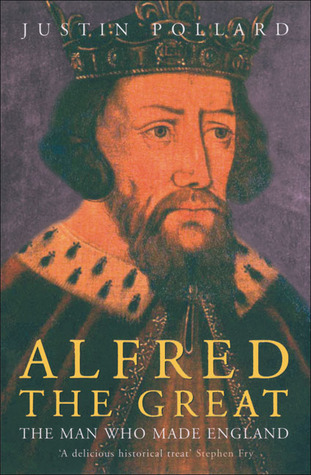
Alfred the Great: The Man Who Made England

118001

Rating: 5 Stars

Review:

Anglo-Saxon England might be the most intriguing period for me in the history of the country. I have often wondered how different the world might be had England remained in the hands of King Harold and the Norman invasion thwarted. The possibilities are interesting. This time period is also frustrating, as there is very little evidence left of these great people, particularly from Alfred's time and before. The scraps of information and rare objects we do have are precious; it saddens me to think that what is now left of the mortal remains of this great king, the man who united the warring kingdoms into what would become England and fought off the Vikings time and again, are scattered somewhere in the soil among the modern buildings of Winchester.

Now, onto the book itself...

Everyone knows the (highly likely untrue) story of England's King Alfred, deprived of his throne and set to wander his lands as a fugitive, taking refuge with a poor swineherd. Here he is either reading a book or lost in thought by the fire, only to be rebuked by the swineherd's wife for letting the cakes burn. Alfred accepts the scolding, unrecognized by his own subjects as their former, but true, king.

It's a highly romanticized story of Alfred's time away from his throne, but one the author touches on time and again when noting the importance of and connection to religion in this time period. Christians at this time still believed wholeheartedly in the daily miracles of God, in a time where men we now call saints were living, breathing people among them. I have not read extensively about Alfred yet, though I have read quite a bit about Anglo-Saxon England in general, so I am not yet sure if this is the author's own conclusion, or the conclusion reached by scholars before him, but he refers to this story as a kind of metaphor for England as a whole. Early in Alfred's reign, in the four years of relative peace before the Vikings again returned and betrayal within Alfred's own court enabled the witan to depose him, Alfred did not do all he might have in order to prepare for the repeated attacks that could only be held off with the Danegeld for so long. The conclusion is that this story is a metaphor for Alfred's reign in that time - he didn't pay attention like he should have so the cakes burned, much like he did not take care to fortify his fledgling kingdom, and so it too burned.

It is amazing to me how, though Alfred lived and died in what would be considered the end of the 'Dark Ages', a significant portion of his time and funds were directed toward learning and educating his people. He was a major supporter of translating great works for his people to read in their native tongue - English. He even sent an item (called an Ã¦stelwith these books when they were distributed to every bishopric - one of which was found in the late 1600s - which has today been concluded that its possible function was a pointer or a bookmark. 

File:Alfred Jewel Ashmolean 2014.JPG
(Property of the Ashmolean Museum in Oxford)

(Property of the Ashmolean Museum in Oxford; the inscription on the side reads: 'Alfred Ordered/Had Me Made' - I have read different translations using either word)

King Alfred felt that literature and education was imperative to the survival of his kingdom. I of course don't mean education as we know it today: all the good little boys and girls in there desks with pencils sharpened, ready to absorb knowledge. I mean in the sense that he felt it was important for the men governing the burhs in his name to be learned men so that they would be able to read his laws, to dispense justice correctly and appropriately, and for all people to have access to the great books. And while it is again highly unlikely that he actually learned Latin in a single day, Alfred did set about educating himself as well and learned the already-dead language.

Whether you have read about Alfred before or this is your first foray into the arena, this is a fantastic read. It is written in such a way that it is accessible both to the lay reader looking for a 'popular history', as well as those who have background knowledge already and would be considered more academic. It chronicles the years and events leading up to Alfred's birth and sets the stage for this king to become, well, great. There's everything you would expect from the time period - Vikings raids, the warring kingdoms of Wessex, Mercia, East Anglia, etc., betrayal, tragedy, and triumph. I highly recommend this one.