Showing posts with label Ancient Egypt. Show all posts

Thursday, June 24, 2021

Mini Reviews | Ancient Egypt


I love Ancient Egypt so much. I want to visit and see all there is to see of that world. It also infuriates me that so much has been lost to history - and continues to be lost as smuggled pieces magically make their way to private collections. Egypt has been robbed of so much and deserves to get their history back.


 Rating ⭐⭐⭐⭐⭐

Absolutely LOVED this one and could not put it down. Easily one of my top-five favorite books on Ancient Egypt. It's the perfect combination of academic and accessible for those who are not as fond of non-fiction as I am.

When one thinks of Ancient Egypt, most likely the first thing that pops into your head has something to do with tombs, mummies, the pyramids, etc. After all, these items make up much of the visible remains of this mighty culture - and mummies + funerary items travel well, all over the world on display.

In this text Dr. Naunton's primary focus is on what we HAVEN'T found yet - such as the tombs of some of the most famous rulers to ever live; think Cleopatra, Alexander, Nefertiti, and Imhotep (I know, I know, he was never Pharaoh, but he's still a big deal). Just think about that line-up for a second and what it would be like if even ONE were to come to light. People would go batshit crazy over it, and rightly so. I would be one of those people.

Yet he also looks at those at the reigns of some more obscure rulers as well, thus giving a well-rounded picture of the whole of Egypt's ancient world and not just those that blockbuster movies are made about. I found these lesser-known rulers' reigns to be just as fascinating as those mentioned above.

Here the author takes deep look into the lives of these rulers and what they accomplished in their time on the throne. Based on incredibly detailed scholarship, he also discusses what their tombs likely contained, how they were buried, and why their tombs have remained undiscovered for centuries. even better, he lays out how they might yet be found.

I appreciated the variety of images that accompanied the text, both color and black and white. The maps came in handy as well - as did the list of kings he included. I think we can all agree that scholarship on this massive period of time is far from complete, but this list with dates is the most up-to-date we have at the moment. And honestly that's what continues to draw people to Ancient Egypt - there's still so much more to discover.

This a must for anyone who happily "suffers" from Egyptomania. Absolutely brilliant. You will not be disappointed.

Rating ⭐⭐⭐⭐⭐

Another great read from Brian M. Fagan, one of the leading experts on this most ancient world. We meet a wide variety of people from many different periods, many who had one thing in common: they were super fucking greedy.

This mainly applies to the tomb robbers who beat modern archaeologists to these finds by thousands of years, to those who paid well for pieces to be spirited out of the country and into private collections. And even today, with so many artifacts on display around the world, sitting in museums far from their place of origin. These artifacts MUST be returned to Egypt, though I highly doubt it will ever happen unfortunately.

Fagan also introduces us to fledgling archaeologists, some who did their best to protect and preserve their finds and others who all but ripped stones, pillars, obelisks, etc. from their resting places.

The author tells the story in chronological order and it's not terribly hard to see why so many artifacts were lost - France and England both somehow thought that they had the rights to another country's history, and could tell that history better than Egypt. It's such a gross perspective. There were of course archaeologists who were in it for the history and not the money, but money ruled over everything else, and still does today. It certainly did not help that there were those within local government positions in Egypt who gladly took the money and handed over the history. Basically, the whole system sucked.

The first volume of this book was published in 1974, but I read the revised edition that came out in 2004. There was much to update and Fagan writes just as passionately about the newer discoveries as he did the earlier ones. He also does not shy away from critiquing the tourist industry and explains what should be obvious - tourism might be crucial to the economy, but it is destroying the very things tourists come to see and if not better protected, they will not survive. Stricter guidelines have been put in place over the years, and hopefully they are enough.

Fagan does a marvelous job bringing to life many of those who sought Egypt's ancient artifacts. yet he does an even better job with those who sought to preserve the history and keep it where it belongs. Incredible attention to detail and brilliantly written.

Highly recommended.

Monday, September 5, 2016

Princesses Behaving Badly: Real Stories from History — Without the Fairy-Tale Endings

17412780

Rating: 2 Stars

I originally rated this book 3 stars, but time away from it has given me a better perspective and I am debating between 1 and 2 stars even. Really, this book was not very good. Perhaps I felt inclined to give it the original 3 stars because within the first chapter there was a subsection about fierce queens from Antiquity and a page devoted to Boudicca. I would have liked to see a blurb about Eleanor of Aquitaine (though she did not live during Antiquity, I know), because she certainly bucked tradition in her life time with the way she took control of her life to end her first marriage and begin her second within weeks of returning home to Aquitaine (and most likely, she had been planning it long before).

But the more I thought about it, and looked back over the few notes I took while reading, I had to accept the fact that while parts of the book were entertaining, by and large the princesses were never really made to feel like real people. The author relied a lot on the myths surrounding these women and did not do a decent enough job separating the two. I guess I would have been more willing to rate the book higher had the two been more clearly divided. Perhaps even presenting the myths first and then following up with what was true in the myth, why the myth grew to overtake the facts we do know, etc. But there was none of that and so the author does herself a disservice, and her readers as well.

Immediately in the introduction, I had some misgivings about the book. Even in the table of contents, the author referred to Isabella of France (wife of Edward II, more on these two in a minute) as a she-wolf. It was at that point I already expected much of the book to be a regurgitation of gossip and nonsense. She-wolf was not a compliment at that time, and using it now without explanation is no better.

While still in the introduction, I found it kind of ridiculous that the author would call her book 'Princesses Behaving Badly', and then rant against Disney Princesses and these cultural and gender norms that exist in society now. Why would these princesses in the book be considered to be 'behaving badly' then, unless the expectation of the behavior was the opposite, and more Disney-like? The message there is already mixed, and nothing is ever done to clarify it.

Back to Isabella and Edward II. Edward was not the king his father and grandfather were, nor his son Edward III would become. I have always felt a bit bad for him, as he enjoyed activities that were considered beneath a king, but he made his own problems as well when he let his favorites sway his opinion and policy. Piers Gaveston was a terrible influence on Edward and there will be speculation until the end of time about whether or not Edward was gay and Piers was his lover. What matters in that bit of information is that Edward never bothered to at least pretend that Isabella mattered, and from their wedding day on it was clear she was of no importance to him - considering the fact that he gave the jewels she'd brought with her to Gaveston, and Gaveston sat with Edward at the coronation, in what should have been Isabella's place.

This quote was one of a few that really sealed the deal for me on how untrustworthy the book is:

"When Gaveston was around, Edward was worse than useless, barely able to hold a conversation, much less govern. When Gaveston wasn't around, Edward was a wreck" (page 79).

This seems a bit...sensational, don't you think? I was interested to read the chapter on Isabella, but it ended up just being a rehashing of rumors and gossip. In looking at the bibliography for this chapter, I found that the author only used one book, Helen Castor's 'She-Wolves: The Women Who Ruled England Before Elizabeth'. That in itself is kind of shady, to use only one source. and Castor's book is definitely not sensational and gossipy. I mean, it has its moments, but it was still well-researched and I liked it. Isabella's behavior was more then justified, by our standards today anyway. As far as we can ever really know, Isabella and her lover, Roger Mortimer took power and eventually Edward II died in captivity under dubious circumstances. At the time her behavior was considered unacceptable, and that is why once their son, Edward III came to power, he had Mortimer executed and Isabella basically under house arrest for the rest of her life.

Basically, the book started out decent, but even after the rough introduction I had concerns. By page 55 when the author referred to Tuthmosis III as 'T-III', I just could not take her seriously. There were some solid stories but over all this is more entertainment than academic. That is not a bad thing necessarily, but it is problematic when myths are presented as fact. If there was not enough factual information about someone available to us today, then perhaps that is a sign that they should not be the subject of a book.

Take it or leave it, but keep in mind its shortcomings.

Saturday, June 25, 2016

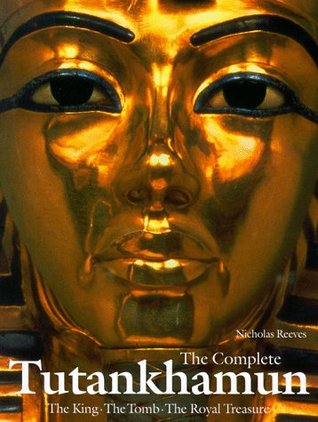
The Complete Tutankhamun: The King, the Tomb, the Royal Treasure

374240

Rating: 5 Stars

I don't even know where to begin with this one. when they say complete, they mean complete. Every last inch of this book is crammed with texts, photos, sidebars, captions, diagrams; you name it, this book has it. It is almost overwhelming, to be honest. There is so much information and detail, I could see it scaring off someone who only has a passing interest. On the other hand, it is a great place to start if you are just learning of Tutankhamun, beyond him being 'the boy king who died mysteriously'.

As I said, there is an insane amount of detail here. The book starts by laying the scene, giving a history of Tut, his father, the religious upheaval, and such. Then  it moves toward who Howard Carter was and his work prior to discovering Tut's tomb. The author then moves step by step, from the discovery, to the death of Lord Carnarvon, the politics of the time that impacted their work, then eventually moves room by room within the tomb and details the discoveries in each space. After that, the author also provides ample information about the kinds of objects discovered that accompanied Tut to the Afterlife: ritual couches, games, chariots and necessary equipment, weaponry, wine jars, pottery, tools, lamps, and so on. There are even charts describing specific statues and figures. I don't think I can stress enough how much detail is here. I feel like I've said it a lot, but it's so very true.

I kind of have this love/hate relationship with the field of archaeology - particularly these, who explore these tombs and remove the treasures to put on display for the world. These are tombs, final resting places of real people who lived and died thousands of years before us. But they still deserve respect and the opportunity to rest in peace. I love seeing the treasures but this is still a kind of state-sanctioned grave robbing. In our never-ending quest to know everything about these people, we've raided their tombs and robbed their graves of anything of value. Sure, it is now done in the name of academia, but it truthfully is no different then those who did this thousands of years ago when the tombs were new and easier to access of the burial.

So, rant aside, I still enjoyed this book for the wealth of knowledge it provides. I do wish there were more color photos. I also found Carter's notes an interesting read and the author uses excerpts of them throughout the book. He took copious amounts of notes, recording what they saw from room to room and these insights are intriguing. The author also includes drawings that Carter's made, though his notes were never published as a volume. It is interesting to see from his perspective as the discoverer, though his methods seem terrible today. The treatment of the mummies never ceases to infuriate me. The fact that Tut (and who knows how many others, by other archaeologists throughout the centuries) had to be dismembered to be removed from his sarcophagus make me so angry. Archaeology is an important field, but so destructive at the same time. It is a field that has to destroy in order to discover, and this is uncomfortable for me.

Side note: the photos of the mummified remains of what are thought to be Tut's two little daughters are absolutely heart-breaking. They're just so tiny (duh).

Overall, this is about as complete a book as you can find about the tomb of King Tut. While there is some history of his reign and the suspicions surrounding his death, as well as information about his father before him, it is more focus on the tomb itself and the treasures it held and what they tell us about burials of the time. Highly recommended.

Wednesday, May 11, 2016

Hypatia of Alexandria: Mathematician and Martyr

797668

Rating: 2.5 Stars

I hate math. I mean, I really hate it. It made me miserable for years. What made my misery ever worse is that my mom is really good at math, so I could never understand when she would try to explain my homework to me, and she could never understand why I couldn't understand her.

It might seem strange then, that I am completely obsessed with Hypatia, a mathematician who lived over 1500 years ago. Part of the allure I think, is that we know so little about her - kind of like Boudicca, another fabulously fierce heroine my daughter will some day know all about. Or, know as much as she can, given how little concrete information we have about either of these women.

And therein, of course, lies the problem. There is so little information about Hypatia herself, that one can hardly write an entire book about her, Instead, one would have to not only include the facts we do know, but give explanation of the times she lived in, the math and philosophy she worked on, and so forth. 

That is exactly what the author does, and really it is almost too much. The math alone is very in-depth and academic. I am all for scholarly and academic texts, I read them often. But for someone like myself who is predisposed to hate math because that gene skipped me somehow, this was like reading a text book at times. I wanted to like this book and for it to be everything I was looking for, but it can't. That is no fault of the author, he did the best he could with the information he had to work with, but there is simply not enough know for certain to fill a book.

The author uses what sources still exist to flesh out Hypatia and at least give her a form - but in truth we do not even know what she looked liked. I appreciate though, that there is not a lot of conjecture here. In truth, very little of the book is about Hypatia. Without beating a dead horse too much, there just is not enough info.

So, I can really only recommend this one to people who love math. Hypatia is there of course, and we know what we can. Sadly though, that is not much and I fear that will never change.

Wednesday, December 30, 2015

100 Documents That Changed the World: From the Magna Carta to WikiLeaks

26236825

Rating: 3.5 Stars

Review:

I really love books like this, the '50 Objects..." or "12 Maps..." that 'changed the world' type books. This book is no exception, as it covered several documents that truly did change the world, for better or worse. While I disagree somewhat with some of the items included ('War and Peace' and '1984' - I do not consider books to be documents per se), the majority really do help the book live up to its name. How can you go wrong when writing about Magna Carta, the Emancipation Proclamation, the Apollo 11 Flight Plan, and Anne Frank's diary in one volume?

Turns out, you can. Or, at least not 'go wrong', but you can be lacking in detail and description at times. I understand this is not meant to be exhaustive, seeing as how it is quite slim to begin with, so I will get my complaints out of the way before I delve further in to discuss some of the specific documents addressed that I felt were among the most important. There is only one actual page of textual information devoted to each document, though that page often included a small picture of those who signed, witnessed, wrote, etc. the document. The opposite page was usually a picture of the document itself. Additionally, for a good portion of the beginning, nearly all of the documents were from Western Europe. Not all, but a good majority. Surely there were other important documents that could have been included from around the world and not just those few.

Now, to the documents I found most fascinating - it is also kind of embarrassing to admit that I did not know some of the facts I learned from this text. In my defense perhaps we were not taught those aspects in school? So many of these documents today exist now in the National Archives and I wish desperately to see them - namely the Fort Sumter Telegram announcing they were surrendering, and the Emancipation Proclamation. These were two hugely important documents that exist as a testament to the resolve of our young country - we were willing to go to war with ourselves to achieve the ends we wanted. The telegram began the war and the proclamation set us on the road to ending it. As an aside, I never knew that the E.P. ONLY freed slaves who were living in the states that had succeeded from the Union - AND applied only to those held by the Confederacy. So, apparently it was a shrug and a 'sorry' to the slaves living in areas recaptured by the Union, or the nearly 500,000 living in those border states who had not succeeded.

I am curious about the exclusion of the Gettysburg Address as an important document and thought perhaps it was excluded due to the inclusion of the Emancipation Proclamation. But both Martin Luther's 95 Theses were included, followed directly by the Edict of Worms. Those documents were separated by only four years, but concerned the same topic, so not sure why Lincoln's famous speech was not considered important enough?

Fun Fact: Apparently our Founding Fathers were not terribly responsible. The original copy of the Constitution had vanished at some point after its signing and no one knew where it was until 1846! Also, it has only been on display since 1952; I didn't realize it was such a short amount of time when I visited in 8th grade on a class trip.

A little dirty laundry gets aired here in the form of which states ratified the 19th Amendment and when - you keep it classy Mississippi, not ratifying until 1984. I am not surprised that many southern states were among the last to ratify it.

The 15 year old girl in me who will forever love Titanic could not help but be wistfully glad to see the inclusion of Titanic telegrams included as important documents that changed the world. Movie references aside, it really was a wake-up call to these shipping companies that safety measures needed to change and improve to avoid another tragedy on such a scale.

There were several documents relating to World War I and II, which should come as no surprise. The Treaty of Versailles is always troubling to me, as it basically assured that there would be another war - how could there not be? Germany was forced to take all the responsible for the Great War, only for the fact that they were the last ones standing when the war came to an end. It should shock no one that the Nazis were able to rise and grab power so swiftly; the treaty was crushing and the reparations were impossible.

When I think of a document, I think of something of the non-fiction, factual variety. This is why I struggle with the inclusion of books - manuscripts - in this text. However, I feel that Anne Frank's diary certainly deserves its place. The importance of this diary can not be overstated and if you do not believe me, try standing in the Annex and imagining living in this cramped space with seven other people, the majority of whom you struggle regularly to even get along with. It is one of the most humbling experiences I have ever had in my life and could not imagine spending two years in that place. Anne's diary gave a voice to the millions who had theirs cruelly and violently taken away. I did NOT like, however, that Miep Gies was simply referred to as the 'family friend' who later saved Anne's diary after the family had been taken away. Even with the focus being on the document itself, surely Miep deserves much more credit than that.

There were so many documents that I found interesting, I could keep writing for a while. I will finish this up with reference to a certain CIA document, dated August 6th, 2001, that stated very clearly an attack on the US by bin Laden was imminent. Unfortunately, this memo was handed to one of the most incompetent presidents in the history of our country, while he was staying at his ranch in Texas. You know, one of his 406 vacation days taken in his presidency, or some absurd number that the GOP conveniently likes to forget whenever they complain about Obama playing a round of golf. As a follow-up, the Iraq War Resolution was included but I couldn't even bother to read such garbage.

So, overall, this really is 3.5 stars. There were so many documents that belonged here, but at times their importance almost felt diminished simply because often only the bare facts were included. It is by no means a be-all, end-all for any of these documents and while I can recommend reading this one, I would also suggest further reading on any of the documents that interest you.

Saturday, December 5, 2015

The Rise and Fall of Alexandria: Birthplace of the Modern Mind

400064

Rating: 5 Stars

Review:

I never knew how little I actually knew about Alexandria until I read this book. The first book I read of Pollard's was about Alfred the Great and I absolutely loved it, it was well-researched and beautifully written. The Rise and Fall of Alexandria is no different. It is truly so beautiful and lovely and depressing to read about this great center of academia, and THAT library, and after centuries of surviving, it's just gone. Based solely on the book's content, I would give this a solid four stars, but given my love of all things academic and library-ish, I had to go with five stars.

There are so many directions I might go with this review, so many things to discuss and dissect, to relate to our modern world, I don't think I would have the space or time to even attempt that. So instead I will just touch briefly on some of the things that were most intriguing to me.

The book begins where you would expect - with the founding of the city. There is a solid foundation, figuratively, to build the rest of the book on. We are given a background of Alexander and Ptolemy take-over after Alexander's death. As time went on, the library accumulated more and more knowledge, just imagine all those scrolls, all that history in one place.

"Alexandria was built on knowledge, and at its heart was not a treasury but the greatest library and museum of antiquity" (introduction).

But, Alexandria was so much more than just the library and museums, if that is even possible. Truth be told, that is really all I knew of the great city prior to picking this one up, aside from knowledge too of its famous founder - who did not live long enough to see the glorious crown jewel of his empire reach its full potential.

I found the medical information to be among the most interesting facts (I mean seriously, despite the plethora of mathematicians who lived and worked in Alexandria, we all should know by now how I feel about math. I think it is a testament to how enthralling Alexandria is that I was able to muster through those sections - I am NOT a number gal!) Given my love for all things medieval England/Ireland/Scotland, I was familiar with the idea of the four humors, but did not know much about what they represented or how this information was used. Here the author goes into a bit of detail when discussing medical practices that were developed in Alexandria, including the understanding of anatomy. The disturbing way they came about this knowledge was that doctors were given LIVE condemned prisoners to experiment and operate on, so...not all was perfect in the city.

One of the both high- and low-lights of this one for me was a whole chapter dedicated to Hypatia. It's a highlight because she is such a fascinating figure in history, and while there is not a lot of information known about her, there is enough that tells us she is certainly someone who was held in esteem. The low-light of course would be her cruel and violent death, and the fact that Cyril played such a role in it and that later he was even raised to sainthood. That is a travesty to me.

"With the death of Hypatia, her city also began to die. Philosophers were still to found in the city's streets and the 'Alexandrian school' continued quietly - ever more quietly - to refine pagan Neoplatonism" (page 280). 

Overall, I really loved this one. I can highly recommend it to anyone who has an interest in non-fiction. Even if you do not know much about this time period, the people, this city, the library, it is a great starting point. It is also great for those who already have a knowledge of any of those topics, as the detail and research is quite evident.

And oh, what I would not give to see that library in its full glory.

"And what of the books? The fate of the libraries of Alexandria is one of the greatest mysteries of the ancient world. It would still be tragic, but at least convenient, if a single moment of their destruction could be found, a moment at which the curtain came down on the classical world and a new and darker age commenced" (page 281).