Showing posts with label Memoir. Show all posts

Saturday, April 2, 2022

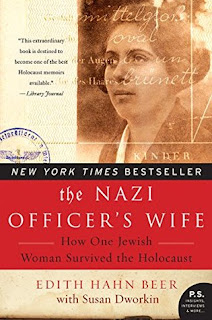
Book Review | The Nazi Officer's Wife: How One Jewish Woman Survived the Holocaust


Rating ⭐⭐⭐⭐

This is a harrowing, beautiful survival story and one I could not put down. I have read more than my fair share of such stories, but they have typically focused on those who survived the death camps, the death marches, all the cruelty Nazi Germany had to offer. That does not mean there was not cruelty in Edith Hahn's life; she was still surrounded by it every single day.

Hahn grew up in Vienna and was forced to live in a ghetto when the Nazis arrived. From there she was sent to a labor camp for many months. Her sisters had escaped the Nazis, but barely. Yet Edith stayed for her mother and her love, Pepi. He insisted it could not really be that bad. Pepi was Jewish, but his mother had him baptized as a Christian. It made no difference in the end, because he was still Jewish and the baptism was not applicable 'retroactively'. He had to hide for most of the war no matter what - as a Jew, he would be deported to a camp; as a gentile, he would be shot on-sight as a deserter from the army. His mother was also awful and hated Edith because she was Jewish and said the most awful things to her all the time, begging her to 'let Pepi go' so he wouldn't be seen with a Jewish person. I am a little disappointed that his mother survived the war, not going to lie.

But I digress.

While Hahn was held in the labor camp in Germany, her mother sent whatever little comforts she could. Hahn remarked that her mother always sent whatever she herself needed - gloves, cakes, etc. While Edith was away, the ghetto was cleared and her mother was sent off to Poland. Hahn always kept the idea in her head and heart that she would find her mother again, and the family would be reunited. It was never to be however, as her mother was murdered within a week of arrival in Poland. Though Hahn does not find this out until after the war has ended. It is absolutely gut-wrenching because logically you know elderly women were not kept alive to work, but you hold out hope nonetheless.

Hahn's survival eventually came to depend on the very monsters who were hunting her people down. After returning from the labor camp, Hahn was supposed to report to a deportation site. She never did, and spent the remaining years of the war under an assumed name of a Christian friend in a plot that would have seen them both tortured and executed on the spot had either been discovered.

Hahn takes the name of her friend in order to get the necessary papers, and lives as Grete Denner. She lived in Munich after she escaped Vienna and eventually meets a man named Werner Vetter. He is a Nazi and pursues her at all costs. He is in the midst of divorcing his wife he later reveals, and in turn Hahn confesses to being Jewish. Despite his inclination to be in the party of mass murderers, Vetter continues to insist they get married. Hahn worries about the identification papers she does not have, those which prove her family's lineage as "pure Aryan", but in the end they are allowed to wed.

Side note: One of my favorite parts of the book occurs when the war is over and Hahn returns to the office where her papers were accepted so she and Vetter could marry. She needed to do so in order to get identification with her real name this time, finally safe from the Nazis. The same officiant is working in the office and he is shocked and angry to find out she lied, that she is actually Jewish. It was a beautiful little snippet.

I can not imagine living in a state of constant, paralyzing fear. Yet Hahn performs in her role so well, never giving in to that fear. She knows what to do in order to survive, and plays the part of the dutiful German wife. For a long time Vetter resisted the idea of having a child, and his terrible temper worried me for Hahn quite a bit, but she eventually becomes pregnant and gives birth to a baby girl. Of course he is pissed because he wanted a boy. Hahn speaks of refusing any pain meds during Angela's birth, out of fear of what she might say when under their influence.

As the war rolls on and Germany's defeat becomes a foregone conclusion, Vetter is drafted. He had previously escaped this due to the fact that he was legally blind in one eye. He is captured by the Russians in battle and a prisoner for ages, though Hahn uses every professional and political connection she has to free him. You see, before the Nazis came to Vienna, Hahn was studying to become a judge. She'd completed all her classes and only had to take the final exam. Yet the day she showed up to do so, she was turned away (with glee, I might add). After the war she was able to fulfill her goal and become a judge.

It was through these connections she was finally able to get Vetter home, though it did not last long. He still went on and on about her Jewish blood infecting their daughter, which confused me. If the Germans were so superior, shouldn't their blood have been "stronger"? GTFO of here, you Nazi scum, is all I have to say about that.

Hahn eventually leaves Germany for good when the Stasi is growing, and she is repeatedly asked to spy on her friends and acquaintances. Under the guise of visiting her sister in England, Hahn escapes for good. The heartbreaking turn of events means she will never practice law, never sit as a judge again. But she survives, as does her daughter.

Hahn was urged by her daughter to tell her story, and for that I am grateful. here we have a complete record of how one woman was able to do the unthinkable - live opening among the very people who hated her and would have wanted her dead had they known her true identity. I worried throughout the book whenever Vetter was angry, that he would turn her in, but that never happened. They divorced eventually when he went back to his first wife. That didn't last long however, and soon he was divorced again. He'd marry four more times before passing away in 2002.

Hahn kept every single piece of paper she was issued over her years in hiding, and when her daughter discovered these, she convinced her mother to give the photos and documents to the world. They are now part of the permanent collection at the Holocaust Museum in DC.

As memoirs from this period often do, this felt like much more of a conversation between Hahn and myself. I was there only to listen to her incredible tale of survival, to be in awe of a courageous woman who kept going, day after day, never knowing if that dreaded knock at the door in the middle of the night would come.

My only slight issue is the title - it is a bit misleading. Vetter worked for most of the war as a supervisor in a paint factory. He was only sent to fight near the end of the war, something he had avoided previously due to his blindness in one eye. But truly, it doesn't even matter all that much, because Hahn's story is so remarkable. She survived.

Highly recommended.

Sunday, November 14, 2021

Publicist Gift | How to Walk with Steve


I received a free physical copy of this book from the author's publicist in exchange for an honest review.

Rating ⭐⭐⭐⭐⭐

One of the most moving, traumatic, beautiful, tragic memoirs I have ever read.

Fromberg's writing style drew me in immediately; I am such a sucker for stream-of-consciousness fiction by certain authors (obviously Hannah Capin) but believe me when I say it works superbly here as well in non-fiction. It create the exact atmosphere for the reader to feel as closely as possible what it must have been like to live through these experiences, all the chaos and uncertainty. It also helped further that feeling with the story written in short vignettes, like scenes in a play almost. We see this one thing happen, then off to the next, unsure if what happened previously will be resolved before the book ends.

Throughout we learn of Fromberg's life first growing up in Peoria, Illinois. He lives with his parents, functioning as both addicts and artists, if functioning can even be the right word. He also has a younger brother, Steve, who was Autistic, and before reading this I could only imagine how hard life was for a family in the 70s with a child on the spectrum. It's overwhelming even now, in 2021, despite all the services and resources available to families today. As a special education teacher, sometimes even I am overwhelmed with how to best ensure that my students on the Spectrum are getting all of their needs met and that they are set up as best as possible for success. With the added chaos of  their parents' addiction, Robert bears much responsibility, far more than he ever should have been asked to at a young age.

The author is examining his life, holding it up to the light as he comes to realizations and makes connections right along with the reader. His tone is conversational and he is nothing but very, very honest. He introduces readers to some of the most traumatic moments in his life as he sometimes simply struggled to survive.

But it's not all terrible. There are beautiful moments too. Moments that you feel so deeply, because of how he has brought you to this window into his life. It sometimes feels are if you reliving the moment with him.

We also see the every-day things that occurred, things one might consider unimportant in the grand scheme of things, yet it was often those moments that became so critical, because we feel time and again what the author felt at that particular point.

it is without a doubt a rollercoaster of emotions packed into a slim volume, but there is one thing that is always certain, that never falters: Robert's absolute and unconditional love for Steve.

An extraordinary work of art, highly recommended.

Sunday, April 18, 2021

Publisher Gift (via NetGalley) | Between Two Kingdoms: A Memoir of a Life Interrupted


I received a free digital copy from the publisher via NetGalley in exchange for an honest review.

Rating ⭐⭐⭐⭐

When I was contacted by the publisher via email with the offer of this book, I admit I hesitated quite a bit at first. The news of the world was already hard enough, and adding something even more awful to my life seemed like something I did not want to do.

Still, I dove in anyway and I am glad I did. I had a few stops and starts, and there were places I skimmed only because some descriptions of her sickness and treatments were graphic and I don't have the stomach for that. Even so, I recommend this read.

The author graduated from college and promptly moved to Pairs that summer. Her dream was to be a war correspondent, but not long after settling into her new life fate had other plans.

It started with a strange symptom - a constant itchiness on her feet and legs. Then came the fatigue and no amount of sleep could make it go away. Don't forget the sores in her mouth. The more she slept, the more tired she became. Just before the author turned 23 she received the diagnosis that I would not wish on my worst enemy - leukemia. Even worse, this version came with a 35% survival rate. Suddenly the world she had been slowly building for herself in Paris was gone, obliterated by that one terrifying word.

Jaouad returned home to New York and began her fight to survive - all of which she chronicled as an on-going story for the New York Times. For nearly four years she underwent all kinds of traumatic events - rounds of chemo, a clinical trial, and then a bone marrow transplant. She made and lost friends who suffered as she did, and those stories are especially heartbreaking. I can't imagine going through something so life-altering, finding those who understand because they are in the same position, then losing them to the very thing you've beaten. Survivor's guilt would crush me.

When Jaouad is finally deemed cancer-free, she finds that in her fight to live, she has forgotten how to do that very thing - to live. This is understandable, having spent the last four years constantly stalked by death. To begin her journey of healing mentally and emotionally, she decides to crisscross the country on a 100-day journey to meet with people who had written to her while she was in the hospital and writing about her battle with the disease for the Times.

Jaouad's account is brutally honest. I can't imagine having to make some of the decisions she did, and so quickly. This is especially clear when it came to the issue of the clinical trial and whether she would do it if she was a candidate. Also the decisions made when it came to fertility and how any treatments could later impact her ability to become pregnant if she decided she wanted to have children. Jaouad had a solid support system there every step of the way. I can't imagine going through this alone and was glad that she did not have to.

Knowing the story has a happy ending did not make the hard stuff any easier. This is a powerful memoir of a life interrupted and the search for how to begin again.

Highly recommended.

Monday, June 10, 2019

Book Review: Life Will be the Death of Me...and you too

43885930

Rating: 5 Stars

I have to say, it kind of confuses me in looking at some of the reviews and ratings on Goodreads. Some people took stars off for the book not being funny enough for them. It makes me wonder if any of them bothered to read the synopsis.

This is easily my favorite book by Handler - and not because I laughed my ass off the entire time reading it. This is not a funny book. This is a book where Chelsea deals with growing up, so to speak, to coming out of her bubble, and seeing that happen is truly impressive. There is humor still, in some of the narrative, but at its heart it is about Chelsea dealing with something she barely mentions, but it is obvious in all her other books that it has impacted her entire life from that moment on: the death of her brother Chet.

 I absolutely love her for so many reasons, but the main one has to do with her honesty. No matter what, I feel like Handler is someone who will always give you the truth. She is honest about her life, her perspective on people and issues impacting our world, her own lack of knowledge on certain topics, and her desire to become more educated on said topics. That is one of the reasons I loved her Netflix talk show so much and was bummed when she ended it.

This book, however, explains why.

Handler discusses her experiences in seeing a therapist, who was once a guest on said show, Dr. Dan Siegel. She works through the trauma and grief over Chet's death, and how it impacted her entire family. The way she writes and speaks about it is so raw and with such emotion and honesty. I was both incredibly impressed with the growth that came out of the sessions, and deeply saddened for her and her family.

While I love Chelsea and admire her, prior to reading this I have to admit that I didn't know if she was someone I would be able to be friends with (you know, that hypothetical game you play where ultimately everyone says they want to best friends with Mindy Kaling because she is hilarious and awesome?) The reason for this is that I also find Chelsea Handler to be kind of intimidating. I mean, I am pretty outspoken and blunt, straight to the point, no fuss. But Handler is on a whole different level and I previously felt like, wow, she would peace-out on me rather quickly. But after reading this book, and getting to see this new side of Handler, I completely take back any previous thoughts about not being BFFs, and have concluded that in fact, yes we would be BFFs after all. It doesn't mean she is any less intimidating, it just means that seeing the vulnerability she puts on display here is truly amazing. It truly humanized her. This is not the same Handler we have seen on her various shows through the years, and being able to look inward, she has come to some really good conclusions about herself, her life, her family, and how to be a better person.

Handler is the first to admit she came completely unhinged after trumplethinskin's election. But that eventually lead her to the point where she began examining her privilege as a white woman in the US and what she has that so many others don't. Handler deals with those topics just as well - politics, her burgeoning activism in the aftermath of the election that stunned all normal, logical, forward-thinking people, and more. Her humor is there, but a bit more restrained, because these are not funny topics. This is the most serious and introspective of all of her work and as I said previously, by far my most favorite.

Perhaps one of my favorite parts comes in one of her therapy sessions, when dealing with empathy and Handler deals with this and how to have empathy for others. It was definitely shocking for her, and something that wasn't easy, but was very eye-opening and relatable. That in itself seems to me to be one of the major turning points for her on this self-discovery trek she has embarked on. 

While most of us will never live the "privileged" life that Chelsea Handler does, readers will still be engaged in the story and connect with it. After all, everyone has lost someone they love, everyone has dealt with the same issues Handler is dealing with in the book, and we can all learn a little from one another.

Excellent read, highly recommended.

Friday, November 16, 2018

Advanced Reader Copy - Holiday SOS: The Life-Saving Adventures of a Traveling Doctor

42190741

I received a free digital ARC from David Haviland and Thistle Publishing in exchange for an honest review

Rating: 4 Stars

I had no idea this was even a job. I mean, I suppose had I given it any thought, I would have realized this kind of practice had to exist, but since I've never thought about it, it never occurred to me what might happen to someone who has a terrible accident or becomes deathly ill while on vacation. I now also know that, despite the perks of travelling around the world, it is a job I could never in a million years do myself. So, thank goodness there are doctors like Ben MacFarlane who are more than willing to.

I really found so many of Dr MacFarlane's patients fascinating. Some of the stories were hilarious, some were terrifying, and some were heartbreaking. As Ben is traveling back and forth, repatriating British citizens who are injured while on vacation outside the UK, we also get an understanding of the job, and a peek into his personal life as well. I felt like that was important too, so we got a glimpse of who he is as a person, not just this robotic doctor who flies in and out of the UK constantly, escorting injured travelers for the insurance companies. He seems to truly care about the patients he is escorting, and more than once having to save mid-flight. I found the way the stories were explained to be respectful to all of those most deserving of it (don't even get me started on that extra rude lady).

There was one point in the book where I teared up. Ben was escorting a sweet elderly lady back to the UK. She'd been traveling alone, and upon arrival, there was no one to meet her or stay with her at the hospital. Ben later found out that Mrs. Dean passed away two days after arriving back in England. No one was there for her funeral either. Just typing this gets me choked up, and I appreciated Ben's sentiment that he would have gone, had he known.

I appreciated the fact that this did not read like a medical textbook full of jargon that no one understands besides the doctors and nurses who might read this. It was not watered-down, but explained in a way that made sense, without being condescending. In a high-stress job like this, not only would a doctor or nurse have to be highly skilled at what they do (comes in handy when your charge suddenly takes a turn for the worst when you in the air), but must also be able to be a calming presence, able to be empathetic and comforting, to the patient who is injured and/or sick, scared, and a long way from home. Such a difficult job and, as I mentioned before, one I know unequivocally that I could not do myself. Ben has a tough job to do and not always a lot of time to do it. He gets a patient, studies the case, heads out, then has to deal with the doctors at his destination (some good, others difficult). At that point he then has to assess the patient to see if he or she is even fit to travel. Sometimes that is an immediate yes, sometimes they have to wait a few days, and sometimes the wrong decision is made. Through it all, Ben remains calm and collected, and delivers each patient here back home safely to a hospital in the UK for further evaluation and testing if necessary. Ben does not accompany patients on that leg of their journey. Once the plane has landed and he has delivered him or her to the waiting ambulance, he is off on his next adventure - whether that be traveling to an exotic location, or sleeping at home for the first time in a week.

I've never given a single solitary thought to purchasing travel insurance, but given the multitude of stories presented here, that is something I will most definitely be thinking about in the future.

As I read, time and again I thought about what a great television series this would be. It is certainly unlike all the other medical shows we see - at least, I think so. Truth be told, I got rid of cable seven years ago and haven't looked back. I don't even bother with local channels much, but this would be a show I might watch. Obviously these cases did not all happen back to back to back, but were presented as some of Ben's most dramatic/dangerous/obnoxious/etc stories. Just imagine, all season long there are these really difficult cases, the doctor almost loses a patient mid-flight on a few occasions, all kinds of good, heart-pounding drama. Then the season finale, literally everything goes as perfectly as it can, it's a totally relaxed episode, drama-free, and everyone makes it home alive. People would be so confused, it would be great.