Showing posts with label Historical Fiction. Show all posts

Friday, July 18, 2025

NetGalley ARC | The Secret Investigator of Astor Street


I received a free digital ARC from the publisher via NetGalley in exchange for an honest review.

Rating | ⭐⭐

I thought this was a cute cover so I snagged it before realizing it was book two in a series. I thought it would be just a quick, cute cozy, but that's not what this is. And since it was book two, I had to find book one at the library. That also a two-star read for me.

In book one, eighteen-year-old Piper's best friend Lydia disappears. Piper is convinced that the police are looking in the wrong direction, so she begins an investigation of her own. I really struggled with that book, and I not so nicely called Piper an 'absolute moron' in my quick review of it. She was so naive and honestly, a bit of a brat throughout much of the book.

The second issue was that the book did not feel like it was taking place in the 1920s. It felt very forced, like dropping in a bunch of words used in the 20s would create the feel of the decade, but it didn't. It felt awkward and like we had to constantly be told over and over, we're in 1920s Chicago through the vocabulary choices of the characters.

These same issues continued in the second book. It still doesn't feel natural, the decade doesn't feel like the 20s, until Piper is saying trilby or cloche, or telling us she is grabbing a beaded bag to take out with her.

Piper has now graduated from high school and doesn't really know what she is doing with her life. She's slowly recovering from Lydia's death and the solving of that case, when a new case is brought to her attention by a friend. Recently the girl's brother died and it was ruled a suicide. She insists he would not have killed himself, and Piper takes the case.

I feel like this story could take place in any city, in any time period. And that is my biggest complaint, because it does not feel like the 20s. This is one of my favorite eras to read about, fiction or non-fiction, and it makes me so sad this series is not working for me.

I also take a major issue with this book being billed as a good one for fans of Agatha Christie. Absolutely not. That's actually offensive.

I will not be reading any more in the series.

Give it a try if you'd like, but I can't recommend it.

Saturday, November 12, 2022

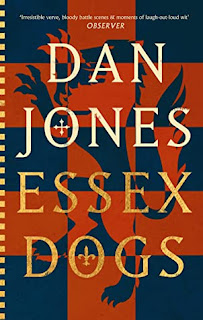
Book Review | Essex Dogs


Some men fight for glory. Others fight for coin. The Essex Dogs fight for each other.

++++++++++++++++++++++++++++++++++++++++++


Rating: ALL THE STARS AND EVERYTHING FOREVER

Not exactly a surprise, or maybe a huge surprise, since it is historical fiction?

But it's also Dan Jones, so come on.

I own two copies of this beauty. One I pre-ordered from The Broken Binding and it is gorgeous. I wrote about it HERE. The first, however, came from Dan himself because he had announced on his Facebook page that the ARC was available on NetGalley. Sad for me, it was only on NetGalley UK at that time; I whined about it, so Dan went out of his way and EMAILED ME MY VERY OWN COPY.

I devoured it, which surprised even me, but ONLY because it is historical fiction.

I'm not going to lie, I was a little nervous going in. I love medieval history (OBVIOUSLY), but warfare and military history in general is not my thing. And anyone who has been here for a minute knows that I typically dismiss historical fiction because why would you read made-up stories set in the coolest time period ever, when you can just read REAL stories about REAL people like my girl Eleanor of Aquitaine, who actually existed?

You know when you DO read those historical fiction books though? When they're written by a historian who actually cares about accuracy and knows what the fuck he is talking about.

The book opens in July of 1346. The Essex Dogs have arrived in Normandy, a group of ten men heading towards their destiny to partake in one of the most important battles in history, the Battle of Crécy. They certainly recognize the importance of what is coming, in the early years of what will become the Hundred Years' War.

I think one of the reasons I liked this one so much is that it is the story of ordinary soldiers, the real men on whose backs wars were really won or lost as the king they were fighting for looked on the battlefield from afar. FitzTalbot leads his men into battle time and again as they fight their way across Normandy. Despite the fact that summer was for war and war was a fact of life, he cares for his men and wants to get them home when all is said and done. However, I will not tell you if he is successful in that.

The men truly begin to shine in their own ways as we get bits of backstory for each as the novel goes on. We find out their individual motivations for going to war, but the bottom line is the men are close as brothers and would do anything for one another. They depend on one another for survival, at all costs. It would have been easy in a novel like this with ten Dogs, for them to blend together, but that did not happen. Each stands on his own, with his own personality, and I was never going back and forth trying to figure out who was who again. I hate when that happens in novels, because it is such a disruption to the story.

Despite being a book about medieval warfare and all the atrocities and horror that come with that, the fact that the novel is so character-driven is what kept me so engaged. War is terrible and violent and something I typically don't care to read about. But I cared about these characters, and their relationships truly were the heart of the story, despite the bloodshed. Time and again through banter and arguments, highs and lows, the men become so real. It was easy to get lost in the story because of how well Jones writes these characters. He truly has a talent for fiction (which I both love and don't love, because I want to know what is coming next for these guys, but also...non-fiction will always be my first love).

Even with this fantastic cast of characters straight out of Jones' imagination, we are treated to appearances by real historical figures -  Edward III, his son Edward, the Black Prince, and the Earl of Northampton. Including them, but not putting them at the forefront, balances the story really well.

Side note: I think we all know what kinds of war crimes occur, especially against women, and have occurred since man began making war. I appreciate Jones not going into detail on said war crimes despite the reality that those crimes did occur and are implied here.

Okay, so despite everything I have said about not typically enjoying military history, I loved Band of Brothers and could watch it over and over. Saving Private Ryan is one of my favorite movies of all time. I was constantly reminded of those groups of men roaming across France as I followed the long and violent journey of the Essex Dogs. Congratulations Dan Jones, you are now the Steven Spielberg of medieval history!

And given the fact that medieval history is kind of Jones' thing, it would have been easy for the story to get bogged down with historical details, but that does not happen. The book is gritty and authentic and raw. It never feels like there's too much information for those even with the least amount of knowledge of the period.

Despite the cyclical nature of war and the constant skirmishes and battles the men participate in, it does not feel like the same thing over and over again. There are raids on villages, the storming of castles, and all manner of events in between. It's exhausting at times, given the chaotic brutality of war, but the story moves along at a good pace.

No question, the book is fantastic. I can't wait to see what happens next. Get to it, Dan! (He's working on book two now, not sure how far along he is in the process. Also, check out his Friday Lives on Facebook because they are still a thing and still fucking hilarious.)

Highly, highly recommended.

Saturday, June 18, 2022

Excuse Me While I Brag...


Isn't it so pretty? And it is ALL MINE!

A couple days ago on his Facebook page Dan Jones posted that Essex Dogs was available on NetGalley.

I thought, "FINALLY!" and went to request it.

Silly me, it is on the UK site but not the US one.

I told Dan this on the post in a reply to his post...

...And now I have a digital copy of my very own!

(I did already pre-order it anyway, but I am not patient and want to read it NOW.)

I know you're thinking, "But Sarah! It's HISTORICAL FICTION! You HATE that nonsense!"

That's true.

However, I heart Dan Jones more, and I trust that he will be as authentic in his portrayal of these lives and events as he is thorough in his research and writing of his non-fiction texts.

Happy Reading!
Sarah

Tuesday, October 10, 2017

Cor Rotto: A Novel of Catherine Carey

24929623

Rating: 4 Stars

Full Disclosure: I have this book shelved as being a gift from an author or publisher because this is technically true. Adrienne Dillard is the author but she has, more importantly, become my friend. It will probably not surprise anyone that we 'met' on a post from Dan Jones' Facebook page. We share a love of history, specifically the Tudor era, and really ridiculous amounts of awesome GIFs. As such, while this book was a gift, it did not come with the expectation of a review. It came as a gift from one friend to another.

Normally, I do not like historical fiction. Everyone and their mother knows this by now. There are exceptions I am willing to make though - particularly if it is someone who I know about, but not too much. I can not abide fictional works of certain real-life people, namely Eleanor of Aquitaine and her brood. She is too near and dear to my heart for me to entertain what someone thinks she MIGHT HAVE said or thought. Novels like this then are ideal for me because I know who Catherine Carey was, but have no deep connection otherwise. I enjoy Adrienne's work because she is thorough in her research and always quick to make note of where she took her information from, what is historically accurate, and what came from her own imagination. That is the reason I read her second novel, of Jane Boleyn, so quickly. I could not put it down. I enjoyed learning Catherine's story, but was also pleased to find that I for the most part was able to decipher on my own what was real and what was imagined, based on my other Tudor knowledge.

One thing I am not a fan of is stories told in first person. That is really the only aspect of the novel that bothered me, and it bothers me in literally every other novel I have read in the last five years. I don't know what has caused this change in me, it never used to bother me so much. Perhaps it is because my brain is now wired for non-fiction, so peoples' thoughts and emotion perturbed me now. Who knows.

I did enjoy some of the perspectives taken in Catherine's eyes, particularly that of Mary I. I have long maintained a special place in my heart for the daughter of Catherine of Aragon. I feel the treatment of herself and her mother by Henry in the years leading up to and following his marriage to Anne Boleyn were what changed Mary into the person she became. By all accounts she was a happy, thriving child, but Henry took that light in her and twisted it and damaged it beyond repair. Had she been treated more justly, I believe her reign would have reflected that. I also appreciated Catherine's portrayal in how she regarded Elizabeth - that she was difficult. Elizabeth is one of my least favorite people in history, I find her manipulative and dramatic and annoying. I am glad to see I am not the only one who might view her as difficult and Catherine and I agreed greatly - though she was still loyal and loved Elizabeth dearly.

The tenderness between the various characters is what really stands out in this novel for me, whether it be between husbands and wives, parents and children, etc. Sometimes it is easy to look back on these long-ago times and see these people as so wholly different from us. But it is also easy to forget they were in fact real people with real thoughts and feelings and hopes and dreams, people who loved those dear to them. I always find this especially true when addressing the high mortality rate in infants and children of the time. Just because a family has so many children does not mean the deaths of little ones are felt any less deeply. I also appreciated the love between Catherine and her husband. While it was an arranged marriage, I can hope that it truly became a loving one - and I think the multitude of children reflects that.

The big question here though, involves the view that recognizes Catherine has Henry VIII's daughter, this making Catherine a half sister to three Tudor monarchs. I believe until there is DNA testing done to prove once and for all, this debate will not end. But, as we can not even pin down the time line correctly, this may be another one for the 'We will never know' pile. 

Overall this was a lovely portrayal of a lesser-known figure in Tudor history. If you enjoy historical fiction based on the facts available, you will likely enjoy this one. Highly recommended.

Thursday, March 9, 2017

First Line Friday: Non-Eleanor Edition!


It's First Line Friday! I decided to take a week off from sharing my love of Eleanor of Aquitaine to introduce you to a fantastic historical fiction novel about Jane Boleyn, wife of George Boleyn and sister-in-law to Mary and Anne Boleyn. I read it in a matter of hours and if you are interested you can find my review HERE. If you are interested in Tudor history, I recommend it highly. Though it is fiction, I really enjoyed it. There's so little we know about so many of these Tudor women, it is kind of nice to imagine what they might have been like and lucky for us, Adrienne Dillard was happy to fill in the missing pieces of what Jane's life might have been like.

34217892

"November 12, 1541
Journey to the Tower

The river was as calm as I had ever seen it."

I won't say any more because I don't want to spoil a thing, so leave your own line or a comment about mine and then visit my fellow First-Liners to see what they have for you this week


Rachel - Bookworm Mama


Lauraine - Lauraine's Notes


Robin - Robin's Nest


Kathleen - Kathleen Denly


If you would like to participate in First Line Friday, let Carrie know.
Happy Friday!
Sarah

Monday, March 6, 2017

The Raven's Widow: A Novel of Jane Boleyn

34236353

Rating: 4 Stars

I received a free digital copy of this book from the publisher, MadeGlobal, in exchange for an honest review. I also must make note that I have read Dillard's Catherine Carey in a Nutshell and you will find a quote from my review of that book prior to the start of the novel.

Who would've thought, my first post NOT about my own book is not my typical fare, but historical fiction instead. I became acquainted with the author, Adrienne Dillard, not surprisingly, through Dan Jones' Facebook page because of course. We bonded over our love of history and these families and I was very interested to learn that Dillard was writing a book about Jane (Parker) Boleyn. Up to this point I had only read one non-fiction book about Jane, by Julia Fox and entitled Jane Boleyn: The True Story of the Infamous Lady Rochford. While that book did the best it could with the material available, there is unfortunately little we actually know in the way of facts. Perhaps that is why I was drawn to one of the historical fiction variety.

I could not put this book down. I mean, okay, I had to physically put it down to go to sleep, but collectively I read it in a matter of hours. For those who have only seen Jane and George as portrayed by Showtime's The Tudors, this will be something quite different. Now, don't get me wrong, I loved the show because I could stare at Henry Cavill and Jonathan Rhys Meyers until the end of time. But it was definitely not an accurate portrayal of the family. Here in Dillard's novel we see Jane and George actually caring for one another, and nothing of the violence as the show gave us a glimpse of. Dillard is able to take information from the period and apply that to Jane and George, such as portraying their attempts to have children and the miscarriages that resulted each time. There is no evidence either way that these ever occurred, but that is not unsurprising. We only know Jane's name for two reasons: 1) she was Anne Boleyn's sister-in-law and 2) She was labeled a co-conspirator in Catherine Howard's affairs and thus executed alongside the disgraced 5th queen. Very little is known of her life and while that is frustrating now, when in the 21st century we want to know everything about these intriguing figures from history, it would not have caused anyone then to bat an eyelash about lack of documentation on her life.

Very early on I could not help but notice simply how beautifully this novel is writing. The major contrast of course first being the way Jane and George were portrayed elsewhere, but also in the way Jane herself is thought about and considered and discussed. She is often seen as this vengeful wraith who gave evidence against George in his trial and Anne's, then threw herself into helping Catherine carry on her affair with Culpeper because she supposedly just liked to meddle and be involved in dangerous, deadly games.

I have to admit that I was skeptical at first when discovering the book was written in first person. This seemed like an odd choice to me, because the end of Jane's life was a fact: she was executed along with Catherine for her involvement in the affair and supposedly helping Catherine. This part was a definite struggle for me. However, it also became clear that for once, Jane needed to have a voice and tell her story herself. Her story could be told in no other way, especially in order to combat the rumors about her. Given the view from inside Jane's mind, the speculation of why she did the things she did seem to make sense in that yes, it may very well be that she lost her mind and was innocent of the charges, but simply was doing what she was told in aiding Catherine.

Fun Fact: I have discovered that no matter what, fiction or nonfiction, I really hate Anne Boleyn. Her arrogance in all of it makes me want to slap her in the face. I know it is kind of mean, but I not-so-secretly hope that the scene around 52%, when Anne and Jane had to escape quickly by boat from the mob of women supporting Katherine, is something that actually occurred in real life.

While Jane is the focus of the novel, I loved the portrayal also of Mary Boleyn. Mary is easily my favorite of the Boleyn siblings and I really appreciate that she is given a voice here also. I do not always think she is given a fair shake and history has been somewhat unkind. Perhaps my favoring Mary over Anne also comes from the fact that they seem like opposites in so many regards. Either way, yay Mary.

The questions surrounding Jane's sanity are touched on time and again throughout the novel. This again is why, though first person was strange to me at first, very quickly I came around to the idea of it, because we had to be in Jane's head to see how she viewed what was happening around her, to her, and to those she loved. The scene where she is finally given permission to visit George's grave is beyond heart-wrenching - though I also teared up when the end arrived as well. Jane throughout seems to be very aware of the thin line she walks between sanity and insanity. I wonder if it is always that easy for some to recognize that they have gone mad, or perhaps that is the clarity she had once she had lost everyone around her.

I greatly appreciated the fact that the author had a rather lengthy note following the novel. In it she explained the choices she made and offered up sound reasoning for doing so. She refers to documentation from Jane's lifetime, as well as nonfiction works by modern authors. Additionally, she has prepared book club questions that could be of value either to an individual reader or for use in a group. Overall, I must say that I highly recommend this one whether you are like me and wade very rarely into the fiction pool, or dive in head first every chance you get.

Tuesday, April 12, 2016

The Assassins

29753536

Rating: 4 Stars

Review:

This book was provided to me by the author, Alan Bardos, free of charge in exchange for an honest review.

I am almost embarrassed to admit how little I really know about World War I. But, think back to your own education - particularly if you are from the United States. How much did you really learn about the start of the war, about any of it prior to the US joining the conflict and being the 'rescuers' so to speak? All I recall from high school or college was that an assassin (never named), killed Archduke Franz Ferdinand, heir to the Hapsburg Empire and within a month Europe was engulfed in war.

I first started to remedy this lack of knowledge when I stumbled upon 'Trigger: Hunting the Assassin Who Brought the World to War', a travelogue by Tim Butcher. In it I finally learned (or possibly relearned) the name Gavrilo Princip, the young man determined to free his country of what he saw as an oppressive regime in the Hapsburg family. Despite the fact that this young man and his compatriots planned and carried out a terrible deed that indirectly or directly, depending on your point of view, results in the deaths of nearly twenty million soldiers and civilians, it is hard to not have a little sympathy for him.. Since then, I meandered my way back to my more typical fare of British history before 1600, and not read much else about The Great War.

This changed about a week ago when an author contacted me and requested I review his book. it was historical fiction, so I did hesitate a bit, but decided that given my coming-and-going interest in the topic, I would give it a try. I was not disappointed. Not, at least in the actual content of the book and the plot. I was HIGHLY disappointed in the absolutely infuriating main character, Johnny Swift, but don't you worry, I will get to him in a moment.

The book follows the fictional character of nineteen year old Johnny Swift, who is employed as a clerk at the British embassy in Paris. He made the dangerous mistake of having an affair with his superior's wife. Not only that, he's gambled away a large sum of Sir George's money with her in Monte Carlo. As a punishment, and in the hopes Johnny will get himself killed while on assignment, Sir George sends his wayward clerk off to see what information he can get about the Young Bosnians and their plans to assassinate Archduke Ferdinand in order to free themselves from Hapsburg rule.

Entwined in Johnny's story are two incredibly important perspectives of the period - that of the Archduke, and his murderer. We see as all three men make decisions that will ultimately lead them to that day, at that time, on Appel Quay, in one fateful moment. We see Gavrilo and his fellow conspirators working together, plotting diligently, even arguing and eventually making final preparations. We also see Ferdinand and his wife Sophie, even small glimpses of them with their three young children before leaving for Sarajevo.

Swift manages to gain the trust of the assassins and becomes a member of the group. He has not, however, lost his poor decision-making skills despite the high stakes. His contact is a man by the name of Lazlo Breitner, a Hungarian man who had been all but banished to his current job due to a previous dishonorable association with a corrupt official who had been allowed to commit suicide rather than face the consequences of his crimes. Johnny keeps himself from being discovered as a spy, right up to the assassination, and after...and the rest is history.

I knew very little about Ferdinand or Sophie before this. I certainly did not know their background, how the marriage was so despised by his family. It was very easy to become sympathetic to the Archduke for this, and as he is shown with his wife and family in the days leading up to the trip. Even though this is a fictionalized account, it is still heartbreaking as he and Sophie leave their children to go on a trip he did not want to take in the first place. I guess there is some comfort in the fact that Ferdinand and Sophie were able to die together, though still tragic that they left three young children behind. Prior to this, I did not have much of a picture of Ferdinand in my head relating to his personal life. I kind of viewed him much like Princip would have - part of this oppressive government that did not allow freedom to the people. While this is a work of fiction, it certainly helped see another side of the Archduke.

Johnny Swift is entirely fiction, and thank goodness for that. I could not stand him. From the start he is arrogant and selfish and a total weasel for stealing both Sir George's wife and money. I did not much care for Libby either, Sir George's wife. I get that they were both young, but what a meaningless existence she had, just hanging around in Monte Carlo and wasting her husband's money, then traipsing from spa to spa and whatever random old moneyed guy she could find when she grew bored with Johnny. I honestly do not know who was worse. Libby disappears for a while and I found myself in those times wanting Johnny to be successful in his mission. I can't say anything else without giving away some things, but she shows up at the worst time and makes Johnny a terrible person all over again, just when I thought he could be a little redeemed. Again, being fiction, I knew he could not stop the assassination, but I was hoping for some effort.

I found the chapters focused on Gavrilo and his fellow conspirators just as enthralling as those relating to Ferdinand. There really is so little information available about these young men, to see them come to life even just a little bit is quite fascinating. I am torn on how I feel about Princip especially, being the one who actually committed the murders. I touched on this in my review of 'Trigger' as well. He had no way of knowing his actions would bring about such a tidal wave of death and misery in the following four years, he was doing what he had always done his whole life - be the little guy, standing up to those who he viewed as the bullies. He repeatedly refers to Ferdinand in the book as 'the tyrant'.

Now, logically of course, this book can only end one way. Archduke Ferdinand and his wife Sophie will be shot on Appel Quay by Princip, they will die, and this spark will ignite the entire world. I also know this was historical fiction, not speculative fiction, so it had to stick to the real events. This means Johnny could not REALLY have done anything to stop the assassination, but come on! What a self-centered dope!

Overall I was very pleasantly surprised with how much I really got into this novel and wanted to see how Johnny would handle the situations he was thrown into. I had no idea what to expect, but the author did his research and it shows. I always appreciate when an author leaves a note for his or her readers, when they have used real people from history. As I read through this note, I was pleased not only to see the author used books that I have on my to-read list, but to see a few texts as well that I had not yet heard of. I enjoyed the multiple perspectives, especially as Johnny began his mission and was interacting with the group. I only wish he could have been successful and there is a brief moment where you think, despite logically knowing better, that he might actually be able to save the royal couple. But it is not to be. I definitely recommend this one to those who enjoy historical fiction, but who have a special interest in World War I.

Sunday, March 6, 2016

1066: What Fates Impose

17566877

Rating: 4 Stars

Review:

I received a free copy of this book from the author, G.K. Holloway, in exchange for an honest review.

Yes, another fiction text! This was one I knew I'd not be able to say no to. My love for Anglo-Saxon England would not allow such nonsense. I was interested to see how fiction authors deal with all the mysteries surrounding 1066 - particularly that of the succession of Harold, whether or not he swore any oath to William, and Harold's unfortunate death.

I might also say ahead of time, that I think it is terribly unfortunate that Harold was never able to reach his full potential as king. By the majority of the non-fiction accounts I have read thus far, they indicate Harold was a fair and just ruler and it is always intriguing to me to wonder how England might look now had William not been successful and the Plantagenet dynasty never followed. I also find that fiction or non-fiction, I really loathe William the Conqueror. Really, I mean I just hate him so much. I know war in the middle ages was awful and horrible atrocities were committed and it almost seems worse somehow, and it seems quite strange to hate someone who lived 1,000 years before me, but I do.

From the get-go I was drawn into this novel, which traces the events from Edward the Confessor's marriage to Edith, Harold's sister, to the many trials and tribulations (some very rightfully deserved) of the Godwinsons, to Harold's oath, Edward's death, and then the devastating battles that ensued as Harold's country was attacked both by his own brother, and the man he supposedly promised to support for the crown.

Something I appreciated before the text was a list of main characters, because even with my background in non-fiction, man those Anglo-Saxon names are a trip and it is almost impossible to keep everyone straight. One thing I am interested in looking into more is how many of the characters were actual people and how many might have either been invented or a combination of real people. Obviously not the most well-known historical figures, but the supporting ones. This list of characters would be especially helpful for those who are unfamiliar with, or just learning about the time period.

One aspect of the story I was supremely excited to see was the inclusion of Edward the Exile, Edmund Ironside's younger son. In so many of the non-fiction books I read that cover the larger history of England, even Edmund Ironside himself doesn't always get a mention. So, Edward and his brother (also named Edmund) rarely make appearances unless it is a specific text devoted wholly to this time period. This was incredibly important to me, as it shows the thoroughness of the research necessary to write a great historical novel of such and important and turbulent time in England's history. The only part that bothered me was the statement about Edward the Exile 'dropping dead' not long after arriving back in England from his exile in Hungary (where it is believed that he and his brother spent the majority of the lives, having been spirited out of England in order to escape being murdered by Cnut after their father Ironside's ((likely)) murder). Unfortunately there are theories that either Harold himself, or someone in his family, had Edward the Exile murdered to stop him from succeeding Edward the Confessor. Since the Exile's son Edgar was considered too young to rule, another obstacle was cleared for Harold. I wish this aspect had been explored a little more, though it just may be that there is so little evidence as to how Edward the Exile died, the author's best bet was to simply say he died and move on.

One of the parts I was most interested in was how the author would portray the meeting between Harold and William in Normandy, after Harold's capture by Count Guy. Controversy has swirled around this meeting for nearly one thousand years. I don't doubt that Harold swore an oath to support William's claim, but I am inclined to believe it was under duress. If Harold's life was being threatened, or the life of his nephews who were hostages of William's, Harold would have had no choice. There is also the matter of whether or not Harold swore the oath over the holy relics in William's possession, which would have made the oath irrevocable; it has been posited that the relics were hidden within the table/casket and Harold did not actually know he was swearing on them. Within this text, it is presented as a Harold being drugged in some way, combined with the fact that he was repeatedly kept from seeing/retrieving his nephews. Eventually when Harold is about to depart, knowing that he has been made to swear an oath he does not intend to keep, he still is only able to take one of the boys with him. I have no doubt that treachery by Williams abounded in this situation (just as Harold himself used treacherous means to achieve his own ends in other situations), and that Harold did not willingly support the claim. How could he, when he was angling for the crown himself? I found the portrayal of these scenes accurate and interesting; again the research behind the novel is evident.

One thing that is difficult for me - in any fiction text that relies on it - is the sheer amount of dialogue that occurs toward the middle to later third of the novel. This is most likely a personal thing, as I am typically a non-fiction reader, so I do not often have to deal with dialogue. It has been a while since I have read much fiction at all, so I don't know how much would be considered too much, but toward the middle it seemed to get especially heavy. Yes, I know dialogue is necessary in fiction, but my brain is wired mainly for non-fiction so it takes some getting used to for me. Additionally, I did find some of the dialogue to be out of place, or word-use was simply incorrect for the time period. This will be less noticeable for those with less knowledge of 1066 England, but the instances were noticeable to me. There were not many, so this is not a major issue.

After Harold and his men won at Stanford Bridge, it was hard for me to keep reading, but only because I knew what awaited him at Hastings. While Harold was no saint, I do believe that having been chosen by the Witan, and given the controversy surround his trip to Normandy, he was the rightful king and William the usurper. But I can hardly fault him completely, given what would play out in England for the next 400+ years, culminating in the dawn of the Tudor dynasty. As for the text, the battle scenes are written well, and you almost feel as though you are there while you are reading. Leading up to Hastings we also see what William and his men are up to, raping, murdering, and pillaging as they go. There is a particular that was very difficult for me and I ended up skipping over involving the murder of an infant. I do not stomach scenes like this very well, especially being a mom to a young child. I ended up skipping over most of the text having to do with the activities of William's men. I know soldiers and mercenaries did terrible things, as they continue to do in our lifetime, and whether or not this actual event occurred, I did not even want to subject myself to reading it. This is the mark of a talented writer though - evoking strong emotions such as mine indicate Holloway has done something quite right, and it made me even angrier at William and his invasion.

So, in summary, I can recommend this novel for those interested in the time period and the people, my dear Anglo-Saxons, who inhabited England before the Norman Invasion. I personally always say to start with non-fiction first so you have an idea of what the 'historical' parts are vs, the 'fiction' parts. This is an engaging, lively novel that will bring history to life for you, and if you are already well-acquainted with the period, you will find many figures you know and love - or in my case with William, abhor!