Showing posts with label Canada. Show all posts

Sunday, June 14, 2026

Book Review | Curse of The Narrows: The Halifax Disaster of 1917


Rating | ⭐⭐⭐⭐

It's 1917 and the port at Halifax is beyond crowded. Ships have constantly been on their way to Europe since the UK's declaration of war on August 4th, 1914. While Canada determined for itself how much military and financial support it would give, there was no question that support would be provided.


But this day, December 6th, would be different. Two ships, the Mont Blanc and the Imo, would collide in the Narrows. Called such because of a hard-to-navigate stretch of the harbor, the ships should never have even been close to one another.


Yet they were, and the result of the collision would have devastating consequences for the entire city. The Imo would survive, despite severe structural damage. Massive repairs would be made and the Imo would return to service in 1918.


The Mont Blanc, though? That one didn't stand a chance.


From the collision, she burned quickly and rammed into the city's docks. Initially bound for Europe with a cargo of 2,700 tons of explosives, the captain and crew abandoned the ship at once, rowing for Dartmouth across the harbor and trying to warn everyone of what was to come. Thousands at the shore crowded with homes and businesses were already watching the fires burn, and at 9:05 AM, said fires reached the explosives packed carefully within the hold.


The result was an explosion with such force that all 3,000+ tons of iron that was the Mont Blanc was immediately vaporized in a cloud that shot into the sky over 2,000 feet high. Not only was much of the city flattened by the blast, but the blast created a massive wave that drenched the decimated and bewildered city. Not a single building in Halifax, or within a 16-mile radius, was left undamaged. An estimated 2,000 people were killed (different reports give different numbers) instantly, while another 9,000 were injured. Of those injured, another 300 would succumb to their injuries later.


On top of all of this devastation, a blizzard would arrive the following morning, completely isolating Halifax from any help from the outside world.


It's so difficult to wrap one's head around just how big this explosion was - the largest pre-atomic explosion in history. The anchor of the Mont Blanc landed some two miles away. The explosion was heard as far away as Boston, Massachusetts, when a fishing boat returned to the harbor there and inquired about the explosion they'd heard. The cloud of smoke was visible to ships more than fifty miles away.


The author describes in great detail each small event that happened, one after the other, in this massive chain of things that should NOT have happened, that resulted in such terrible death and destruction. Mac Donald does not stop there though. She shares how a massive relief mission set out from Boston almost immediately, despite not knowing the exact nature of the damage or even what was needed to help. Even with communication pretty much cut off completely, there was no hesitation. Food and water, clothing, money, building materials (especially glass - not a single window was left in Halifax after the explosion), doctors, medication, and volunteers headed northeast, ready to do whatever necessary to help a community in need.


The sheer volume and magnitude of injuries and causes of death were overwhelming. As mentioned previously, not a single window was left in Halifax. Much of that glass was embedded in the victims - including in their eyes. I can not stress enough how many eyes were removed due to this. The author goes into great detail. Buckets-ful of eyes. No anesthesia except ether, sometimes. We're talking HUNDREDS of severe eye injuries. Roughly 250 eye removals occurred to prevent infection, with sixteen people losing both eyes. The majority of those hundreds had partial vision loss due to the glass.


Scores of bodies were recovered, though many could not be identified due to the damage inflicted by the blast. The massive tsunami dragged dozens of witnesses and sailors back into the freezing water to drown. Others were crushed in collapsed buildings, mutilated by flying debris, or consumed by the raging fires.


Naturally when something of this magnitude occurs, there is the need to assign blame. Someone had to have caused this. While the captain and pilot of the Imo were killed in the collision, the captain and pilot of the Mont Blanc survived and were able to give their accounts of what happened in the moments before the fatal collision. Investigations, both judicial and military, were conducted and came to the same conclusions.


First of course, is that the two ships never should have gotten as near to one another as they did in the first place, regardless of what was on board. Both investigations ultimately decided blame was to be placed equally on the pilot and captain of the Mont Blanc, and the pilot and captain of the Imo. While the latter were both killed, the former were never indicted and there would be no actual trials to decide innocence or guilt. There was also the issue of the whistles from both ships, sending contradictory and misinterpreted signals to one another. The Imo had moved into the Mont Blanc's shipping lane to avoid a smaller vessel in its own, which caused more confusion. And of course there is the issue of the Mont Blanc not flying a red flag to indicate explosives were on board. However, maritime law at the time stated the flag only needed to be flown when loading or unloading cargo, not while in transit. As the Mont Blanc was moving to the harbor to join an Allied convoy, they were not required to fly it - nor would they have, as German u-boats were certainly on the look-out for just such flags.


The author does a masterful job recreating the horrific events of the day and documenting everything that came after. It is a riveting story of both catastrophic loss and enduring hope as people came together to bury their dead and rebuild their community.


Highly recommended.


Thursday, March 11, 2021

Publisher Gift | Our Story: Coming Out in the Time of HIV and AIDS


I received a physical copy free from the publisher in exchange for an honest review.

Rating ⭐⭐⭐1/2

This is an incredibly powerful memoir of coming of age and finding oneself in the late 70s, just a few years before the terror of the AIDS-crisis would unleash itself onto an unsuspecting populous. I will say straight away that the reason for my rating has more to do with editing than anything else and I feel like one more round with an editor and this is easily a solid four-five star read. The story is told in a diary format, which I sometimes struggled with because the narrative could be choppy in places.

The author takes us on a journey through his life story from young adulthood and on.  Hamilton leaves his hometown in New Brunswick in 1977. With not much going for the paper mill town, he has little choice, really, if he wants to see all that life has to offer. At that point in his life he was not out, though that did not stop some family members from talking and I feel such heartache for young women and men who still go through this experience today. Hamilton spends two years in Toronto, then moves on to Edmonton , still a bit naïve about the world as a whole and the world he is about to become part of.

As Hamilton begins testing the waters and somewhat hesitantly comes out while living in Toronto. He finds his best friend in Joe, a drag queen who rules the night. The friendship is not without its difficulties but it proves to be a lasting one, as they become roommates and eventually move to Vancouver. This occurs in the summer of '82, and they believe they have their whole lives ahead of them, nothing but good times and good friends on the horizon.

Soon reality comes crashing in as a mysterious and terrifying illness starts making its way through their large and extended group of friends, just as it did to so many around the world. Suddenly the AIDS crisis is in motion and no one is immune. With so little information but plenty of homophobia, young men in particular die at alarming rates. In hospital rooms the doctors and nurses are too afraid to enter, these young men often spent their final moments alone.

Hamilton writes of all of this with brutal honesty, never shying away from the difficult parts. His focus specifically is on living life with his best friend, from those days before Joe tested positive for HIV, right up to his death and the aftermath. It isn't always pretty, but it is honest and that is the best way to honor the memory of a loved one who passes too soon. Hamilton tells his story, Joe's story, and the story of so many young men just like them, going out to live their lives, never imagining where it might lead.

Recommended.

Friday, December 4, 2020

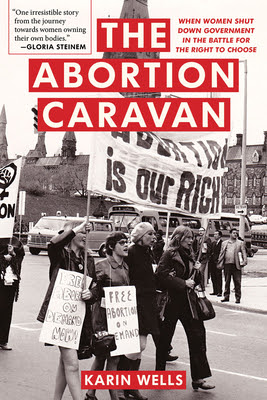
NetGalley ARC | The Abortion Caravan: When Women Took to the Streets, Shut Down the Government, and Battled for the Right to Choose


I received a free digital ARC from the publisher via NetGalley in exchange for an honest review.

Rating ⭐⭐⭐

It kind of bothers me that I was not as hooked by this one as I thought I would be. I am not sure if it was the writing style or what. It was very dry, I felt. Maybe it was because it is the story of reproductive rights in a country other than the one I live in. I really don't know. The story is an important one though, and that is why I continued reading, even when it became more of a chore than anything else.

The idea for the caravan began in January of 1970 and the Vancouver Women's Caucus began putting together a plan for how best to petition the government to bring about the legalization of abortion in Canada. It is important to remember that this was, of course, long before social media was a thing. Even long-distance calls were not common - or cheap. Yet even with these challenges, a group of seventeen women left Vancouver, a collection of women from various walks of life all crammed into a convertible, a VW bus, and a truck. Over the course of their journey toward Ottawa, the women made stops in various towns and cities to get their message across, hold rallies and give speeches, to gather support, and to draw more attention to the cause they fought for - the fundamental right for a woman to have control over her own body.

The journey was not easy and there were squabbles among the women traveling, arguments sometimes that threatened to pull their mission apart. But even so, day after day and mile after mile, they continued on, knowing their purpose and their end goal was so important. Thousands of women died each year from botched abortions performed by back-ally doctors who were not often actual doctors. It had to end, and abortion had to become legal and SAFE.

After over 3,000 miles the Abortion Caravan reached its destination - Parliament Hill in Ottawa. There they staged their grandest performances yet, drawing the attention of the entire country. The women camped out on Pierre Trudeau's lawn in protest and managed to infiltrate the visitor galleries of parliament and chain themselves to their chairs, demanding that their voices be heard. Parliament was effectively shut down as a result, but their efforts worked in the long run. While the Abortion Caravan became a unifying symbol for women across the whole of Canada who believed in their right to be in charge of their own bodies, it would take another 18 years for reproductive rights laws to officially changed. In that time doctors were performing abortions, and were often charged with the 'crime', but were often also acquitted.

Over all the book was very informative, but simply not told in a very engaging way and I really had to force myself to finish reading it.