Monday, May 30, 2016

Monday Meme!

 :

From the time I was young, Little Women by Louisa May Alcott has been among my most favorite of books. As I grew older my tastes changed, from the Baby-Sitters Club to Fear Street, and finally it has evolved into almost exclusively reading non-fiction as an adult. But time and again, I know that the most comforting and wonderful of books for me will always be Little Women. I own at least fifteen different copies and can never pass up the chance to snag a new one.

Books in general are of great comfort and refuge, and can accompany you anywhere. Which book in particular provides this for you?

Sunday, May 29, 2016

The Phantom of Fifth Avenue: The Mysterious Life and Scandalous Death of Heiress Huguette Clark

18453221

Rating: 4 Stars

Basically this book shows you that everything you think is probably true about people that you wish was not actually true, is true.

Is that a sentence?

At least it makes sense in my head. People are selfish and manipulative and will do whatever they can to cash in on an inheritance that does not belong to them, all under the guise of 'caring for a family member'. What bullshit.

Having first read Empty Mansions by Bill Dedman, I feel like both are well-written and engaging. I don't really recommend one over the other and think that if you are interested in the strange life and sad death of Huguette Clark, you should read both.

This book doesn't just cover the end of Huguette's life when she voluntarily chose to leave her number of homes and live in Beth Israel Hospital. Instead, the author traces Huguette's life from the start - her life in Paris, growing up in Butte, Montana, the family's home in Santa Barbara at Bellosguardo, and the main residence on Fifth Avenue that stood for only eleven years before being torn down after her father's death. By all accounts, Huguette was an active social - albeit shy - young lady who  enjoyed the life that her robber baron of a father provided with his copper fortune.

So what changed?

First, Huguette's beloved older sister Andree died of meningitis at 17, when Huguette was only 13. I feel like this was really the point that changed Huguette and her mother. Then her father passed away in 1925 - but not before imparting this gem on his youngest daughter: "No one will love you for who you are. They will love you for your money." It seems like a harsh lesson to have dropped on such a 16 year old, but he was not wrong. As Huguette neared the end of her life, family members from her father's first marriage seemed to come out of the woodwork to get their hands on her inheritance - despite the fact that they had all already received their shares of the family fortune. Not that anyone else in Huguette's life was any better. Her nurse, doctors, the hospital, her lawyer, and accountant - all of these people just wanted her money and it was painfully obvious that the only two people in her life who were not gold diggers were her goddaughter Wanda and her assistant Chris. I get the fact that there was concern about elder abuse, that Huguette might be a hostage of some kind and being coerced into giving her money to those around her. However, her money-grubbing family members had no footing on which to claim they were looking out for her best interests.

There are so many aspects of Huguette's life that are intriguing and tragic and heartbreaking. The whole 'eviction' notice from her father in his will was awful. So, basically Clark spent a ton of money to build this house that everyone said was ugly. I thought it was beautiful, and wish all these old mansions still existed as a testament to this bygone time.


"The public be damned - William Clark was happy with his new home" (page 82). I'd agree with the sentiment.

Huguette and her family lived in the house for only eleven years and then it was demolished to make way for apartment buildings. Huguette and her mother moved into an apartment and slowly but surely withdrew from their once active social lives. They stopped visiting Bellosguardo in the 1950s, but continued to maintain the home at a cost of $1 million per year. Were they just so dependent on one another, or was it more so that Huguette was terrified of losing the last person she loved and cared about, and so they kind of wrapped themselves in this cocoon and never went anywhere or saw anyone because they were so afraid of losing one another? I don't know. And now, after Huguette passing in 2011, we will never have the answers to any of the questions we might have about what made Huguette behave the way she did, make the choices that she did, and ultimately end her days in a hospital as a healthy individual who could have gone home.

In the early 1990s it was discovered that Huguette had skin cancer and she was taken to the hospital, from which she would never leave. This is another issue that will never really be resolved - why would she refuse to go home once she was cancer-free and healthy again? The author contends that while change was difficult for Huguette, once she discovered this new world she could live in and have limited contact with other people on her own terms, she did not want to return to her home.

The problem became that everyone she came in contact with after her arrival and subsequent stay in the hospital, they are wanted her money. It is absolutely disgusting how these people behaved. Huguette's close friend Suzanna helped to hire a full time private nurse named Hadassah, who for many years worked 12 hours a day, seven days a week to be with Huguette at the hospital. So apparently, because Hadassah agreed to Huguette's outrageous terms, she felt entitled to every penny she could get out of her employer? Whether that was the intent or not, that is exactly how she comes across - especially with the issue of this check for $5 million that she felt she was owed because Huguette has promised it. THEN she and her husband had the nerve to be pissed that they did not have the money when they wanted it. It's all just so gross.

If you are in any doubt about how yucky these people were in grubbing for Huguette's money, here are a few gems from the book:

"What Hadassah learned was that if she simply mentioned her problems to Huguette, her wealthy and healthy patient would reach for her checkbook" (page 245).

"The secret of Hadassah's salesmanship was that she never had to directly ask for anything. All she had to do was discuss her concerns over the high cost of private school (and the college) for her three children; Huguette began paying not only the tuition bills but the cost of after school activities" (page 245).

The hospital staffers were no better, from the CEO to her doctors, they all wanted money for the hospital. They were constantly coming up with ways to mention to Huguette that the hospital was in need of donations; one doctor even used his own mother to spend time with Huguette in order to try and get money that way. All of these people were taking advantage of her kindness, and had not done anything to deserve the thousands and thousands of dollars she gave to them. At first they were keen to send her home, but when they realized how much money she was worth, it is pretty clear they wanted her to stay to keep the money coming in.

"The nurse was not alone in seeing dollar signs above Huguette's hospital bed; the administrators and doctors running Beth Israel Hospital wanted their share, too" (page 264). Except, wait, they were not entitled to her money just because. Again, so disgusting.

So many of Huguette's actions I simply do not understand. Perhaps it is because she had so much money her entire life to do whatever she wanted with, that $1 million meant nothing to her? For example, she never took any legal action when she was wronged. Was it really that terrible to have her name in the papers, that she would rather just let the money go than claim what belonged to her? At one point, "Even when she was wronged, she refused to sue. Citibank had informed the heiress several years earlier that more than $5 million worth of jewelry, including her mother's wedding ring and a magnificent bracelet adorned with sapphires and diamonds, had been pilfered from a custodial account at a bank branch" (page 259). How does this happen? I don't understand. THEN, on top of that, the remaining pieces that had not been stolen had been put into a new safety deposit box, which was 'inadvertantly' listed as abandoned and the rest of the contents sold at auction. These were family pieces that Huguette had thought were safe, and twice she was robbed. But again she did not choose to sue. Instead she accepted a monetary settlement for far less than the pieces had been worth. It's just so sad that all these terrible things kept happening to Huguette and she continued to just grin and bear it.

So, in the end, the book paints a pretty grim picture of a woman who was completely surrounded by vultures. Even so, she continued to spend her time as she wished, creating grand art projects that occupied her time up until the very end. Perhaps she did not mind people constantly asking for money? Perhaps it really meant nothing to her. When her attorneys continually tried to get her to sign a new will (her previous one left her inheritance to her mother), she was reminded time and again that without a new will, the descendents of her half-siblings would get her money. And still she refused to entertain the idea of a new will. It doesn't make it right that they all came after her money anyway, but still.

Anyway, Huguette Clark is a fascinating figure. The people around her will infuriate you with their greed. I would like to think that she was mentally competent to be signing these checks, and that all the money really did mean nothing to her. Above all, I hope she was happy with her choices. Highly recommended.

Saturday, May 28, 2016

The Bible: A Biography

520771

Rating: 2 Stars

Man, this book was dull.

Considering the fact that the topic is one of the most important books ever compiled, you'd think the history could be put together in an engaging way. It's not. There is a ton of information in this short volume, but it is so haphazard and random that I don't even recall anything I learned. My total lack of interest could also have to do with the fact that the author needs a thesaurus because she used the word 'exegesis' or a variant on every single page. It was the worst. You could make a drinking game out of how many times she uses it, and you would be hammered after the first third of the book. 

Don't bother with this one.

Summer Reading!

UPDATE/EDIT:

So after visiting the library today, I found out from one of the librarians that we could actually start the Summer Reading Program on May 15th - that's the day the site opened to start adding books and hours, and collecting badges. WHAAAAAATTTT??!! 

So, I upped my goal from 35 books for the summer to 50, and went back to look on Goodreads for all the books I had read since May 15th. I am at 11 so far. I also had to try to figure out my actual reading hours, which is not easy because I am trying to account for the last two weeks.

Happy Reading!
Sarah


It's that time of year again! I am super excited, mostly because I am super competitive and I love to read (duh!). I have set my summer goal a bit more modestly than my Goodreads goal.

Summer Goal - 35 Books

Goodreads Goal - 250 Books

Although the official start date is listed as June 1st, everyone has already started. The requirements for the OPL Program is to read 10 hours. I have obviously already surpassed that, as I started a couple days ago. You also have the chance to collect badges, which for every I believe three badges up to a certain amount, you get your name entered into the drawing again. I don't really like this, basing it on hours read. I wish it could be based on the number of books read, as it was my first time participating. And this whole badge thing is also kind of hard to keep track of, because half the time I forget to check and see which badges I qualify for. Plus, it is easy for cheaters to just go enter a bunch of badge codes, because a lot of them are listed on the website. Mostly, I am doing this to be competitive and I love to read.

Happy Reading!
Sarah

The Far Traveler: Voyages of a Viking Woman

1631447

Rating: 3.5 Stars

Gah! I really wanted to love this one, because if you have been reading my blog, or know me at all, you know that bad-ass women are among my most favorite topics - hellooooo Boudicca and Eleanor of Aquitaine! Gudrid would certainly qualify as being pretty bad-ass herself, but the author just could not let the story tell itself and she had to push and pull it along and put herself into it and just, argh.

So, anyway.

This text tells the story of Gudrid, an extraordinary woman we know about because of the Icelandic Sagas, but who no one thought really existed. Or, sure she existed, but the details of her life simply could not possibly be true. However, 15 years ago archaeologists discovered a Viking long house buried in a hay field in Iceland, exactly where the sagas stated that Gudrid had lived and cared for her family. Prior to this book, I had no idea who Gudrid was. My own experience with the Vikings has so far come in the form of my poor, dear Anglo-Saxons constantly being harangued and sold as slaves by those nasties from the north. I know very little of the sagas, Leif Eiriksson, and of course Gudrid. Until now.

The problem is, though, that we will not really know FOR SURE if this is Gudrid's house. Those involved in the project were even slow to identify it exactly as yes, this is her house. The author is very enthusiastic about her topic and that is good and necessary, but it can also be a bit deceiving. I myself want to believe that the excavation did uncover Gudrid's former home, but in truth we simply can not know for certain. However, I think at least we can say it is LIKELY to be her home, given the accounts as told in the sagas. And truthfully, I really, really want it to be her home. I want to visit the land and see it someday. Unfortunately, once the excavation was completed for the season, photos taken and any artifacts accounted for, the home was recovered and buried again beneath the sod. Perhaps this is as it should be, it should be left to return to the land it came from, but part of me just wants all that history out in the open so we can see it and walk around it and learn from it. And really, I just love history too much to see it waste away back into nothing. Iceland's government does not share my opinion: "But as for digging on purpose in historical spots, the official opinion is that Iceland's history is far safer left in the ground" (page 43). I get it, because archaeology really does destroy some of the history it is aiming to preserve, but just think of everything left undiscovered.

The book is not without major issues though, no matter how engaging the topic. It is always frustrating to me when the author has a really interesting story and they go and ruin it by making themselves PART of the story. I was not interested in the author's own experiences, I wanted to know about Gudrid. The problem is, of course, having enough material to actually complete a book and thus it became necessary for the author to share said experiences when she participated in the excavation of the long house (another point of contention, by the way. Though, at least the author had the common sense to address this - how she, someone with no archaeological experience, was permitted to work on such an amazing find and make judgments in the spur of the moment of what ash to keep and what to discard. That is unreal to me). I get it, I understand the author is as fascinated by Gudrid as I am, but I wanted this to be Gudrid's story. It was not entirely.

I also find it problematic when authors recreate conversations about their topic in nonfiction texts. This really is something that bothers me beyond belief and maybe I am just being nit-picky but I don't care. Unless the actual conversation was recorded and the author could refer to it and write it word for word in the book, I can do without that nonsense please. It gives less credibility I believe.

Another issue plaguing the book was the fact that it jumped around in time constantly. This occurred within the same paragraphs and I found it rather distracting. For example. there is a paragraph on page 223 that starts out talking about Gudrid making clothing for her family, then suddenly the paragraph morphs into the techniques being used today at Copenhagen's Center for Textile Research. This happened a lot and I feel like the book would have come across as better organized if this jumping around had not occurred - at least not within the same paragraph.

The problem, overall, is that there really is not a lot of information to go on about Gudrid aside from the snippets even mentioned in the sagas. This book is supposed to be at its heart about Gudrid, this amazing woman who traveled all over the world, from Vinland to Greenland, to a pilgrimage to Rome, and yet it is not. This instead is just as much about the time period in which she lived and she merits a mention because she was a woman making the dangerous voyages typically reserved for men at the time. You might go pages at a time with information of the period but not one single mention of Gudrid. The positive in that is that it piqued my interest in the Vikings, their Sagas, and their exploration of the West, but left me feeling very unsatisfied in the pursuit of knowledge about Gudrid.

Also, for the record, I can't take an author too seriously when she describes a boat as "humping the waves". Just sayin'.

Overall, go into this one realizing that it will not be about Gudrid. it will be about the Vikings, their long houses, their sheep, the Inuits, and everything else related to the time period of Viking exploration. You will have glimpses of this woman through time, but will be left wondering, with more questions than answers. Still, worth a read to get even those glimpses.

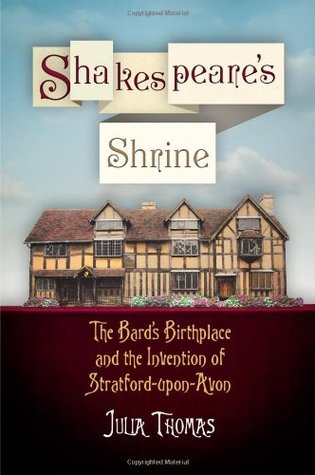
Shakespeare's Shrine: The Bard's Birthplace and the Invention of Stratford-Upon-Avon

13792737

Rating: 3 Stars

Oh you funny Victorian tourists. 

I feel like I should have liked this one better than I did. I think perhaps the reason is, is that the writing was kind of dull at times. I am not particularly interested in Victorian England, and that is really when Stratford became Stratford. So, there's that.

The book, however, does a fine job of tracing the history of the home. The author introduces us to the house in Victorian times, traces the ownership and the task of authenticating it, as well as restoration and the habits f tourists writing their names on the walls. (Yeesh!) It just was not done in a very engaging way to me, and again this could go back to the fact that the place came to be what it was during the Victorian era and nothing makes that interesting to me, unfortunately not even Shakespeare.

I appreciated the fact that there were numerous photographs, carvings, etc. It would have been nice to see these in color though, and not printed directly on the page with the text so they remained in black and white. Or, black and cream, as the pages were not white. The author also had quite an exhaustive list of notes and bibliography that runs some 40 pages. The research is there and it shows, but still it was kind of a struggle to finish this one. That bummed me out, given my Shakespeare obsession. I wanted to like this book a lot better but in the end it was just much more dry than I care for. I don't mean it was overly academic, because I do enjoy my academic texts as much as the next nerd, I really just think it is because the Victorians bore me to tears.

So, give it a go. There's tons of history and information about how that little house in Stratford-upon-Avon became what it is today. Perhaps you will enjoy it more than I did.

Friday, May 27, 2016

Shakespeare's Freedom

8865703

Rating: 3 Stars

Do not be fooled by the slimness of this volume. This is by far Greenblatt's more academic work relating to Shakespeare, as compared to Will in the World (also very good though, from what I hear. It's on my to-read list, I hope to get to it soon). This might come as a surprise but there is a ton of information packed into this one, despite only being 160 pages. Greenblatt explores the themes of beauty, hatred, power/authority, and autonomy and he does so well, almost too well.

I think I would have rather heard this as a lecture instead of reading it, as it is a bit dry. However, it is interesting nonetheless due to the content. It is not yet another book about what we *might* know or suppose happened in Shakespeare's life. Instead, Greenblatt looks at his plays and uses them to explore said themes as mentioned above. It might bother some that some of the lesser-known (if there is such a thing) plays are used as opposed to say, numerous obvious examples from Hamlet or Romeo and Juliet, etc. This is a must for any Shakespeare fan, but probably not as enjoyable for the casual reader.

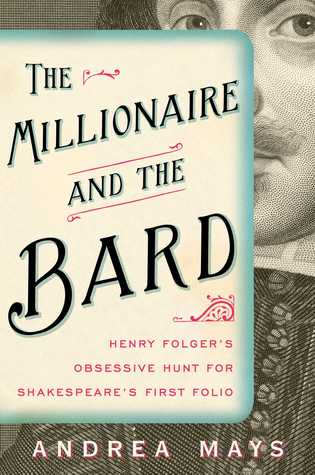
The Millionaire and the Bard: Henry Folger’s Obsessive Hunt for Shakespeare’s First Folio

22609466

Rating: 4 Stars

I first have to note that I picked this book up at the museum here while the First Folio was on display as part of it's tour for Shakespeare400. It is the most beautiful book I have ever seen in my entire life. Unfortunately we were, of course, not allowed to take pictures, but you can bet I was standing over that glass case every chance I had that someone else was not waiting to view it. It was open to Hamlet's "To be or not to be" soliloquy and I must have read the words a hundred times in the two visits I made to the exhibit. If it has not yet come to your state and will be soon, you must see it. It is completely worth whatever museum admission fee you might pay. It is absolutely breathtaking.

More than anything, this book makes me want to see the Folger Library and bask in the glorious beautiful of so many Folios in one place. Unfortunately they are not accessible to the public and that is terribly disappointing. I do not think I qualify as a special enough scholar with the exact credentials needed to gain access. What a pity.

I understand being obsessed with things, being so obsessive that I have to collect everything possibly related to whatever the subject is. Unfortunately, I will never have the funds to fuel any kind of obsession the way Folger did. He was able to spend obscene amounts of money to secure more First Folios than any other collector in the world, on top of playbills, paintings, and all sorts of Shakespeare-related items. Not only that, but he then proceeded to construct a temple to house his treasures that still stands to this day, one of the foremost authorities on the greatest writer to ever live.

The book begins with a jaunt through the life of Shakespeare, which of course makes sense. Without him, Folger might instead have been collecting the works of Jonson or Marlowe. The bulk of the text though relates to that first purchase that Folger made, then his subsequent quest to collect every Folio he could find - regardless of condition. Like Folger, I am of the mindset that condition does not matter. To have as many copies as possible would be the ultimate goal. Not to mention all the lose pages - it's even mentioned at one point that it may be possible to create another two or three Folios just from said loose pages. This is completely fascinating to me, to see all of those documents and books together in one place.

While I enjoyed the book over all, the actual portions dealing with the acquisitions of the each major Folio were a bit dry and took me the longest to get through. I'm not quite sure why, it is not a poorly written book and the there is no sudden change in style. Perhaps it is again that aspect of money, and knowing that there is no way I will ever be able to indulge myself in anything of interest quite the way Folger was able to in his lifetime? Who knows. But, either way, this section did take me the longest to get through and it has never taken me so long to read a book related to Shakespeare before.

The text really picked up for me again once Folger began planning his grand library and I was anxious to see how it would turn out. The fear he would pass away before it was complete unfortunately came true as I worried it might. But, his wife Emily was there to carry on the dream and I was at least glad to see that the library was completed in her lifetime. I do not find it strange, as the author kind of thought people might, that Henry and Emily Folger are interred in the library that bears their name. it makes complete sense to me that this would be their final resting place, surrounded in death by the collection that was so important to them in life.

One issue I take with the book is the idea that Folger was 'rescuing' the Folios. First and foremost, Shakespeare belongs to England. To think that he and his words would be better taken care of here in the US than in his native England seems kind of pompous. I do not think that was Folger's intention, to be that pompous. Or maybe it was, but as the text states, "His was a selective and singular madness" (page 276) and I think his intent was solely to collect s many as he could. I can understand why the English took issue with the great robber barons of the day rummaging through the cabinets so to speak, and carrying off anything of value that they could find.

Two more quotes I found interesting:

"At the library that bears his name, there is little remembrance or recognition of Folger's other life, the one that paid for it all" (page 273)

and

"In a library filled with signs and symbols that evoke the age of Shakespeare, there is none that evokes the industrial age of Henry Folger" (page 273).

It is unfortunate that in Folger's triumph in giving the world this library, he himself is largely forgotten. We tend to look back now on the industrial age somewhat negatively, to look at the likes of Rockefeller, Vanderbilt and Morgan as these robber baron-esque types who were only concerned with making money for themselves. While Folger certainly was part of that age (he worked at Standard Oil for Rockefeller), he was also a philanthropist and his library is the proof. He could have kept his collection private and never shared it with the world. He chose not to. And so, his and Emily's legacy will live on. Highly recommended.

Game of Crowns: Elizabeth, Camilla, Kate, and the Throne

18775308

Rating: 4 Stars

This really is not a book that needed to be written. It is full of all the usual gossip we have been hearing about for years all the crap about Camilla (barf) and Charles (double-barf) carrying on with their affair, Harry not being Charles' son, Elizabeth and Philip being cold and unloving parents, etc. On the other hand, it is exactly what you would want and expect if you are obsessed with the House of Windsor. It is every tabloid article ever, condensed into a book. I am kind of embarrassed to say that I plowed through this one in about three and a half hours, I just could not put it down. That does not mean the content is academic, or that it is a great literary work, but if you love to read about the royal family, it does serve its purpose. Unfortunately I am part of the problem, as if people would stop reading this kind of stuff, then there would be little incentive to publish it. And perhaps William and Harry especially could be regarded as real people, instead of being gawked at all the time.

Basically, the book looks at Elizabeth II, Camilla, and Kate, comparing the women and how they are shaping the future of the throne. Elizabeth, of course, is the longest-reigning monarch in British history. Camilla is a home-wrecking devil, and Kate is the one everyone would actually want to become queen after Elizabeth. Time and again the author addresses several facts regarding Camilla and Charles; how many would rather see William become king next, that Charles said Camilla would never be crowned but has since gone back on his word, etc.

Really, this review is about to become a diatribe against Charles and Camilla and cheating. This book just reiterates the fact that they're both terrible people who deserve each other, and unfortunately Diana suffered as a result. Not only that, but William and Harry suffered greatly as well. Can you imagine, week in and week out, your family's personal affairs being splashed all over the pages of every newspaper and magazine around the world? Is anyone surprised that Harry acted out the way he did? He had the luxury to do so, something William was never afforded - being third in-line and all. Diana and Charles' whole marriage was just so heartbreaking, and Camilla and Charles seemed to enjoy the game, it is just insufferable. And then to try and make Diana look as though she was crazy? I know Diana was not perfect and she certainly had her own flaws, but how much of her behavior was brought on by the way Charles treated her? Ugh, just yuck.

I wish once an for all this whole issue of who Harry's father is could be put to rest. The author points out at least twice when Harry was looking "less like a Windsor and more like a Hewitt". We get it, Diana had affairs too. It's a big deal because Harry is 5th in line to the throne. But there was reportedly a paternity test done - though of course whatever results they wanted to report could be stated as truth and we would never know for sure. I'd like to think at this point however, the truth would be out. And perhaps it does not even matter. Or perhaps Harry knows the truth and Hewitt is his father. Really, it is not our business. It's just not fair to Harry, either way. He's had this hanging over him his whole life and probably will forever. I'd like to think he knows for certain, so at least he has some kind of closure and peace of mind.

While the book as a whole is pretty tacky, one part I truly thought was weird was the imagining of Queen Elizabeth's death. It was weird and I did not like it. This author did the same thing in one of his books about JFK Jr., imagining the last moments of his life before his small plan crashed in the ocean. It's creepy and weird. We get it, Elizabeth will (likely) have to pass on for either Charles or William to become king, but it is not something we need to plan out. That's the kind of thing that would get you executed in Henry VIII's day. As an aside, the idea of abdication is an interesting one. It would be fabulous if Charles would abdicate. William is much more popular, and younger, and Kate is far more queenly than Camilla. I mean, as queenly as a 'commoner' can be of course, right? And seriously, no one wants to see Camilla as queen. No one. Nor do I really want to see Charles crowned king. The author insinuates should this happen, it might mean the end of the House of Windsor. That would not be such a great thing.

So, in the end, this is nothing more than gossip at both its best and worst. It's a very new publication (my library system just got it this month), so it is the most up-to-date as can be, outside of daily and weekly gossip publications. Please though, do not spend the money on it. If you are, like me, part of the problem and have to read it, check it out from the library instead. Everyone is manipulating and conniving (except William and Harry - there's actually very little mention of Harry at all), even Kate's family. You'll thank your lucky stars time and again to not be born into the House of Windsor.

Monday, May 23, 2016

Monday Meme!

Library:

Heaven will be a kind of library much like what Belle found in Beast's castle, I believe.