Showing posts with label Juana and Katherine. Show all posts

Thursday, March 30, 2017

First Line Friday Non-Eleanor Edition III


First I would like to say my apologies for not making it around to all of the blogs last week, especially those who commented here. I hope everyone saw my quick note about having gotten a concussion last Thursday and being unwell in the following couple days while the headaches and nausea did their work and finally subsided. I will be much more functional this weekend and make it around to see what first lines you've all chosen.

Happy Friday! it has been rainy all week and I am excited to do nothing this weekend except read and work on my book. Of course, I am trying to hack my way through my TBR list while still researching and writing about Eleanor of Aquitaine. A couple months ago I was incredibly lucky to have received a copy of my book for this week from Amberley Publishing. Unfortunately the file format was kind of wonky and I could not adjust the size of the words to read with ease. So naturally I did the next best thing: I submitted a purchase request to my public library and finally got my hands on the physical copy a couple weeks ago.

Totally. Worth. The. Wait.

29139385

I love Catherine. Truly, completely am in such awe of her strength and intelligence, and how she held fast to the title that was rightfully hers, Queen of England. She did, after all, learn from her mother - the indomitable Isabella of Castile and it is tragic and heartbreaking not only that Catherine and Mary were separated after Henry's break with Rome and subsequent marriage to the Concubine (Chapuys' words, not mine), but that even in illness and the face of death, they were never allowed to see one another again.

This week's first line is actually three sentences, because I do what I want:

"This story begins with a map. A map that depicts a world that no longer exists; a map painted on paper that has itself disappeared - burned, lost, drenched or reused at some point in more than five hundred intervening years."

Leave a comment below about my line or feel free to share one of your own. Then take a look at what my fellow First-Liners have for you this week.


Rachel - Bookworm Mama


Lauraine - Lauraine's Notes

Andi - Radiant Light


Robin - Robin's Nest


Kathleen - Kathleen Denly


Happy Friday and Happy Reading!
Sarah

Monday, September 5, 2016

Princesses Behaving Badly: Real Stories from History — Without the Fairy-Tale Endings

17412780

Rating: 2 Stars

I originally rated this book 3 stars, but time away from it has given me a better perspective and I am debating between 1 and 2 stars even. Really, this book was not very good. Perhaps I felt inclined to give it the original 3 stars because within the first chapter there was a subsection about fierce queens from Antiquity and a page devoted to Boudicca. I would have liked to see a blurb about Eleanor of Aquitaine (though she did not live during Antiquity, I know), because she certainly bucked tradition in her life time with the way she took control of her life to end her first marriage and begin her second within weeks of returning home to Aquitaine (and most likely, she had been planning it long before).

But the more I thought about it, and looked back over the few notes I took while reading, I had to accept the fact that while parts of the book were entertaining, by and large the princesses were never really made to feel like real people. The author relied a lot on the myths surrounding these women and did not do a decent enough job separating the two. I guess I would have been more willing to rate the book higher had the two been more clearly divided. Perhaps even presenting the myths first and then following up with what was true in the myth, why the myth grew to overtake the facts we do know, etc. But there was none of that and so the author does herself a disservice, and her readers as well.

Immediately in the introduction, I had some misgivings about the book. Even in the table of contents, the author referred to Isabella of France (wife of Edward II, more on these two in a minute) as a she-wolf. It was at that point I already expected much of the book to be a regurgitation of gossip and nonsense. She-wolf was not a compliment at that time, and using it now without explanation is no better.

While still in the introduction, I found it kind of ridiculous that the author would call her book 'Princesses Behaving Badly', and then rant against Disney Princesses and these cultural and gender norms that exist in society now. Why would these princesses in the book be considered to be 'behaving badly' then, unless the expectation of the behavior was the opposite, and more Disney-like? The message there is already mixed, and nothing is ever done to clarify it.

Back to Isabella and Edward II. Edward was not the king his father and grandfather were, nor his son Edward III would become. I have always felt a bit bad for him, as he enjoyed activities that were considered beneath a king, but he made his own problems as well when he let his favorites sway his opinion and policy. Piers Gaveston was a terrible influence on Edward and there will be speculation until the end of time about whether or not Edward was gay and Piers was his lover. What matters in that bit of information is that Edward never bothered to at least pretend that Isabella mattered, and from their wedding day on it was clear she was of no importance to him - considering the fact that he gave the jewels she'd brought with her to Gaveston, and Gaveston sat with Edward at the coronation, in what should have been Isabella's place.

This quote was one of a few that really sealed the deal for me on how untrustworthy the book is:

"When Gaveston was around, Edward was worse than useless, barely able to hold a conversation, much less govern. When Gaveston wasn't around, Edward was a wreck" (page 79).

This seems a bit...sensational, don't you think? I was interested to read the chapter on Isabella, but it ended up just being a rehashing of rumors and gossip. In looking at the bibliography for this chapter, I found that the author only used one book, Helen Castor's 'She-Wolves: The Women Who Ruled England Before Elizabeth'. That in itself is kind of shady, to use only one source. and Castor's book is definitely not sensational and gossipy. I mean, it has its moments, but it was still well-researched and I liked it. Isabella's behavior was more then justified, by our standards today anyway. As far as we can ever really know, Isabella and her lover, Roger Mortimer took power and eventually Edward II died in captivity under dubious circumstances. At the time her behavior was considered unacceptable, and that is why once their son, Edward III came to power, he had Mortimer executed and Isabella basically under house arrest for the rest of her life.

Basically, the book started out decent, but even after the rough introduction I had concerns. By page 55 when the author referred to Tuthmosis III as 'T-III', I just could not take her seriously. There were some solid stories but over all this is more entertainment than academic. That is not a bad thing necessarily, but it is problematic when myths are presented as fact. If there was not enough factual information about someone available to us today, then perhaps that is a sign that they should not be the subject of a book.

Take it or leave it, but keep in mind its shortcomings.

Tuesday, August 25, 2015

The First Queen of England: The Myth of "Bloody Mary"

2752070

Rating: 5 Stars

Review:

This is one of the best biographies I have read this year. It is all the better for me personally in that it is a much more balanced look at the first queen of England, Mary I. I have always found is heartbreaking in that she is so overshadowed by Elizabeth and her reputation so blackened by Foxe. It is s though even in death, she has continued to suffer at the hands of others, 500 years on. Mary went from both parents doting on her (as much as parents - especially royal parents - did in the 1500s), to being taken first away from her mother, the incomparable Katherine of Aragon, to slowly but surely having nearly every person who ever mattered to her taken away one after another. It can't be a surprise to anyone that she turned out the way she did/ Time and again she was subjected to terrible psychological torture as her father first separated Mary from her beloved mother, and then continued to force her hand in accepting the divorce of her parents. And you only have to look at the cruel execution of the elderly Countess of Salisbury and what can only be described as her state-sanctioned murder that was botched horribly, to see how this mental torture continued for Mary. However, I do also feel like the saying that references 'how Mary turned out' is not entirely accurate, as I feel like after reading this, a lot of peoples' perceptions of Mary will be quite different. There is no doubt that the religious aspect, the executions that gave her the nickname 'Bloody Mary' later on, had a major impact on her reign. But so often people are then willing to overlook, or do not know about at all, the similar experiences under the reign of Elizabeth.

I feel like this book was very all-encompassing and did not only look at Mary herself, but how the world around her impacted her life. We are privy to her life from birth, through her briefly happy childhood, to the horror of the divorce and being forced to attend Elizabeth, reconciling (so to speak) with her father, being subjected again religious battering from her brother, her triumphant ride into London to take the throne from her cousin Jane Grey, the subsequent terrible marriage to Philip, phantom pregnancies, and finally her death. (As a side note, this book presents quite possibly the saddest line I have ever read in regards to Jane's execution: "Then the axe fell swiftly and cleanly and this hideously manipulated, unloved slip of a girl was gone." UGH! It still gets to me.

Mary's marriage and phantom pregnancies are especially heartbreaking to me. As a young woman she had assumed she would end of not marrying. Then she becomes queen and it never occurs to any of her counselors that she can or should remain unwed. It seems fairly straightforward to me why she clung to Philip and the marriage so tightly, and why she wanted so desperately to be pregnant - from the time her mother passed away (and even before then, really, once they were split up), Mary had no blood family to call her own. Being married and having a child could have been a way for Mary to fill that void that had existed so long within her. I don't know how to describe it but heartbreaking. You can't help but have wanted her to have a child, to overcome everything terrible in her life that had occurred in her earlier years. I can't even imagine how devastated she was.

All in all, this is a superbly written account of a queen who deserves a second look and deserves much more respect than she has gotten in the centuries since her death. Porter gives a much more balanced and unbiased account of Mary's life. It is highly recommended for those interested in the Tudor era. As an additional note, I recently read somewhere that because of the way their tombs are designed, with Elizabeth's on top of Mary's, that Mary's is in danger of being crushed under Elizabeth's. This would be tragic, and yet one more time that Elizabeth gets the one-up on Mary. I hope this can be rectified before it is too late.

Saturday, May 16, 2015

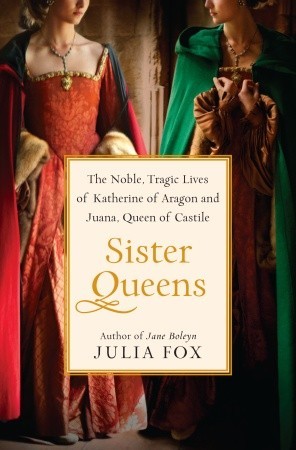
Sister Queens

11848081

Rating: 5 Stars

Review:

This is quite easily the best biography I've read so far about Katherine. Perhaps that's because she's presented fully as her own person from childhood, sharing the page only with her sister and not Henry's subsequent wives.

Prior to this book, I knew nothing of Juana except that she was crazy. How wrong I was. Juana has been done a terrible injustice and this text does well to clear her name. That's not to say she wasn't shrewd or even manipulative, but certainly not 'mad'.

Heartbreaking is really the only way to describe the lives of these two women. Katherine's story is one I know well - at least from the time she arrived in England as Arthur's intended bride. I can't imagine being separated from my daughter, and yet she endured. What choice did she have? Is it then any wonder that Mary became the monarch she did? This should surprise no one.

Juana, on the other hand, is equally as heartbreaking a story. Manipulated and discredited by both her husband and father so they could steal the throne that was rightfully hers, then all but forgotten by an indifferent son, the Holy Roman Emperor Charles - who in turn championed his aunt Katherine's cause for so long.

This is a beautifully told story, one I could hardly put down. Here are two women who history has not been kind to, finally getting the recognition they are due, having their stories told based on contemporary writings from those close to them. It is a compelling story, highly recommended and well worth the time.