Reviews, recommendations, memes, and general book-related musings on my favorite topics.
Thursday, March 20, 2025
NetGalley ARC | Clan Battles: Warfare in the Scottish Highlands in the Late Middle Ages

Tuesday, January 3, 2023
Book Review | Heroines of the Medieval World

Monday, January 2, 2023
Book Review | Dracula, Prince of Many Faces: His Life and His Times

Saturday, June 18, 2022
Excuse Me While I Brag...

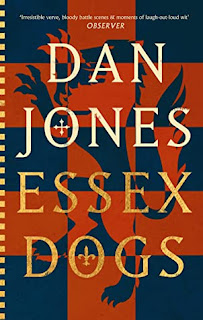
Isn't it so pretty? And it is ALL MINE!
A couple days ago on his Facebook page Dan Jones posted that Essex Dogs was available on NetGalley.
I thought, "FINALLY!" and went to request it.
Silly me, it is on the UK site but not the US one.
I told Dan this on the post in a reply to his post...
...And now I have a digital copy of my very own!
(I did already pre-order it anyway, but I am not patient and want to read it NOW.)
I know you're thinking, "But Sarah! It's HISTORICAL FICTION! You HATE that nonsense!"
That's true.
However, I heart Dan Jones more, and I trust that he will be as authentic in his portrayal of these lives and events as he is thorough in his research and writing of his non-fiction texts.
Happy Reading!
Sarah
Saturday, June 19, 2021
NetGalley ARC | The Brothers York: An English Tragedy

Saturday, December 15, 2018
Marco Polo

Overall, I probably learned more about the period as a whole, specifically daily life in Venice, and China under the Mongol rulers, but that is actually kind of what I expected. So little is really known about Marco Polo's life that there are some who questioned whether or not he even existed, while others strongly try to refute the fantastical claims Polo wrote in his travel journal. But...what if he wasn't exaggerating? Why couldn't those numbers have been accurate? Or, at least fairly close to the actual numbers he gave? It's obvious that while most of Europe plummeted into at least some decline with the fall of the Roman Empire (let's stop calling it the Dark Ages though, okay? Plenty was still happening), the far East experienced no such turmoil. There was no comparison at that point between China and much of Europe, as the former was far richer and far more advanced (paper money, anyone?), simply because Western Europe had more catching-up to do. Even into the 1200s/1300s in Venice, where Polo was from, life was not easy. "Life in Venice could be very hard, especially for women, the poor, and anyone who was out of favor with the authorities. Slavery was common, and master frequently abused their female slaves. Women were second-class citizens, and social customs underscored their status" (7%).
I really appreciated the specific look at merchants and how they conducted business. Typically I am reading about the royal families of the period, so I have little background knowledge of how various merchants carried on their business, so I found that knowledge helpful. The author looks at Venetian merchants specifically, and notes that, "Of necessity, the merchants had to deal with a variety of currencies...The Polos and their friends often preferred to convert coins into pearls, rubies, and other gems, but the Venetians also developed the most advanced banking system in the Western Europe, along with sophisticated contracts, a precise accounting system, and even insurance" (9%).
We finally meet a couple of the Polos around 12%. I learned that it was actually Marco's father and uncle who traveled to China first and spent several years with Kublai Khan. They were gone so long that within that time, young Marco's mother died and he was sent off to live with an aunt. Though we know almost nothing about his childhood, that would not be an easy situation for any child - especially not knowing if your father was still alive or not, given the amount of time he had been gone. This is the part that weighs down any biography of an important historical figure whom we know almost nothing about. All any author can do in these cases is explain what would have been customary for a person of that rank, in that time, and be done with it. That is exactly what the author does here. "Little is known of his childhood. Because the average Venetian youth barely spent any time in school, Marco probably wandered about the city, and he cam to know it as only a curious boy could" (13%).
By the time Marco's father and uncle returned, Marco was a young man of about 17. One could imagine the shock of family members finally coming home, after fifteen long years away. If possible, even less is known about the brothers than of Marco. "All that is know of their long, arduous journey eastward comes from the few details that Marco Polo included in the introduction to the story of his own later travels. But it is certain that the mountains, deserts, rivers, and gorges that they crossed still remain among the most rugged and perilous in the world" (20%). I also found it really interesting that author's perspective on Marco's fame vs that of his father and uncle. "Marco's father and uncle actually deserve much of the fame that Marco received over the years. After all, it was the two elder Polos who made the first great trek to Kublai Khan's court; Marco went with them on their second journey. But it was his account of their years in the Far East that dazzled the world, and it is his name that endures" (12%).
There are so many interesting quotes I want to share, but I am a bit more cautious in doing so for the rest that I highlighted, simply because again, the author only cites three sources for material for his own book. I have not read any of the three yet listed there, though two have been on my TBR for a while. In addition, the writing is not always great, so while I understand the gist of what the author was conveying, it does sometimes come across as very amateurish. And that might not even be the right word, because I know nothing about this author, aside from the fact he wrote this book.
I appreciate the factual information the author conveys; how China flourished during the Tang dynasty, achieving "new heights in education and the arts and also in industry, commerce, and invention" (22%). I learned that the subsequent Song dynasty saw further achievements, and within those years. "They invented firearms, built libraries, and developed architecture into an art" (22%). If anything, the book also showed me just how little I recall about Asia in this time period, and has piqued my interest enough to find further reading material on that subject. I also found the idea of Kublai Khan as a generous benefactor rather fascinating. I feel like we learn about the Mongols as this terrifying marauding tribe of warriors (which they were), but Kublai Khan went beyond that and wanted prosperity for the lands he controlled, not just himself. We find out quite a bit about the grandson of the fierce Genghis Khan, and I am now anxious to read some of the books on my TBR of the Mongols and Genghis in particular. "Kublai ascended the throne only thirty-three years after the death of Genghis Khan, but during those years there was a profound change in the character of the Mongol rulers. Where the first great Khan had been a barbaric nomad as well as a ruthless conqueror, the new emperor was a highly civilized man who would develop into a shrewd ruler who loved refinement, elegance, and luxury...Kublai Khan also understood that his most potent weapon was not armed conquest but commerce with the outside world. The Mongols had created a new world order; to thrive in it, they needed to exchange goods, technology, and knowledge with the Arabs, Europeans, and Persians. Thus, Kublai enforced his Pax Mongolica along the Silk Road and welcomed not only the goods but the ideas and creeds of Buddhist monks, Christian missionaries, and Arab, Genoese, Jewish, and Venetian merchants who trudged along it" (53%).
The younger Polo recorded so much in his journal, but almost nothing of what he thought of his time so far from home. He wrote of the goings-on at Kublai Khan's court, traveling freely around the empire once he had earned the emperor's trust. Without those opportunities, the curtain between the East and West might have hung far longer. Something Polo completely overlooked, the author points out, is the idea of print. He finds it baffling that while Polo marveled at the paper currency used within the empire, the least interesting aspect of said currency was the fact that it was printed. "The use of this money enchanted Marco so much that he didn't recognize the overwhelming importance of printing itself" (60%). I personally think that is kind of a stretch to say he did not recognize it. Perhaps it was still inconceivable in the West to even think of such a thing. Or perhaps Polo did think of quite a bit, but again chose not to write about his own personal thoughts on it.
Eventually their time in China would come to an end; Marco, his father, and uncle would return home. As one might expect after seventeen years, Kublai Khan did not approve of this idea and it took a long time for the Polos to convince him that it was time for them to go.Kublai Khan had lived a long, full life, and was entering his last years. The younger Polo would remember their benefactor kindly, and do wonders for rehabilitating the rulers of the Mongol empire. "According to Marco, Kublai was a kindhearted ruler, less concerned with principles than with the overall good of the empire. When storms, blights, or locusts ruined farmers' crops, he excused victims from paying taxes and game them grain for sowing as well as for food to keep them healthy and productive. To provide for periods of scarcity, he stored huge quantities of grain in times of plenty. When a family had bad luck, he would insist that the family receive as much food and clothing that it had the year before. He made certain that homeless children received care and education. He also established many hospitals" (62%). Now, we must remember of course that Polo was a quest in the khan's court, so it is no surprise that he has such wonderful things to say about the emperor. On the other hand, Polo did not seek someone to write of his journey until he had been back in Venice some years, and was captured during a battle between Venice and Genoa. It's not as though he wrote his memoir while still at the grand and glittering court that so fascinated him for years. It is hard to know what is fact and what is embellishment, and further reading will be necessary to sift that out.
When Polo returned to Venice, he was 41 years old. He was married at some point in the ensuing years and his wife gave birth to three daughters. Aside from his capture during the war, little else is known about the man who pulled back that curtain between East and West. We know he was modestly successful in his trade, and died in January of 1324. In that time since returning from China, Polo often found himself on the receiving end of ridicule, for what people perceived as grossly exaggerated sites that he recorded. Fellow Venetians were quite skeptical of Polo's reports and it is reported that on his death bed his priest asked Polo if he wanted to take back some of his "far-fetched tales" from his travels. Polo's response is quite respectable, knowing his claims were often doubted (92%):