Showing posts with label African and African American History. Show all posts

Tuesday, July 16, 2019

Book Review | I Can't Breathe: A Killing on Bay Street

32740061

Rating: 5 Stars

"Try to imagine a world where there isn't this unspoken consensus that black men are inherently scary, and most of these police assaults would play in the media like spontaneous attacks of madness. Instead, they're sold as battle scenes from an occupation story, where a quick trigger finger while patrolling the planet of a violent alien race is easy to understand" (page 225).

Five years ago tomorrow, Eric Garner was killed on Bay Street, on Staten Island.

Today it was announced that no indictment would be brought against the NYPD "officer" responsible for Garner's death. The Department of Justice is not bringing civil rights charges against him for something or other and at that point honestly I stopped listening to whoever was speaking on NPR at that moment.

What else will it take?

I thought surely, Garner's death, of all the senseless murders of unarmed black men plaguing our country, surely THIS family would get justice. His death was captured on video. Everyone heard him say over and over that he could not breathe. He repeated it eleven times as the "officer" (and I use that term loosely, because fuck that guy), used a choke-hold that was barred from use by the NYPD.

ELEVEN FUCKING TIMES THIS MAN SAID HE COULD NOT BREATHE.

The medical examiner would eventually rule that Garner's death was a homicide. While we understand that this does not necessarily mean it was intentional to cause Garner's death, the "officer's" actions did indeed lead to it. His actions were intentional, his goal was to bring Garner down. And he did.

So, after hearing the news that no indictment would be forthcoming, I sat down to write this review, but I find now that I can't. Not properly anyway, because I am so heartbroken and angry for his family. I am so disgusted by the rhetoric spewing from the White House, and the wall of silence coming from the GOP.

Please read this book.

Please understand why this is a problem.

Please understand that no one thinks all officers are bad.

Please though, above all else, understand the reality of being Black in America.

Here I will leave you with Garner's final words before the choke-hold that killed him:

"Get away (garbled) for what? Every time you see me, you want to mess with me. I'm tired of it. It stops today. Why would you...? Everyone standing here will tell you I didn't do nothing. I did not sell nothing. Because every time you see me, you want to harass me. You want to stop me (garbled) selling cigarettes. I'm minding my business, officer, I'm minding my business. Please just leave me alone. I told you the last time, please just leave me alone."

Sunday, September 23, 2018

We Were Eight Years in Power: An American Tragedy

35265200

I received a free digital ARC from the publisher via NetGalley in exchange for an honest review.

Rating: 4 Stars

I cannot think of a for fitting subtitle than the one for this book. An American Tragedy, indeed, well-deserving all caps, even. This collection of Coates' articles written during President Obama's years in office are a sobering and heart-wrenching look back at a groundbreaking presidency, only to be followed by such a ginormous shit-show that it is hard to believe we are talking about the same America. Sadly, we are.

Prior to this read, I was familiar with Coates' work and had enjoyed several of his articles for The Atlantic, though some of these were still new to me. And truthfully, I am having a very difficult time putting into words all the emotions I felt while reading this one. As a result, this might actually be one of the worst reviews I have ever written because no matter how I try, the words I write don't properly convey how important this book is. I might as well just stand on an actual soapbox on a street corner, banging a drum and shouting at passers-by that they MUST read this book. What I CAN say is that if you are looking for the voice of this generation in regards to writing, speaking, thinking about race, you can stop now; Coates is that voice, that writer, that thinker. Not only are the articles fantastic, but it is the in-between stuff that really pops. Coates prefaces each article with further writing, discussing his frame of mind at the time, what was going on when he penned that particular articles, and his reflections on it now that President Obama's time in office is receding further and further in the rear-view mirror. It is interesting to read of how his writing and thinking evolved over the course of Obama's two terms, and how that impacted him as a whole. You can certainly locate each individual article online, but please trust me when I say your time and money spent on the book would be well worth it. In fact, I wish this would become required reading in high school and beyond - especially two of the most powerful essays in a strong collection of work: "My President Was Black" and "The Case for Reparations". The latter is especially eye-opening, even for those who think they already have a solid grasp on how deeply racism is embedded into every day life in America, even in 2018. ESPECIALLY in 2018

In the final essay, the epilogue really to eight years of President Obama, comes Coates' final thoughts entitled, "The First White President". The title alone really makes one stop and think, with Coates providing his thoughts on why the statement is so infuriatingly accurate, and I thoroughly agree with his argument - that trumplethinskin's "entire political existence hinges on" a black president coming before him. he truly won for no other reason than being a white male, it really is that simple. This grossly unqualified candidate lead the way on the birtherism 'movement', and has demanded multiple times to see President Obama's transcripts, because OF COURSE a black man could not really be intelligent enough to attend an Ivy League school (sometimes when I type, I roll my eyes so hard I am worried they will roll right out of my head). If this line of thinking from trump makes you uncomfortable, good. It should. His thoughts, words, and actions are so normalized at this point, I fear we may never recover. 2020 can not come fast enough, and we must do all we can in the Midterm elections to right this ship before we reach the point of no return.

In addition to the aforementioned articles, Coates touches on a number of other topics as well in his selection of work from each year of the Obama presidency. One of my other favorites was a piece on Michelle Obama, her upbringing, and message sent in conjunction with that of her husband's. Also addressed at length is the epidemic of mass incarcerations and the impact that has on Black families - another fantastic piece that is timely and horrifying.

Basically what I am trying to say here is that the collection is superb. Even those articles from the earliest years of the Obama Administration are just as important now as they were then. We are also lucky enough to be able to go back to those articles now, with the knowledge we have gained in the time since they were first written. This brings another dimension to Coates' writing that we should be thankful for. In these articles, as well as the prefaces he has included for each of them, Coates writes in such a persuasive way, yet still allows himself to be completely open and vulnerable. He does not have all the answers, nor does he claim to. But to understand one another and work toward building a better, more inclusive future, his words provide a wonderful starting point - if everyone is will to take those steps and begin that journey.

I highly recommend this book to pretty much any and everyone. The unfortunate part is that those who might need it the most in all likelihood will never pick it up. Therein lies the problem. But the rest of us can and must pick up the slack and keep moving forward.

Sunday, July 22, 2018

Lighting the Fires of Freedom: African American Women in the Civil Rights Movement

37591134

I received a free digital ARC from the publisher via NetGalley in exchange for an honest review.

Rating: 4 Stars

I loved this book. I could not put it down, for a number of reasons. First and foremost, it is a beautiful living history of so many women who did so much of the hard work to keep the movement going. That does not mean women like Coretta Scott King and Rosa Parks are unimportant, it simply means that we are finally learning the names of so many other women who made great contributions to the Civil Rights Movement, who are often overlooked because they did the everyday grunt work, doing what needed to be done.

A second reason why I loved this book so much is that I teach in a school that is predominantly African American. Specifically I teach in a Behavior Skills classroom, which means my class size is smaller and comprised of students who have been diagnosed with an emotional disturbance, sometimes among other disorders as well. These students especially need to see others who look like them, achieving and being successful. I am a firm believer, and research supports this, that children need to see members of both their gender and their race in positions of success as role models, to see just what is possible for someone who looks like them to achieve. HERE is a great article from a couple years ago explaining some of the research. So when I have in my hands a book that showcases some very exceptional women, I know already that it will be useful in my classroom.

To ensure that I am doing what I can to pass on the names of these brave and inspirational woman, I want to list them before delving into the text a little further. Commit them to memory, and learn all you can. Their unique stories are endlessly fascinating not only as African Americans fighting for equal rights regardless of race, but as powerful women making their mark on the movement to show that gender would also not be a factor in holding anyone back. Female leadership was key and it is about time that these women, and I'm sure countless others, were given their due recognition (links go to various articles/websites about each woman):


The author chose these nine women whose experiences in that turbulent time are remarkable for both how similar and different they were. Most of the women are in their 80s now, and to read their stories felt like I was there, part of the conversation. The events they described were so vivid, the fear and the exhilaration all at once, I felt it as I read every single word. Each voice was clear and authentic, it did not feel like the same person speaking, over and over.

I have read my fair share of history told in this format and compiling an oral history seems easy enough on the surface: interview some people and record exactly what they say. Easy, no? Well, not really. The Civil Rights Movement was so huge, with so many working parts, sometimes trying to get everyone to work together so that the movement would 'keep moving' so to speak, could be difficult. The same goes for attempts at oral histories. The parts of the whole have to flow to keep the narrative moving. I think the author has done a fantastic job in piecing together this important history. For me personally there were no lulls, or places where I wished the stories were longer or shorter. It flows well, even as we are given such widely varying perspectives of the time. Though their accomplishments were not the same, the impact of their hard work and dedication will still be felt for many years to come.

Friday, May 4, 2018

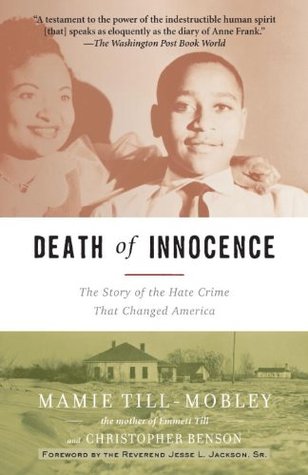
Death of Innocence: The Story of the Hate Crime that Changed America

19480905

Rating: 5 Stars

As I finished the book, I recalled Mother Mobley's remarks about a speech she had to give in one of her college courses when they were assigned to give a eulogy. Naturally she delivered a eulogy for her beloved son and when her speech was over another student asked what grade she would receive. The instructor, who she said was particularly hard on her, said to grade it would diminish it. I feel the same way about the book. To pick it apart and analyze it and all of that, this is not the book to do so.

It is a testament to a mother's love for her only baby, one who was so brutally tortured and murdered. This book should be required reading for everyone in high school. We are not as advanced as we believe we are as a society and I think the vitriol aimed at President Obama and his family is proof of that, as are the absolute disgusting displays of white guys marching with tiki torches. This book absolutely ripped my heart out and I cried so much. I can't ever fathom that kind of pain, to not only lose a child, but to lose one in such a horrific way. Especially because I truly got to know Emmett Till - who he was as a baby, a young boy, and then there on the verge of becoming a young man. I only knew the bare bones of this story prior to this book. Long before that awful Accessory-To-Murder finally spoke and said she made the whole story up, I think we all knew it was a giant lie. This is further confirmed by Mother Mobley's words. There is no way in hell, with her raising Emmett the way she did, that he would have for one moment said any of the things it was claimed he said - let alone even whistled at that woman. I can't even speak or write her name, she disgusts me just as much as those who physically carried out the lynching. In a way, I am kind of glad that Mother Mobley did not live long enough to hear about the retraction. She had suffered so much in her long life, and while I know she knew quite plainly that none of it had been true, to hear it confirmed might have been too much. To relive it all again, knowing that no matter what Emmett had said or done that day, nothing would ever even come a tiny smidge close to justifying his lynching, would be unbearable as a mother. It is hard enough to wrap my brain around, that there were people who lived with this kind of hate in their heart - and still live that way today.

This is an important book, and one that needs to be read widely. Highly recommended, a must-read. It is still currently on sale over at Amazon for $1.99. Possibly other sellers too, I found it via BookBub.

Saturday, April 28, 2018

Things That Make White People Uncomfortable

37823157

I received a free digital ARC via Edelweiss in exchange for an honest review.

Rating: 4 Stars

I have no other way to really sum up the book than this: every single person who has ever had the audacity to say #AllLivesMatter when that is clearly NOT the case in America needs to read this book. They won't, but they should. Let's clear something up right now: No one ever said #BlackLivesMatter MORE, we are saying #BlackLivesMatter also. So please spare me the #AllLivesMatter bullshit because until black lives do, that simply is not true.

Bennett touches on so many issues that are so hugely important right now and will remain so until we can find a way to come together and fix what is wrong with our country. I teach in a school that is predominantly African-American. I teach specifically in a Special Education class for students diagnosed with emotional disturbances. I have nine students and guess how many are African-American males.

I'll give you a second...

Six. SIX. Six, out of NINE.

And with this being my sixth year teaching in this setting, you can imagine how many little black boys have come through my room (though I must also make note that my students are with me for three years. I was a 4-6 room until our district moved 6th grade into the middle schools and last year I became a 3-5 room.) It absolutely terrifies me for these boys I know and care about so deeply, that someday some might be will be looked at the way Trayvon was, or Philando, or Eric, or Freddie, or any of the countless young men who have been murdered because their skin color was deemed dangerous. 

Bennett makes several good points about several related topics, including the NFL as a whole (and the idea that the league is roughly 70% black, yet the "owners" are 100% white), the n-word, his support not only of #BlackLivesMatter, but women's rights, LGBTQ rights, and so on. He also speaks specifically about Kaep and what a complete clusterfuck it is that he is not allowed to play in the NFL.

The book is written very much in a conversational style, and it would be easy to imagine yourself sitting down with Bennett and having a long chat about a whole host of issues we must resolve if we are going to survive as a nation.

Highly recommended.

Friday, April 27, 2018

Book Brag!

37823157

WOOOHOOO!

I requested this one ages ago on Edelweiss and did not think I would get approved once the publishing date had come and gone. BUT I finally was approved today! Definitely going to drop everything else I planned to read/write tonight for this one, and I won't even feel one smidge bad about that!

Happy Reading
Sarah

Tuesday, February 20, 2018

No Justice: One White Police Officer, One Black Family, and How One Bullet Ripped Us Apart

35099638

I received a digital copy of this book for free from NetGalley in exchange for an honest review.

Rating: 5 Stars

This was a tough one for me to read, for many reasons - similar to those I discussed in a previous review of the book The Day Sonny Died. In fact, I finished both of these books within a day or so of one another and was not eager to review them because they were truly draining. They were exhausting because it was so easy for me to see one of my students in the place of either young man, fictional or flesh and blood. While the young men in each story had a very different journey in how they came to be where they were, both are still situations any of my babies might find themselves in later in life. As a special education teacher in a behavior skills classroom, the majority of my students are young black males (grades 3-5). This over-identification of young black males in special education is a whole other issue that is as exhausting to deal with as the topics for either of these books. But I know I can not give up and can not let that exhaustion get to me because when put simply, their lives depend on it.

The gross miscarriage of justice in Tolan's story should infuriate everyone. Unfortunately, it won't and until something changes, incidents like this will keep happening. The shooting of unarmed black men by police officers has to end. I am not here for or interested in any "But what about..." arguments. This is an issue in our country. It is by no means the only issue we face today, but it is of great significance and the subject of the book.

Robbie Tolan nearly died in his own driveway, accused of stealing his own car. Just let that sink in for a moment.

In the early morning hours on New Year's, Robbie and his cousin had returned to Robbie's home where an officer approached the two young men, accusing Tolan of stealing the car he had driven. This ended up being a mistake on the officer's end, having mistyped the license plate number. Yet there was no double confirmation of the plate. The second officer to come on the scene did not help, and in the confusion and chaos of Tolan's parents coming out of the house to see what was going on, being told to get back, one officer roughly pushing Tolan's mother, Tolan reacted with angry words and apparently the officer feared for his life because Tolan received a bullet in his chest for trying to defend his mother.

Grim reminders that this is not the first time a scene like this has played out in America are scattered throughout the book. Before each chapter, Tolan recounts previous cases where both boys and men were not as lucky as he - though it sounds weird describing someone being shot as lucky. Yet I think Tolan recognizes that he was. He could have died just as countless others have before him. Even so, living was just as hard. Not only did the family fight for ten years to get any kind of justice, but the physical, mental, and emotional damage was at times overwhelming for everyone.

"I was able to make sure to keep any impulse responses, you know, like being the stereotype of the angry black man, out of the public eye, and my frustrations were only meted out in privacy" (34%).

This quote stuck out for me especially; he shouldn't have to not be angry. He was unjustly shot by a police officer, FFS. Yet, he's not allowed to be angry in public because he is black, and that would in turn impact the public image of him and potentially harm his case. How is that even fair? Tolan is allowed to be angry, without it framing his story in a negative way.

I do not recall hearing about this case, but I am glad that I was able to read about Tolan's journey and how he has slowly but surely put his life back together. What he and his family had to go through during the entire ordeal is beyond words. This should not be the experience of any citizen in our country, period.

Thursday, January 4, 2018

John Quincy Adams and the Politics of Slavery: Selections from the Diary


33415086

I received this ARC for free via NetGalley from Oxford University Press in exchange for an honest review.

Rating: 4 Stars

I have to confess my complete lack of knowledge about some of the earliest presidents after Washington. I vaguely thought both John Adams and John Quincy Adams were the only two among the first ten or so who never owned slaves and were staunchly against slavery. I could've sworn I read that previously. But as I started this one, I quickly found that was not the case at all and early on his career, JQA was actually a supporter of this cancerous practice that still impacts our country today. In fact, at around 49%, the books states "The Adamses rented slaves during their years in Washington DC...". This is quite a different picture painted of a man who, in the last years of his life, was so well-known for his opposition to slavery. He was even called by one of his political rivals, Henry Wise, "the acutest, the astutest, the archest enemy of southern slavery that ever existed." This is quite a contrast to how JQA even viewed himself, as he often criticized the abolitionists who didn't think he was going far enough to denounce slavery.

The editors did an excellent job with this volume, first introducing the journal, their purpose for choosing the entries they did, as well as their process for doing so. Throughout the text they also gave summaries and their own insights into many of the entries, explaining the larger politics of the time and events going on while JQA wrote what he did. They also provided commentary in comparing what he was writing in his diary versus what he was saying publicly on the issue of slavery. JQA left the most extensive collection of personal writings than any other statesman in the history of the US. These diaries give us one of the most complete pictures of any of these early politicians and the complexity of evolving views on a myriad of issues surrounding the young nation, slavery being at the forefront.

While I read this as a ARC on my Kindle, I definitely think it would best be read in a physical format. Throughout the text the editors reference other entries which are similar and it is just a bit more difficult going back and forth between them. There were also tons and tons and tons of footnotes. One must also be prepared for the mental exercise needed in reading a text like this. It will take some time, as sometimes reading what those who lived 200 years ago can be consuming. To quote one of my fave movies, National Treasure, "People don't really talk that way anymore." And it's true. I must also make note of the huge undertaking it was for the authors/editors to tackle such a project. JQA left behind 51 volumes to peruse, not a project that can be done in a few weeks. And if you care to browse any of the 51 volumes for yourself, you can find them online for here.

JQA is a certainly an early politician worth getting to know better. He was deeply involved in those early decades of our nation - and how could he not have been, given the fact that his father was a Founding Father. JQA was not only a president, but he later served in the House of Representatives for Massachusetts. Time and again, he filled important roles within the government, also serving as a diplomat and Secretary of State. He literally gave his life serving his country, suffering a stroke on the House Floor after voting during a debate. Adams was a contradiction though, because while he opposed slavery later in life, he was also not keen to discuss it all that much either. He never identified with abolitionists though because he thought their demands were too extreme. So many proposals were put forth in how to handle ending slavery and what would become of all the freed men and women. Adams wrestled with this constantly, all the while worried that as the divide between the north and south grew, it would only lead to war and the potential destruction of the fledgling country.

The book is very involved. There were times I did not know if I would finish it, but it is worth the time. Definitely recommended for those who have an interest in the time period, as well as politics.

Wednesday, January 3, 2018

Long Road to Hard Truth: The 100 Year Mission to Create the National Museum of African American History and Culture


32021155

I received this ARC free via NetGalley from Proud Legacy Publishing in exchange for an honest review.

Rating: 5 Stars

This is yet another ARC that I had put aside in 2017 when life was crazy hectic and I wish I had not. This book is so important to our nation's history and the specific struggle that our African American brothers and sisters have endured in fighting to be recognized as citizens in their own country. This book needs to be taught in all high school history classes.

In this text Robert L. Wilkins tells the story of how the National Museum of African American History and Culture finally came into being, after decades of starts and stops, permeated by the latent and outright racism of several players in this saga. Judge Wilkins writes not of the museum itself and the numerous artifacts, oral histories, and exhibits, or the celebrities who lent their time to its creation, but of what it took to actually get the museum built in the first place. He has exhaustively searched archives and all possible repositories of knowledge to find every single instance of attempts to create a museum of African American history and the multiple reasons those plans were halted. This became a kind of obsession for Judge Wilkins, first leading him to cut back on his time as a public defender to devote time to his goal of seeing a museum dedicated to the sacrifice and struggle of African Americans and their place in US history. I think Wilkins job as a public defender really helped him realize his greater purpose and it is something the author touches on at various points. He mentions that the majority of his clients are young black and Hispanic men, many of whom he says don't see a future for themselves when he asks where they see themselves in five years. The heartbreaking answer is that some do not even see themselves as being alive in five years. These young men, many still teenage boys, did not care much to know the history of the Civil Rights Movement, how people died for their right to attend proper schools and get the education they deserved. But, Wilkins also discovered something else: when many of these same boys and young men were incarcerated, they started reading because they had nothing else to do. When they truly learned about all that it took to get the access to that education, it opened their eyes to opportunities they had wasted. Wilkins saw the museum as an opportunity not only to showcase the achievements and contributions of African Americans, but to be an inspiration to the young men and women who saw only a bleak future for themselves.

Through this book Judge Wilkins chronicles the attempts by various groups to create a space to honor African American history. it begins with the exclusion of black troops being honored after the Civil War ended. Various excuses were made as to why the troops were not invited, and none were acceptable. To rectify this, on the 50th anniversary of the original Review, again when African American units were excluded, supporters first attempted to create a monument to these men who fought for the Union and were all but erased from history. Through the era of Jim Crow, which saw lynchings become a disgusting sport, these advocates sought to create a national museum. Decades of obstacles followed, including the back and forth on whether the Smithsonian should be involved, should it be located on the Mall, and so on. I was so very disappointed to read of the specific lack of interest from the Smithsonian in the creation of a national museum. As I was reading I did not understand the hesitation, as I hoped that surely such a bastion of culture and knowledge could not also be so deeply entrenched in systematic racism. I was disheartened to see an institution I held in such high esteem could be on the wrong side of history. Yet, it was.

In his quest to see this vision come to fruition, Wilkins was named as a member of the Presidential Commission. The commission was tasked with writing the plan to create the museum, the space to be used, and so on. Wilkins poured over every single document related to the attempts to create a museum in the past, also taking note of what the reasons were for the project not moving forward. All of this culminated in a report that was finally accepted and 100 years after this journey first began, Congress finally authorized the museum. The National Museum of African American History and Culture opened in September of 2016.

As I wrote earlier, this is a book that must be taught in high school history classes. Until we as a nation confront the fact that so much of our history is steeped in the horrors of  slavery and discrimination, from the rise of the KKK to Birth of a Nation, and everything beyond, this is a very real part of shaping our nation even today. It took so long for this museum to become a reality, far longer than it should have. Not until a bipartisan effort of both Democrats and Republicans, an effort also supported by George W. Bush, did this happen. This is something important to consider, and is worth reflecting on. Why did it take so long? I think the answer is a hard truth that we don't want to see.

While the text itself is not terribly long, there are extensive notes (12% of the ARC) that highlight the numerous sources the author drew on in his quest to see this project through to the end. I highly recommend this to all.

Saturday, October 8, 2016

The Invisibles: The Untold Story of African American Slaves in the White House

25862358

Rating: 4 Stars

Michelle Obama's speech at the DNC has been dissected and argued about in the press and by these talking heads since it happened, but it was that speech and this particular part:

"...I wake up every morning in a house that was built by slaves -- (applause) -- and I watch my daughters –- two beautiful, intelligent, black young women –- playing with their dogs on the White House lawn." (Speech text taken from www.whitehouse.gov).

...that made me feel like a total moron. In my defense, and the defense of countless others across the country who have never given much thought to those who built the White House, it is because we were never TAUGHT that. Yes, we learned about the Revolutionary War and those tough early years of the fledgling country that is now the greatest power on earth. We may have read a paragraph about the War of 1812 when the British burned the White House to the ground and Dolley Madison bravely saved the Landsdowne portrait of Washington before fleeing for her life - though even this is not entirely accurate and she almost certainly had help in removing it.

Basically, it never occurred to me that slaves built the White House. And that is embarrassing.

So, in order to remedy this and gain some much-needed knowledge, I found this one while perusing the new releases at the library. It was kind of another wake-up moment for me. I have known as an adult that most of the early presidents owned slaves, but again even then, it did not occur to me that slaves lived and worked in the White House. Perhaps because I am white, this is not something I have ever had to consider - that my ancestors may have been owned by others and forced to work while their owners profited from the labor (most of my family is German with a lil bit of Swede and came to the US in the late 1800s or so). When people say white privilege is not a thing, this itself is a prime example that white privilege is very much a thing that is alive and well today.

The only real flaw in the book is the fact that there are so many unknowns about the people who worked and cared for the early presidents and their families. As we now know, very little record-keeping was done then in regards to slaves. We simply do not know who many of these people were, because of their status as slaves, and were deemed property instead of human beings. I was interested to read in the conclusion that the author is continuing his research in order to find more information on those mentioned in the current book, as well as other stories yet to be discovered. He also mentions the research being done in regards to the life of slaves on the various presidential plantations. I would be very interested to read those stories as well.

I have a love/hate relationship with these presidents, particularly George Washington and to a lesser extent, Thomas Jefferson (this is only because Washington was one of my favorite presidents from my youth, and there has always been something about Jefferson that rubs me the wrong way, though I can not quite figure out what it is, aside from the obvious in being a slave owner). From the time I was old enough to learn about these early presidents, Washington captivated me. He was a strong leader in the army, before becoming our first president. He had stood up to the British, won numerous battles, and freed the colonies from the oppressive taxes of a far-off government. I was enthralled by him and this group of men who dared to stand up and fight for their freedom. But as I got older, mostly in high school, college, and now that I have settled back into my reading-for-pleasure habit again, cracks began to appear in this image I had of Washington. How could someone I admired so greatly for all of his courage and virtues, in turn deny the very freedom he fought for, to the slaves he owned? The author does point out the times in which the slaves were freed in the wills of their owners, but this is not good enough. We can not deny the fact that slavery and all its trauma and horror played such a prominent role in building the very foundation of this nation. While we may still revere these men for those aspects of their character that made them great leaders, we can't forget that while they forged ahead with their new-found freedom, their slaves were left behind in bondage.

Highly recommended.
really liked it