Showing posts with label City Biography. Show all posts

Wednesday, July 28, 2021

Mini Reviews | Hodge Podge

I feel a potential reviewing slump coming on so obviously the only way to stop it is to write lots of reviews about completely unrelated books. Here's hoping it works!


Rating ⭐⭐⭐⭐

I really enjoyed this book - but I am such a sucker for books about cities, city biographies so to speak. I love learning about how massive cities we now take for granted started out sometimes at tiny villages with futures no could have predicted.

The author does a fantastic job pulling together many threads - history, anthropology, archaeology, and our own modern observations. She is an archaeologists, so that level of expertise is welcome as she not only discusses the rise and fall of some major urban centers, but the process of discovering them.

We visit several fantastic locations around the world - Tenochtitlan, Pompeii, Tell Brak, and the like. In these city remains, and others as well, the author explains how over many thousands of years the city as we know it today emerged. As we journey through the ancient world, even through some of the author's own digs in India, we see that the world as we know it today has more in common with these cities of the past than we think. She makes a lot of comparisons between cities now vs then, and delves into the idea of cities impact the people who live there. I found this part particularly interesting; our environment impacts us as much as we impact it.

I also found her take on the future of cities to be of interest. The likelihood of all major cities simply collapsing over time is not necessarily a given. It's true that many cities in the ancient world came to an end at some point and were abandoned, otherwise archeological digs at these locations would not happen. However, for cities to simply end is not all that common. The citizens move elsewhere, taking the influence of their former cities with them when they move on to other cities, and the cycle continues.

Recommended.


Rating ⭐⭐⭐⭐

I have a fairly good working knowledge of the Kennedys as a whole, but the bulk of my deeper knowledge revolves around Jack, Jackie, and JFK, Jr. I know some about Bobby, but only as he functioned in relation to JFK in the White House years, and then later in regards to his assassination. I was sixteen when JFK Jr. died and was absolutely gutted. Even at that age I remembering wondering how much more one family could take, and that Caroline was now all alone.

Side note: If you are one of those crazies who thinks JFK Jr. secretly survived the plane crash that killed his wife and sister-in-law, and that he would ever in a million years support the former guy and run as his VP, you can kindly fuck all the way off into the sun. A) That would never happen, given the fact that he was a Democrat who many thought could win the party nomination and presidency someday and B) Shame on your for piling more hurt onto Caroline every time you spout this nonsense.

When I came across this book I was delighted, as I am trying to learn more about all of the Kennedys. I am not sure why, and there are many detractors who deride the obsession our nation has with the family, but so many of us still can not look away. Even as the generation after Caroline and JFK Jr. have not managed to capture our attention the way their predecessors did, there are still many who read books such as this, about the eight children of Joe and Rose.

Kathleen, called Kick by her family, was Joe's favorite child and Jack's favorite sister. It is easy to see why. She was adventurous, charming, clever, hilarious. She made her debut into London society in 1938 when Joe was appointed the US Ambassador. London fell in love with Kick as well, as did a specific young man named Billy - William Cavendish, heir to the Dukedom of Devonshire and Chatsworth. They married despite protests of her family over the religious divide, and Joe Jr was the only Kennedy to attend the civil ceremony. Unfortunately a long life together was not in the cards, as Cavendish was killed in action while fighting in Belgium just a few months later. Kick would not live much longer than her husband, dying in a plan crash four years later, at age 28.

Kick was in many ways ahead of her time. She did what she wanted, when she wanted, and saw whomever she wanted - despite threats from her family that she would be cut-off on various occasions. Kick lived her life to the fullest, never minding a bit of scandal that came along with whatever she was up to.

Kick would become the second Kennedy child to die, but certainly not the last. Joe Jr was killed four years earlier in the war, around a month before Cavendish. Her beloved and favorite brother Jack would become the third in 1963, and from out of these family tragedies the so-called Kennedy Curse would emerge.

The author makes good use of sources, relying both on family stories and words by Kick's own in hand in the form of letters she wrote.

I would recommend this one to those with an interest in the Kennedy family dynamics and these 'forgotten' children who have been eclipsed by Jack, Bobby, and Ted.

Wednesday, October 28, 2020

NetGalley ARC | Enchanted New York: A Walk Along Broadway Through Manhattan's Magical Past


I received a free digital ARC from the publisher via NetGalley in exchange for an honest review.

Rating ⭐⭐⭐⭐

I love New York City. I am thoroughly obsessed. I have yet to visit myself, and have been waiting until my daughter is a little bit older, so she will be able to appreciate it as much as I do. As a result of my love for this city I have never been to, any book relating to the history of NYC especially and people/places/events in general, gets my attention immediately.

This would make for a great guide book, if you are interested in the magical side of the City That Never Sleeps. The author takes readers on a ride starting at the Battery and weaving up Broadway, making various pitstops at locations along the way to introduce a whole cast of characters that even many New Yorkers might not know once strolled the sidewalks of the most famous street in the world. We meet magicians, Freemasons, alchemists, seers, spiritualists, occultists, mediums, wizards, and fortune tellers, among many others.

As you can imagine, this is not your average history book. The author begins in 1789, the year George Washington was inaugurated as our first president. From there, the book is split into seven distinct chapters and stays on a roughly chronological course right up to the present day. Within each chapter, the author further breaks down the history by location. There are tons of stories and anecdotes, all related to that wider theme or topic of the chapter.

Personally I found some of the stories more interesting than others, only based on my preference - for example, I am not terribly interested in alchemy. Even so, those stories did not distract from those topics I was interested in.

I do have to say that this did take me longer than usual to get through, but I think that is more due to the nature of the book itself, almost as an encyclopedia of information. Some might be able to read this straight through cover to cover. Others might enjoy it more as one they skip around in, from one entry to another in a different chapter perhaps. I do think the book can be enjoyed either way.

Highly recommended, especially to those who love any and all history of NYC.

Saturday, October 20, 2018

NetGalley ARC: George Washington's Washington


36739995

I received a free digital ARC from the publisher via NetGalley in exchange for an honest review.

Rating: 3.5 Stars

I was super excited to be approved for this one, because it had been on my NetGalley Wish List for ages, and I have never gotten a 'Wish Granted' before. Unfortunately, I did not enjoy it nearly as much as I was expecting/hoping to. I don't know what my deal has been lately with the Revolutionary War and its aftermath, but I have struggled with a lot of books on this and related subjects for a few months. It has always been a period that has interested me, but maybe I have just read too many in too short amount of time. Back to Medieval England I go.

I don't want to say that the book was boring, because that is not the right word. There are PLENTY of shenanigans to keep one's head spinning, but perhaps that is exactly what I was frustrated about. Frustrating is a far better word, and much more accurate. I was not frustrated by the author and his writing, but the content itself and all these guys who could not get their acts together. There was this grand plan for a beautiful and functional capital city to properly represent our fledgling country...and all the garbage one would expect when it came to implementing such a grand vision as the one that Washington had for the city that would be named for him. There were several stumbling blocks, the main one being the new government itself, which will come as no surprise to any American who is constantly asking themselves wtf is going on in our country today. During Washington's administration, then followed up by Adams', they had little money to work with to even get the plans implemented, nor did it seem that anyone was actually sure of just how much authority the administrations had to do literally anything. It was almost comical at times, until one remembers that this actually happened and is not just some made up stories about a bunch of guys who fought for the freedom from the tyrannical rule of George III, only to find they did not know what to do with the freedom when they actually had it. Harnessing the energy of the revolution was a tricky thing to do, especially when the competing parties that Washington warned everyone about started, well, competing. Jefferson and his posse managed to withhold funds that would have gone toward supporting any project that was not related to the government itself. It would take another decade to pass before the politicians really began working together in order to make our capital one that our young nation deserved.

Recommended for those who enjoy US history and politics, and biographies of cities.

Wednesday, December 27, 2017

Aleppo: The Rise and Fall of Syria's Great Merchant City

30196147

Rating: 3.5 Stars


I received this digital ARC via NetGalley from I.B. Tauris in exchange for an honest review.

I am forever fascinated by this region of the world and the splendor of old cities like Aleppo, Constantinople, etc. These cities managed to mix East and West and thrive for centuries. Unfortunately, nothing good can last and the latest civil war has all but destroyed one of the grandest old cities in the world.

My major complaint about this text is that it starts in the 1500s and I would have loved to read more about its existence before that. While we still get a vivid pictures of the city from that time up to now, there's so much more that could have been explored. This is an especially important point for me to make I feel, as only the first shorter portion was the history of the city as written by the author. The remaining bulk of the book was filled with eyewitness accounts of the city from different men and women who traveled there throughout the centuries, again from the 1500s, on. I feel like this was a missed opportunity, as there is so much more that could have been addressed. However, I must say that those eyewitness are invaluable. These accounts are incredibly thorough and paint a lively picture of a once-bustling city that no longer exists. This is a tragedy.

At one time Aleppo was one of the greatest cities in the world. Christians, Muslims, and Jews co-existed in relative peace. Despite different religions, traditions, and cultures, the city boomed. Even with the city changing rulers over the centuries, from Romans, Persians and Greeks to the Ottoman and French. It was under the rule of the Ottoman Empire that Aleppo found its place as one of the cosmopolitan cities of the world, where world-wide trade allowed it to flourish. Merchants came from all over to trade, and some ended up staying. In this first section we see Aleppo as a powerful city, even up until about ten years ago when the population was over two million inhabitants. Now, with the war have devastated the old city, the population is fewer than 500,000. It is such a shame that so much history has been lost and I truly hope that the city can recover and become what it once was.


The notes section is satisfactory, starting at 86% and ending at 92%. From there the bibliography went up to 96%

The lack of attention given to Aleppo prior to the 16th century is what really sunk this one to three stars for me. It seems like such a missed opportunity to have portrayed the city in all its glory, as one of the longest continually inhabited cities in history. I'm still interested in the subject and will seek out other texts on Aleppo.

Friday, July 8, 2016

The Bowery Boys: Adventures in Old New York: An Unconventional Exploration of Manhattan's Historic Neighborhoods, Secret Spots and Colorful Characters

26196406

Rating: 5 Stars

(I really, really, REALLY hope I win the Goodreads giveaway for this one. Like, desperately. It's a rare book that I actually say I MUST own. This is one of them. So, Goodreads, please pick me.)

Love. Love. Love. I loved this book. I loved it so much I don't even know if I can write a proper review of it because all I am going to say is how much I love it. This is exactly the kind of book I was looking for about New York City. I love city biographies and this was phenomenal. Easily one of the best books I have read this year. Loved it. Just loved it.

But I suppose that's not enough, is it? I should probably show you why I loved it so much, so you can go out and buy it or check it out from the library and love it too. Man, this is a daunting task.

This book was very slow-going for me, but in a very positive way. It is so filled with interesting facts that I found myself constantly pausing to take notes on what I was reading, or to go to Google Maps and Google Street View when I came to the 'Stand Here' section in each chapter. I took so many notes, in fact, that I think I set a new record - 43. It only took me three days to read, and I could have zoomed through much more quickly than that even if I was not stopping to take said notes, but then I would not have been able to look back at it now and appreciate everything it has to offer. I like to take notes in general when I read so I have some idea of what I am going to write in my review, but this time it was so much more. I have never been to New York City and it is my dream to visit there some day with my daughter and drag her along to all the historical sites that we can possibly cram into a week's visit. Normally I have very specific time periods I am interested in, whether it be Anglo-Saxon England, Roman Britain, Biblical Middle East, etc. But New York City is the one place that, no matter the time period, I want to know about it. From its early days as the Dutch settlement of New Amsterdam, to the bustle and blinding lights of Times Square now, I want to know about all of it. All the secrets of the neighborhoods, all the stories, I want to know it all.

I have often wondered where this obsession came from, and sadly I think part of it came from the September 11th attacks on the World Trade Center. Around the country and around the world, we watched this city of millions come together as one and rise up from unspeakable horror. The City that Never Sleeps became a symbol for what it meant to be an American, to be resilient in the face of tragedy, and soldiered on. Then, in 2004 the Beastie Boys (one of my favorite groups EVER) released their album "To the 5 Boroughs", with 'An Open Letter to NYC' and I wanted to be a part of that. I wanted to not only visit New York, but to live there, to become a New Yorker and BE there.

While that has not exactly worked out the way I wanted for the time being, I have to be content with planning trips and reading books like these to help plan said trips. This is the perfect guidebook without actually being a guidebook. It touches on so many well-known and obscure details of the city and I learned so much more than I even thought I would. It is written in such a way that is easily accessible for any reader and educates without being pompous or overly academic. That doesn't mean you won't learn anything, you will learn TONS. But it won't feel like you are. The authors do a fantastic job keeping the book almost conversational without dumbing anything down.

The book begins with a map of Manhattan. In a section they call "Situate the Reader', this map is broken up into numbered sections which correspond to the subsequent chapters in the book. The authors start us out in New York Harbor in chapter 1, and we meander north through Battery Park, Chinatown, Little Italy, SoHo, the Bowery, Greenwich Village, Gramercy Park, Times Square and Rockefeller Center, Central Park, and finally end up in Washington Heights - but not without seeing all the amazing and historical sites in between. On top of that, interspersed throughout the book we also get sections titled "A Brief History of..." and are given glimpses of the remaining four boroughs - Staten Island, the Bronx, Brooklyn, and Queens (I really, really hope these guys write four more books. Look, four boroughs, four books. Hmmm. But please write them, okay guys?)

The set-up for each chapter is relatively uniform. While they may not be exactly in the same order, they contain the same sub-sections. Each chapter starts with a map that shows points of interest, preceded by a brief summary of the area called 'Situate the Reader'. Then there is a main article related to the area, followed by short paragraphs related to the points of interest on the map at the very beginning of the chapter. There's literally so much information, I was constantly flipping back and forth as I read, first to look at the map to figure out where on Manhattan it was, then looking up further information on my computer, then back to the book. The authors also make a note of each point of interest and its location today, or also let the reader know if it no longer exists - but usually still give the cross streets of where the landmark stood at one time. As mentioned previously, there is also a section called 'Stand Here', and the authors explain their reasoning for a particular view of what they want you to see (this is one of the many reasons why this is the perfect guidebook). Throughout each chapter then are also shorter articles in addition to the main article. These shorter articles often pertain specifically to a point of interest and are a bit more in-depth. There are also many black and white photographs included throughout. While I am normally a stickler for photos, and color ones in particular, in this text I found that the black and white photos were very fitting. I think color photos would have been out of place. The beginning of each chapter also included a photo, as well as some kind of quote from a contemporary source of the period.

There were a lot of points of interest that I knew about, but still learned so much more. A prime example is the disaster of the fire/sinking of the General Slocum. I knew the basics of the tragedy - families out on a Sunday cruise and a fire broke out. The crew panicked, the people panicked, and in the end over 1,000 people were dead - mostly women and children. The fire hose had rotted, as had the life vests. The image of mothers strapping their children into these vests and putting them into the water - only to watch in horror as their children sank in the water and never came up - is horrible. I do not know that I learned about this in school - it is possible but I do not recall. It saddens me that there is not a better, more prominent memorial to these victims. The authors address why this may be - whether it had to do with the nationality (mainly German) or social class (poor) of those killed that June day in 1904. I'd think now though, in 2016, surely a better memorial could be built to honor them. Why more people don't know of this event, I do not know for sure. But this book goes a long way to start educating. I would hope at least that students in New York learn about this events that have impacted their city, even if the rest of the country may not.

Other events were news to me too - like the Astor Place riots, or the Civil War Draft Riots. The former occurred because of class differences (and theatrical preferences), the latter due to, more obviously, the Civil War and thus, race. So many events like this, totally unknown to me before. Hopefully not so to the youth of New York City.

There were also many events and buildings and neighborhoods I did know about - including my personal favorite: St Marks (and for an in-depth look at St Marks Place, you should definitely read 'St Marks is Dead: The Many Lives of America's Hippest Street' by Ada Calhoun). But in addition to St Marks, there was Strand Bookstore (imagine seeing Book Row, wow!), the Triangle Shirtwaist Company fire, the Stonewall Riots, the Cunard and White Star Line piers (Piers 54 and 59), the Flatiron building, the Cloisters...I feel like I could go on and on naming the places and events of interest to me.

One thing that kind of disturbs me is the amount of cemeteries that were turned into public parks, or just completely plowed over when people realized what prime locations the cemeteries were using. One example (of many) is the James J Walker Park. The only thing remaining in the now-park to show it was ever a cemetery is the Firemans Memorial Stone. When the city turned the land into the park, they removed the headstones and left the bodies buried. Seriously creepy.

One last place and event I think warrants a mention - Penn Station. The loss of this building seriously makes me terribly sad. I love train stations and the idea of this kind of travel in the late 1800s/early 1900s. The train station here in Omaha has been turned into a museum, and is a place my daughter and I enjoy very much. The high ceilings, the benches and waiting areas, the original ticket counters and such - I love it. I'm so glad that many of these places have been preserved and the authors note that Penn Station kind of became the tipping point where people realized these structures needed protection and saving. They write of Penn, "the station is often credited with being the martyr that saved other jewels from similar destruction" (page 308).

There is something about New York City that speaks to my soul and calls to me. I don't think I have articulated it in quite the right way and mostly I am coming across sounding like a loon, but I think it is possible to be in love with a city (It's true, because I love Edinburgh, Scotland in much the same way I love the idea of New York and I hope the real thing lives up to the idea of it I have built up in my head).

Books like this are such fantastic resources in two ways - first of course being the wealth of information they provide themselves. The second way is the sources the authors used that they then pass on to their readers. At the end of the book is a section titled 'Bowery Boys Bookshelf'. I added nearly all of them to my Goodreads to-read list - all the ones not already there, anyway. I was pleased to see so many already were and also to find some sure-to-be gems that I will have to find ASAP. In addition to the many books the authors offered, they included a list of favorite websites, including many blogs dedicated to the history of New York City. You can be sure I have checked out most of them already.

I wish I had a time machine to go back specifically to Gilded Age New York. Can you imagine seeing those mansions lining Fifth Avenue, or the ladies shopping on Sixth, all the department stores and everyone dressed up just to shop? Oi. I can't even. What a sight that would be.

So in the end, I think it is pretty clear that I very highly recommend this one. It has so much to offer, whether you are obsessed with New York like I am, or are just a general lover of history. I have decided it is definitely one I have to own. Then I will highlight and make notes and plan all the places we will see when we visit (So please, Goodreads, choose me for the giveaway!)

Saturday, December 5, 2015

The Rise and Fall of Alexandria: Birthplace of the Modern Mind

400064

Rating: 5 Stars

Review:

I never knew how little I actually knew about Alexandria until I read this book. The first book I read of Pollard's was about Alfred the Great and I absolutely loved it, it was well-researched and beautifully written. The Rise and Fall of Alexandria is no different. It is truly so beautiful and lovely and depressing to read about this great center of academia, and THAT library, and after centuries of surviving, it's just gone. Based solely on the book's content, I would give this a solid four stars, but given my love of all things academic and library-ish, I had to go with five stars.

There are so many directions I might go with this review, so many things to discuss and dissect, to relate to our modern world, I don't think I would have the space or time to even attempt that. So instead I will just touch briefly on some of the things that were most intriguing to me.

The book begins where you would expect - with the founding of the city. There is a solid foundation, figuratively, to build the rest of the book on. We are given a background of Alexander and Ptolemy take-over after Alexander's death. As time went on, the library accumulated more and more knowledge, just imagine all those scrolls, all that history in one place.

"Alexandria was built on knowledge, and at its heart was not a treasury but the greatest library and museum of antiquity" (introduction).

But, Alexandria was so much more than just the library and museums, if that is even possible. Truth be told, that is really all I knew of the great city prior to picking this one up, aside from knowledge too of its famous founder - who did not live long enough to see the glorious crown jewel of his empire reach its full potential.

I found the medical information to be among the most interesting facts (I mean seriously, despite the plethora of mathematicians who lived and worked in Alexandria, we all should know by now how I feel about math. I think it is a testament to how enthralling Alexandria is that I was able to muster through those sections - I am NOT a number gal!) Given my love for all things medieval England/Ireland/Scotland, I was familiar with the idea of the four humors, but did not know much about what they represented or how this information was used. Here the author goes into a bit of detail when discussing medical practices that were developed in Alexandria, including the understanding of anatomy. The disturbing way they came about this knowledge was that doctors were given LIVE condemned prisoners to experiment and operate on, so...not all was perfect in the city.

One of the both high- and low-lights of this one for me was a whole chapter dedicated to Hypatia. It's a highlight because she is such a fascinating figure in history, and while there is not a lot of information known about her, there is enough that tells us she is certainly someone who was held in esteem. The low-light of course would be her cruel and violent death, and the fact that Cyril played such a role in it and that later he was even raised to sainthood. That is a travesty to me.

"With the death of Hypatia, her city also began to die. Philosophers were still to found in the city's streets and the 'Alexandrian school' continued quietly - ever more quietly - to refine pagan Neoplatonism" (page 280). 

Overall, I really loved this one. I can highly recommend it to anyone who has an interest in non-fiction. Even if you do not know much about this time period, the people, this city, the library, it is a great starting point. It is also great for those who already have a knowledge of any of those topics, as the detail and research is quite evident.

And oh, what I would not give to see that library in its full glory.

"And what of the books? The fate of the libraries of Alexandria is one of the greatest mysteries of the ancient world. It would still be tragic, but at least convenient, if a single moment of their destruction could be found, a moment at which the curtain came down on the classical world and a new and darker age commenced" (page 281).


Saturday, September 12, 2015

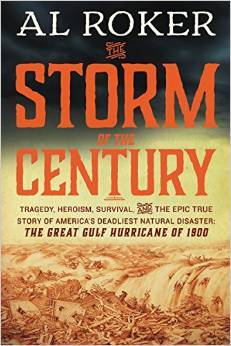
The Storm of the Century: Tragedy, Heroism, Survival, and the Epic True Story of America's Deadliest Natural Disaster: The Great Gulf Hurricane of 1900

23460968

Rating: 2.5/3 Stars

Review:

First, the title. While I love Erik Larson, even his titles are sometimes too long for my taste, and they are not even that long. But THIS ridiculousness is just that. I mean, it is absurd and bordering on comical. THE SUBTITLE HAS A SUBTITLE. It was almost enough to make me not even bother with the book, because books with stupidly long titles tend to be on the pretentious side and no one likes too much pretension. Luckily, the book itself is written very simply, almost too simply for what the title implied. Does that even make sense? Oh well, it makes sense to me at least.

This is by no means the worst book I have ever read. Though it is certainly written in such a way that 'popular' history is, to make is easily accessible, there are some good things here. I did like that the book introduced and focused on specific citizens of Galveston prior to the hurricane. Though as I have said in other reviews, when there are children involved, that always seems to tug at my heart more and the moment we meet little Louise, I had to flip to the end to make sure she survived. I'm not sure I could have continued reading if she hadn't. It is one thing to think about the destruction and death in general terms, because in that way the victims are nameless. But when you get more personal, it is even harder to comprehend or accept tragedy on this scale. I don't mean to make that sound impersonal, but it does make the reading of events easier to stomach.

The book moves very quickly and I read it in almost one sitting. It menaders back and forth between Galveston, meteorology, and the path of the hurricane. I found this to be interesting, though was less interested in the meteorology in general. Once again American arrogance shines through brightly, and the warnings from Cuba are silenced and ignored. It is infuriating that so many lives could have been saved had they just listened. It is heartbreaking to think of all these people going through such trauma and tragedy, for nothing.

I am especially interested in reading more about Issac Cline. It is a wonder he was able to continue in his job after losing his wife and unborn child in the storm, and some of the blame can surely be laid directly on his shoulders for denying the necessity of building a seawall to protect the island city. He was arguably the best weatherman in the country and his opinion was naturally highly valued. Had the seawall alone been built, even if the warnings from Cuba still been ignored, who knows what difference that might have made. I understand that in that time they were of course operating with the best scientific understanding of the time, and hindsight is always 20/20, but I imagine that burden might have been difficult to carry for the rest of his life.

I am wavering back and forth between 2.5 and 3 stars on this one. It really was okay, and it is not that I didn't like it at all, I just have a feeling that after I finally get around to reading Larson's version (Isaac's Storm), everything else will pale in comparison.

Saturday, August 1, 2015

London: A History

Author: Francis Sheppard

Rating: 3.5 Stars

Review:

Naturally I found the early sections of the book far more interesting, as they pertained to the periods in England's history that I know and love so well. Unfortunately those sections as a whole only made up the first roughly third of the book, so it took a little more willpower to continue after saying goodbye to my beloved Anglo-Saxons, Plantagenets, and Tudors in regards to their relationships with London. I generally enjoy city biographies but I think what made this one so different for me is that I am also highly interested in very specific time periods in England, so later chapters (mainly from the Stuarts after James I and beyond) felt much heavier and slower to me, despite of course the writing style changing not at all.

It is interesting to me to watch cities slowly evolve into the places we know them as today. Having been to London myself, albeit an incredibly short venture due to a long delay out of Edinburgh, I can't even imagine it being anything than the bustling city it is today. I can't wait to go back and spend the time there that the city deserves, to see all the places still standing where so many of these great and terrible leaders stood, worked, slept, etc.

While the Victorian and Edwardian eras were more than a bit sluggish for me, my interest was piqued at the transformation of the city during the German air raids of WWII. So much of my past study of WWII focused on Germany, I truly had no idea the devastation and loss of life inflicted on London. It amazes me that so many palaces and castles survived, while countless citizens were left homeless. I can't even imagine sleeping in a bunk bed in the subway. Like many, I might have just taken the risk of sleeping at home.

Overall, this is a highly researched, thus very academic, work. At times even the periods of most interest to me were dry. Still, it's very informative and I can say I do recommend it.

Saturday, July 18, 2015

From Pompeii: The Afterlife of a Roman Town

18770182

Rating: 3 Stars

Review:

First I have to say that the cover is perfect, and is what caught my attention right away. I am a firm believer in the importance of cover art and this was just too beautiful and sad to pass up. I am especially fond of black and white photos, particularly when modern photos are taken this way (which does kind of sound strange to say since Pompeii is anything but modern in itself). Plus, I am a sucker for anything related to Vesuvius and Pompeii, so there's that too.

Unfortunately, I should have read the inside flap to get a bit more info about what the book was actually about. I was looking more for a text related to "life" in Pompeii since the eruption, primarily a focus on the excavation work that has been done in the last few decades. Instead, this was more a social history of how actors, writers, artists, and various others have experienced the ruins of this once-thriving city. It doesn't make it a bad book by any means, it just was not what I thought it would be or what I was looking for.

I particularly enjoyed the last chapter - or perhaps enjoyed is the wrong word, since it related much to how Pompeii is neglected and slowly being eroded and destroyed by all manners of natural means and otherwise. But I enjoyed it because the focus was Pompeii itself, a city I very much would like to see one day. I only hope it still exists when I get the chance.

The idea of Vesuvius erupting again is not something to be dismissed lightly and I found the information on the evacuation process interesting. As one can imagine, this will not be an easy task to evacuate the 3.5 million people living in the area. Still, these people know the risks, and many have lived on the same land as their ancestors, some of the families going back several generations. It would not be easy to just leave all that behind.

In the end, recommended for those who are interested more in a cultural history of the site since 79 AD. For those looking more for a book with a archaeological focus, you could pass on this one.

Monday, July 6, 2015

Londoners: The Days and Nights of London Now - As Told by Those Who Love It, Hate It, Live It, Left It, and Long for It

12088899

Rating: 3 Stars

Review:

I am a bit obsessed with city biographies. I love the history, how this or that place could just be this village, or this town in a swamp, or whatever and then BOOM, it's this huge, thriving metropolis. I especially love the idea of London, because so many things that I am interested in happened there, albeit 500-1000 years ago.

This is an interesting idea and I appreciate the work that must've gone into this book. The hours and hours of talking to people, I myself would enjoy doing that as well. This is not strictly a history of physical London though, so if that is what you are looking for, look elsewhere. This is a social and cultural history told through the eyes of dozens of current and former Londoners.

The author speaks to a wide variety of people, so you can appreciate the different points of view that comes with varying ages, cultures, careers, etc. There are those who love the city as it is now or was, and those who hate it and want to get out. But none of the perspectives are wrong, because each comes with their story, so you're reading along thinking, "Wow, this guy's life is awesome, I want to move to London" and then the next story is just depressing and you're like, "Oh dear Lord, no way." And of course, the only way you will ever know is if you go for yourself and give it a try.

Interesting read, I recommend it if you are interested in this type of city biography.

Additionally: 

Our time in London was so short, due to our delayed flight from Edinburgh. As a result, we didn't get to see any city sights before taking in a show, the BEST show you could ever hope to see. And let me tell you, those cab drivers REALLY are as awesome as they sound in the book. Because our flight had been delayed, the visitor center where we were supposed to pick up our tickets was already closed, so I didn't even have the info with the name of the theatre. I was nearly in tears again (the first time being after Mom and I got separated in the train station!) But I told the driver what show we were going to a BOOM, we were off! We got a super quick tour of the city, he pointed out Big Ben and Buckingham Palace and then, suddenly, we were there:


Some day though Mom and I will go back, and take Eleanor too, and see London as it is meant to be seen - in the daylight!