Showing posts with label Victorians. Show all posts

Sunday, April 5, 2026

Netgalley ARC | Broadmoor Inmates


I received a free digital ARC from the publisher via NetGalley in exchange for an honest review.

Rating | ⭐⭐

I would venture to guess that anyone who has an interest in historical true crime knows the name of Broadmoor. The facility opened in 1863 for the 'criminal lunatics' of society who needed to be confined for the safety of the public, and themselves. Each inmate committed some horrific crime - or attempted one, leading to their incarceration.

Of course we know that treatments of the time were in no way effective - fresh air was often considered a treatment for pretty much anything ailing someone in that time period. But inmates were also expected to work, and were provided leaisure activities to participate in as well. Even so, this was no idyllic place for anyone to be 'cured'. Doctors of the time simply did not have the knowledge or resources to provide actual treatment for the wide range of causes that brought inmates to their door.

While the stories were interesting, and many incredibly tragic, I was a bit disappointed with this book. I was hoping there would be more information about Broadmoor itself and the attempts of treatment at the time. Given the subtitle, it seemed like a logical expectation.

Instead, this was a collection of stories, some with a lot of detail and some without, about how these particular inmates ended up at Broadmoor throughoutt its history, up to the 1950s. When looking at the bibliography, much of it was simply a list of newspapers. I always appreciate when an author uses contemporary sources, but we also have to remember that Victorian-era newspaper accounts of crimes was rather...colorful.

This had the potential to be an interesting look at an infamous asylum, going back to its very beginning. Unfortunately that is not what we got here. And given that this was only about the crimes people committed, and not their later "treatment", the stories got repetitive after a while.

If you've been around a while, you might know that I am absolutely obsessed with the way Victorians were obsessed with crime and punishment, so I was really excited for this one. But with it being indidivual stories about the various murderers and would-be murderers who ended up behind Broadmoor's walls, there was no common thread to tie any of the stories together. I feel like exploration of society's attitudes toward mentall illness at the time, attitudes toward treatment and care, and toward punishment in between the stories could have made this a much more cohesive book.

I would say I still recommend this if you are interested in true crime stories from the era, as long as you do not expect a deeper look underneath the crimes at the root causes, or how they were treated for perceived lunacy.

Monday, July 7, 2025

Book Review | The Secret Poisoner: A Century of Murder


Rating | ⭐⭐⭐⭐

I went back and forth on this one, debating 3 or 4 stars because it did get repetitive at times, but in the end the amount of research the book contains won out.

The Victorians loved a good murder, and this book is a social history on one particular kind of murder - poison. The nineteenth century was peak-time for poison, though it had obviously been available many centuries earlier. The author addresses the class and gender issues of those most likely to use which poisons and why.

1800s England was a time when the poisoner reigned supreme, going head-to-head with authorities to commit their crimes for various reasons. Authorities had quite the uphill battle. Testing for poisons was in its infancy, with the first textbook on these toxins and their effects being published in 1814. But the field took off rapidly and by mid-1800s work was being conducted at hospitals and universities to study various poisons, how to detect them, and possible antitdotes.

The author takes care to look at the evolution of issues which many times led to these crimes - to get rid of spouses, parents, or children - sometimes to collect the insurance money. There are also cases of employees taking revenge on their employers. She also focuses on scientific developments of detecting poisons and how these crimes were prosecuted.

For a long time aresenic was the most common poison used and this one is the main focus. It was the easiest to get a hold of, as it was used to kill rats and no one batted an eye when a woman purchased large amounts. Thus, it was also the poison most commonly used by women to commit their crimes because they had easy access to it.

This was a time when science and law were starting to work together, sort of. As doctors and scientists developed methods for detecting poisons, egos inflated big time. No longer would prosecution have to rely only on reports of the victim's symptoms prior to death and hope it was enough to (sometimes wrongfully) convict. Instead, these doctors and scientists became "expert witnesses" for both prosecutors and defense teams, as we are familiar with today. Issues arose quickly, however, with the men most often trying to one-up each other with their knowledge, overwhelming juries with scientific explanations that they didn't wholly understand, and frustrating the public when a verdict was given that was clearly incorrect.

The repitition that bothered me comes in the format of the book. Each chapter begins with a specific case. We learn about the victim and killer, the course of events that led to the victim becoming ill, whether or not they died, and exhumations when necessary if poison was not considered a possibility immediately following the death. Then the trial, and executions of the convicted.

After the specifics on the importance of said case, the author discusses how this case contributed to the development of detecting poisons or the laws necessary to keep poisons out of the hands of the public. We are introduced to the men involved in either aspect and their work.

While all of this is necessary, it did make for a slog to read sometimes. I would sometimes skim the cases to see the gist of what happened, then focus on the developments in science and law as a result.

Even so, I would still recommend this one to anyone with an interest in this fascinating period.

Thursday, July 3, 2025

Book Review | The Lady in the Cellar: Murder, Scandal and Insanity in Victorian Bloomsbury


Rating | ⭐⭐⭐⭐

Not having the answer is sometimes a fact of life. There's something about Victorian-era murders that are deeply fascinating to me. Maybe because the Victorians were super obsessed with murder themselves and it's interesting to be obsessed with people who are obsessed with murder.

Living in a boarding house in the Victorian era was not uncommon, and naturally there were varying degress of respectability associated with various homes. Some were well-kept, fully-staffed, and catered to this with a bit more money. Others, not so much.

Number 4 Euston Square in Bloomsbury was definitely the former. The home provided comfort and hospitality to many tenants over the years it was in operation, though one disappeared without a trace and what followed was an absolute chaotic series of events.

While tenants paid rent, something not included was coal to heat one's room. When a new resident was moving in, space needed to be cleared in the cellar to accompany the coal the gentleman brought for his stay. In that space was discovered the badly decomposed body of a former tenant, Matilda Hacker. She'd not been seen in two years, yet she'd never left the property. Clearly someone in the home had killed her, but who? One of the owners? An employee, or fellow resident? Yet even now, there is still no clear-cut answer. Given the clotheslines tied tightly around her neck, all that is certain is that she was murdered.

Matilda Hacker's life was as puzzling as her death. The wealthy heiress had never married and was in her sixties at the time of her death. She preferred to dress as a young girl desite her age (which is not a big deal now, but then it was seen as absolutely ridiculous). There is some conflicting information about her final years regarding her behavior and it is likely that some kind of mental illness was the root cause of either or both scenario being true. Matilda often used aliases and moved constantly around the city and country despite owning property, convinced that she was being stalked. She also was avoiding paying taxes on her land, so the aliases came in handy for avoiding the law as well as the supposed stalkers.

The shear amount of research that went into this book makes it worth the read. The author uncovered heaps of information about all of those involved, from those trying to solve the case to those who desperately wanted their roles to remain hidden. You will not be surprised by the policework in 1879, no dount if you are interested in this corner of the Victorian era, you've read plenty about Jack and what the constables were up against in trying to solve those murders. But the author details their work in such a way that you see their hard work and so badly want them to get their man (or woman).

The story is well-written and I feel like it really presented life as it was in the late 1870s. Readers are completely immersed in the Victorian world brought vividly to life, while attempting to figure out what happened to cause the death of Matilda Hacker.

Highly recommended.

Sunday, July 14, 2024

NetGalley ARC | The Criminal Classes: Who Does Society Fear and Why?


I received a free digital ARC from the publisher via NetGalley in exchange for an honest review.

Rating ⭐⭐⭐

This one is hard for me to review and I am not sure why. I liked the chapters dealing with earlier periods much better than more modern times. That will surprise no one, because history is my favorite thing and I chose this one for that aspect as much as the psychological/sociological/social aspects. Even so, it took me a bit longe to read than it should have, because I struggled to keep going through the more modern periods.

The authors begin with those Victorians who pretended to hate the sensationalism but really loved all the sordid details so much. The book then moves through the decades up to the modern drug trade and the violence that comes with it. The authors explore reactions to these crimes, laws enacted to deter them - yet how effective are they, really? They also examine the role of media in crime, the part I found most interesting. The media does an excellent job telling us who we should be afraid of, even if they are completely wrong. The authors also discuss various groups who have been labeled as those 'criminal classes' and it will suprise no one that those targeted are typially young and/or ethnic/racial minorities, because this world sucks.

One strength the book has its use of historical artefacts. I am always partial to books that use the material and show it off in some way. The authors chose well, especially with court records/testimonies, newspaper coverage of the times, etc. Another strength is that it took opportunities to compare real live criminals with their fictional counterparts. I was familiar with some, but not all.

The purpose though, is not simply to list some crimes committed in the last 150-ish years and their punishments. The authors look specifically at who these so-called 'criminal classes' are and why we fear them so much. They also look at how said punishment as evolved, and whether or not these consequences are all that effective in stopping crime.

Recommended.

Tuesday, December 28, 2021

NetGalley ARC | Castles of England

I received a free digital ARC from the publisher via NetGalley in exchange for an honest review.

Rating ⭐⭐⭐1/2

I love a good ghost story, but that is not what I was expecting here so it kind of threw me off. I was expecting a book about the history of castles in England, from their beginnings up to present day. We get that here, but we also gets tons of stories of mysteries - unsolved murders, deaths of prisoners, executions, and so on.

I was anticipating much more in regards to physical histories and family histories, and there really was so much more that was paranormal. You might think it is weird that I am so hung up on that part, but it's just not what I was looking for from this book, so I think that's why I was honestly kind of annoyed.

The origin of the castle, or castellum in Latin, is so deeply imbedded in the history of England. You can't discuss the country's history without an in-depth focus on these structures. Castles are part of the landscape, and have been for 1,000 years. To not see one is far more strange.

Luckily there are so many to choose from, and whether you prefer crumbling ruins or castles that transport you back to the middle ages into a still-functioning relic of the period, everyone will find some castles of interest here.

Even this review is hard to write and I am struggling with it. The book just wasn't what I expected, and had such a heavy focus on the myths and legends, usually paranormal. I wanted to know more about architecture, builders, etc. I would have also loved more photographs.

Monday, March 22, 2021

Book Review | Murder by the Book: The Crime that Shocked Dickens' London


Rating ⭐⭐⭐

I am strangely drawn to the Victorian era for one very specific reason: their weird obsession with death and murder - by poison in particular. The way murder and death was written about in that time period is so scandalous and salacious, which seems to be a direct conflict with the 'values' and 'morals' of the era. You may have noticed I have reviewed a lot of these books lately, and there are a couple more coming.

The murder of Lord William Russell is little-known today, but in 1840 it was a HUGE story, not only because of the viciousness of the attack, but because of how it shook the very foundation of the literary circle of London.

The well-known member of parliament was found dead, a massive wound to his throat/neck/head from an ax left at the scene. It was a brutal murder and his valet was immediately suspected, though there was little physical evidence. Small items such as coins and a watch are missing, and before his murder Lord Russell had reported that the locket containing his deceased wife's picture had gone missing also. Eventually, in an unlikely turn, it is discovered Courvoisier (the valet) had done quite a bit of reading in the couple years before the murder. At a time when the publishing industry began to boom, with books being made quickly and cheaply, it wasn't hard to find true-crime stories - which no one will be surprised about because Victorians loved the lurid tales of murder.

The valet finally claims in what feels like his fifty-third confession that he was influenced by the book Jack Sheppard, written by William Harrison Ainsworth. The story tells of a criminal who manages to escape justice time and again. He actually used this as a defense, but the idea was solid enough in that time to get the likes of Dickens, Thackeray, and even Queen Victoria talking about it.

Though this was a fairly quick read, it ended up being a bit of a disappointment. I thought the literary aspect would be a lot more interesting than it was.  It is still a decent look at a horrible crime, but the connection to Jack Sheppard is tenuous at best. The parallel commentary about the works of Ainsworth and Dickens, among others, and how the criminal element of their novels is interesting at times but also felt kind of forced. It is interesting to note that the arguments being made about violent music and video games in our lifetime were made back then about books.

Recommended for those with an interest in Victorian true crime.

Sunday, March 21, 2021

Book Review | The Invention of Murder: How the Victorians Revelled in Death and Detection and Created Modern Crime


Rating ⭐⭐⭐

I had such high hopes for this one, but it ended up being somewhat of a disappointment.

The premise was fantastic. The author set out to explore some of the most sensational attention-grabbing murder cases of Victorian England. I feel like the title and subtitle were misleading because we know the Victorians did not invent murder. They did, however, invent making it salacious. Sensational newspaper accounts shouted grisly details (often inaccurate, but who cares? It's murder!) and people actually went sight-seeing to the locations of the crimes. So gross.

Side Note #1: It reminded me of the Villisca Axe Murders in Villisca, Iowa in 1912. A family of six and two girls who were friends with the children were horrifically murdered with an axe and the killers never captures. People from all over the town traipsed through the house when the murders were discovered, even HANDLING THE MURDER WEAPON. So gross, on so many levels. No respect for the dead.

Side Note #2: Okay, so I have been to the Villisca Axe Murder house on a tour given by owner Darwin Linn, who has sadly passed away since then. But we were on a tour of the restored house, not the bloody crime scene, so it is not the same.

Murder became entertainment and the author recounts all the ways in which this entertainment was produced - ballads, operas, novels, broadsides, and more. It is easy to see how this fascination with gruesome deaths paved the way for novelization of these crimes to develop - Sherlock Holmes is a product of this age.

Overall it was not a terrible book, but it became a repetitive one. The chapters were long, and followed the same format: the murder or group of murders were discussed with a good amount of detail, and then we are told how the crimes were depicted and in what medium. I skimmed at times only because the latter was indeed repetitive.

The author has researched and explains the ones you would expect of the era: Burke and Hare, Sweeney Todd, and Jack the Ripper, but also delves into some cases that are lesser-known today, but were huge when they occurred. I appreciate the variety, as many kinds of crimes were explored, though murders were always the most sensational and best-selling.

Side Note #3: When my mom and I were in Edinburgh, we went on a Burke and Hare night tour. It was November, so it ended up just being the two of us and our tour guide, Dougal. He was lovely and quite pleasant to follow around the city. We saw all the places associated with the body-snatchers and their crimes. This is kind of morbid too I suppose, but again, at least we didn't make a day of visiting a crime scene to look at dead bodies and having a picnic lunch with the kids!

I did find it distracting and unnecessary that the author would randomly insert herself in the story to make some quick little quip about the research she conducted. I really hate when authors do this.

Recommended for those with an interest in the shenanigans of Victorians  who were obsessed with murder.

Monday, March 15, 2021

Book Review | The Butchering Art: Joseph Lister's Quest to Transform the Grisly World of Victorian Medicine


Rating ⭐⭐⭐⭐

It will surprise no one that surgery was dangerous in the nineteenth century (and, as a result, every century before that). Not the surgery itself, but the aftermath when infections were likely, causing death rates to soar. Here you will read about the operating theatres and can easily imagine being in the room as surgeons worked quickly and without anesthesia. I am grossed out very easily by all manner of bodily fluids, so there were definitely parts I had to skim or I would have been gagging. If you suffer from a similarly quick gag-reflex I would still recommend this highly engaging and illuminating work, and skim over certain parts like I did.

Not until Dr. Joseph Lister came along would this seemingly complex mystery be solved - what caused infections post-op, and how could they be prevented? We are fully immersed in his world from the start. In addition to front row seats in the operating theatres, we go along to the dreary and disgusting hospitals, dead houses, even graveyards to procure bodies for the med students to practice on. Hospitals were considered the last option, especially if you were wealthy, due to the filthy conditions, and were basically where one went to die instead of heal.

Surgeons in particular were a nasty bunch. They certainly did not wash their hands, nor their tools or clothing as they went from patient to patient, living or dead. At the time, the death rate post-op was a ghastly 90%. Congrats on surviving a painful and bloody surgery, your reward is a painful and less-bloody death. The idea of germs, something so small they could not be seen, being the root cause of so much death was unfathomable and it would take several long, arduous years for Lister to convince colleagues of his discoveries.

Yet this is the world Dr. Lister wanted to be part of and we should be eternally grateful for that fact. I can't even begin to count the number of lives saved due to Dr. Lister's experiments and the confidence he had in himself that he had found not only the cause of so many needless deaths, but also the cure. With the discovery of those pesky and microscopic germs, the field of medicine/healthcare was completely transformed - though not without struggle on Lister's part to get his colleagues to see the error of their ways and convince them of the merits of cleanliness.

Dr. Lister focused on the cleaning of surgical tools and operating tables, as well as cleanliness of hospitals and specifically the beds in which patients were supposed to recover. Often patients returned to lice and bedbugs, and were somehow expected to recover in such conditions.

Dr. Lister began experimenting with the best ways to rid both surgeons and patients of the germs he was certain were causing so many deaths. He conducted experiments and took extensive notes on what worked and what did not. He put his antiseptic theories to test by creating a system in which he used carbolic acid to clean both his hands and surgical equipment. He also used the acid to soak gauze, then he applied gauze to the would post-surgery.

As Dr. Lister found success with his new system, he faced extreme backlash from colleagues in the medical community - big surprise, many did not believe that germs were the root cause of the problem. This would prove to be his toughest battle, as few surgeons were willing to come around to his way of thinking.

Overall I found this to be an incredibly captivating account of the practices of medicine in the 19th century. The advances Dr. Lister made still impact us today. I admire his work greatly; it would have very easy for him to give up, given the pushback he received from others. Yet he persevered and we should be grateful for that.

Highly recommended.

Friday, July 19, 2019

Book Review | The Five: The Untold Lives of the Women Killed by Jack the Ripper

37545347. sy475

Rating: ⭐⭐⭐⭐⭐⭐⭐⭐⭐⭐⭐⭐⭐⭐⭐⭐⭐

Okay, so realistically, this is a five-star read, but it was truly so good that I could not stop myself from adding more stars. I was in the library hold line a long time for this one. It was absolutely worth the wait.

The Five has earned a place among my 'Best of 2019'. It's beautiful and brilliant and tragic and haunting, but it is more than anything a memorial to the women who have become but a footnote in their own lives, and deaths, cast aside for the thrill of trying to figure out who could have so brutally murdered them.

How many books have you read about their murderer? If the subject interests you, I can think of five or so off the top of my head who have attempted to shine a spotlight on a man who has for over a century eluded capture, and most likely always will. But how often are his victims in those works only mentioned in passing, gleefully describing his handiwork, often showing pictures of the women who were mutilated almost beyond recognition? We are told they were prostitutes, as if that statement alone tells us everything we ever need to know about them, implying that had they been moral, upstanding women, they would not have been so cruelly dispatched.

Guess what? Fuck that noise. Seriously.

I don't care if they all were prostitutes and honestly, that is the very last thing that should matter. Unfortunately in Victorian England and the world today, it still matters very much, thus the need for this book. It is frustrating that it even needed to be written, to show people that, "Hey, guess what, not all were prostitutes", but it is so important; it brings the women out of the shadows and shoves their killer back into the darkness where he belongs. It also shows just how misogynistic society continues to be to this day.

There is so much incredible detail here - so much of this was completely new to me. As the title suggests, this book only focuses on the women, each given her own chapter, in the order that their lives were brutally cut short. I could not believe just how much the author was able to uncover about these women, their places of birth, childhoods, and so on. There is some conjecture but for once this did not bother, as it was not rampant and was necessary to provide context and a fuller picture. For example, did you know that not all of the women were even English? One was from Sweden, and another was Welsh. I am trying to not give too much away, because this is something I want everyone to read, there is so much to discover. These women were so much more than the terrible endings they suffered.

One major difference you will notice in this text compared to others about the crime, is that there is almost no reference to the murderer himself. Nor does the author humiliate her subjects by recounting the horrific conditions he left their deceased bodies in. Throughout it all, she treats the women with the dignity and respect that they were denied in life. 

Not only did the author recreate the lives of these women, but she also placed them in their era with stunning imagery. I am usually not terribly interested in UK history much beyond the reign of Mary I, but for some reason, Victorian London is enthralling. Here the author describes the neighborhoods, slums, back alleys, doss houses, orphanages, and the people who walked those streets looking for work or drink. An incredibly vivid pictures seems to rise from the pages and you can practically see and smell and hear all there is to take in during that stretch of of time in 1888.

Instead of all being strung together with the prostitute label, what better suits the group's characteristics is that all struggled with addiction to alcohol. Most of the women were born to working-class families, where life was tough from the start and the deck was already stacked against them. But they fought hard just to survive their childhoods, and most went on to marry and start families. For various reasons that the author describes, all became stuck in the grasp of alcoholism. If you think the social stigma placed on people struggling with addiction today is bad, rest (not so) assured that it was even worse for people in the 19th century, and worst of all for women. If you were a woman without a family to care for, and a man to care for you, you had no value. You were broken, You had failed at the one thing expected of you in life, regardless of station. And that is one of the many reasons that no one thought twice about lumping all of these women together in one heap, newspapers gleefully showing off the horrible photos of the women, who would not be afforded dignity or privacy even in death. There killer knew this, knew that these were women no one would miss, that they were viewed as deserving what happened to them because they chose to live outside society's expectations of them.

These women were poor and homeless, and contrary to popular belief, the author comes to an obvious conclusion when taking all of this into consideration: The women were not murdered by an all-but-invisible fiend who killed them as they plied their trade on the street. They were, in fact, murdered as they slept. All but one (Mary Jane Kelly) had been "sleeping rough", the term used when one was not able to secure enough money for lodging that night and instead had to find somewhere out of the way to try and catch a few hours' sleep. Survival was difficult, and was day-to-day when you made ends meet however you could, but still needed to dull the pain of losing your family, your home, your children was the alcohol which all relied on. Yet, all five women were described best by those who knew them, that they were kind and gentle - when not drunk.

Much like our media has only recently started to do when a terrible crime has been committed, the author asks you to remember not the name of the murderer, but the women who lost their lives for being in the wrong place at the wrong time.

Mary Ann "Polly" Nichols

Annie Chapman

Elisabeth Stride

Catherine Eddowes

Mary Jane Kelly

"It is only by bringing these women back to life that we can silence the Ripper and what he represents. By permitting them to speak, by attempting to understand their experiences and see their humanity, we can restore to them the respect and compassion to which they are entitled. The victims of Jack the Ripper were never 'just prostitutes'; they were women. They were human beings, and surely that in itself is enough" (page 295)

Meticulous research of both the women and the period. Incredibly thorough notes and references. Highly, highly recommended.

Thursday, July 18, 2019

Book Review | The Trial of Lizzie Borden

40538605

Rating: ⭐⭐⭐⭐

I truly am baffled by the low rating this book has on Goodreads right now, a 3.41. I know to some people that seems decent, but I am a bit more strict in my own ratings, and so anything under 3.5 gives me pause before I read it. I am also confused by the readers claiming this was too much about Lizzie's trial, or it was too legal or boring and not enough narrative. Um, what the hell? First of all, the title should have given you a clue on that 'trial' part. Second of all, nothing about the Borden trial could ever be boring. Third, it's NON-FICTION, not a novel. People who call non-fiction texts 'novels' are seriously the bane of my reading existence.

Personally, I thought this book was fantastic. I couldn't put it down. It is yet another book that appears to be true crime, but that I also feel transcends the genre (I have said that a lot lately, haven't I?) because the case is so well-known, so huge that we are still talking and writing about it well over a century later.

I knew quite a bit about the case already, as I find Lizzie Borden such a confounding enigma. On one hand, there is simply no way that her father and step-mother could have been murdered such a length of time apart, that neither Lizzie nor the family's maid, Bridget, would not notice something was amiss. One of the biggest hurdles for me in any attempt to believe in Borden's innocence is the story Lizzie told about Abby receiving a note to visit an ill friend. No one ever found, or came forward, to say that they had delivered the note, or that they had been the ill friend who sent it. On top of that, the note itself was never found.

On the other hand, if we are to believe that Lizzie Borden is this criminal mastermind who managed to murder both her father and step-mother in cold blood without being caught by Bridget, or even seen through the window from someone outside as she murdered her father, isn't this something she would have anticipated, and thus created evidence in the form of a note?

I feel like for whatever piece of evidence is presented to prove her guilt, it does - but then there is a tiny little thread left dangling that you can pull at to discover a little bit more to prove she is innocent.

To say that this story has captivated the nation is kind of an understatement. It seems that everyone had an opinion on the case, and still does, but in all of that the victims get lost. This happens often, and I have mentioned so in other books of this nature. While we spend so much time deciding if we think Borden is innocent or guilty, we forget that while her life hung in the balance, two had already been taken away. I can't imagine too many more horrible ways to die than to be hacked at multiple times and not being able to defend one's self from the onslaught of the ax.

I feel some deep sympathy for Abby especially. I imagine the living arrangements got rather uncomfortable, considering the fact that her step-daughters openly despised her by the end of her life, for the property deal her father went through with for Abby's sister. The women were then given their own holding of land, because they demanded Andrew Borden make things equal in some way...yet Emma and Lizzie never forgave them anyway, and refused to eat their meals together. It's all just incredibly messy and I think the key to finding out who the killer was depends on truly understanding the dynamic in the house at the time of the murders. There are so many conflicting accounts of the tension, or lack-of. Some witness testified that Emma and Lizzie hated Abby and said mean things about her, were still harboring anger toward their father, and so on. Others said there were no problems that they were aware of. 

What makes this book on the topic so important, and the low rating again a surprise, is that there is a lot of new information here - even if that information does not directly point to the killer (except possibly for the attorney files which are still under lock and key, but more about that later). The author has clearly devoted much time and energy to telling the most complete story she can about the murders and life for Borden during and after the trial. Here she draws from many documents never seen before by the public, such as unpublished journals from attorneys. There is also a treasure trove in the form on Lizzie Borden's own letters that were recently discovered. In addition, information comes from transcripts from the legal proceedings, previously unpublished local reports, and news articles from the day.

Now, back to these files I mentioned above. At the very end of the book the author discusses the files kept by Borden's attorney after the case was over. The files have never been seen by anyone outside the law firm, and I am so incredibly curious as to why. All of the participants have long since passed away, there is no danger anymore in showing these records to the public. And yet...

"So there, in Springfield, Massachusetts, locked in a five-drawer file cabinet, the file languishes, more than 125 years after Lizzie Borden, gloved hand on Robinson's arm, walked out of the New Bedford courtroom a free woman" (page 289).

I can't possibly be the only one who wants to know once and for all if Lizzie was guilty or not and I believe something in those files will tell the truth. Why else might they be kept sealed, away from anyone outside the firm? Perhaps I should see if they have any job openings...

I feel like looking at the case today, people will think almost without doubt that she must have been guilty, there are too many little things that do not quite add up. But we must remember that Lizzie Borden lived in a very different time. The Bordens were a well-to-do family, possibly the wealthiest family in Fall River. Based on class alone, it would have been unfathomable to the upper reaches of society to believe for one moment that a person of Lizzie's station could have even committed such a crime. it was simply inconceivable, in a time when it was thought that one could tell if someone was a criminal by their features, ethnicity, etc. Not surprising for the time, but also totally wrong in its assumption. it would have been very difficult, given the actual evidence presented, for the all-male jury to convict Lizzie Borden. So much of it is circumstantial, there is no 'gotcha' that firmly points to the younger Borden sister.

Not only did Lizzie's class matter in the minds of the jury and her society circles, but gender was important too. The tiny speck of blood found on the inner part of one of her dresses was explained away in that Lizzie was menstruating. This is also set up as a way to explain the rags in the basement at the sink, where Lizzie was observed standing for quite some time, though due to the high window, the officer who did observe Lizzie later that night could not see what she was doing. Perhaps she was trying to wash the blood out of the dress she had worn when she had committed the murders? Or perhaps she was only washing said rags commonly used by menstruating women in the 19th century (side note: I am so glad I live in the 21st century). The theories at the time concluded that women who were menstruating lacked self-control and were prisoners of their hormones, unable to think or act clearly. If Lizzie did indeed have her period, and really did murder Andrew and Abby, this would have been an accepted 'insanity' defense. It would also be the only reason the upper echelons of society could have understood as a reason for one of their own to have committed such a heinous and brutal crime. I really think this social commentary that the author provides is critical to understanding why, even when given enough circumstantial evidence to lean toward guilt, those twelve men serving simply could not bring themselves to say she'd done it.

One of the reasons I enjoyed this book so much is because of the author's own background. Robertson used the Borden trial as the subject of her undergraduate thesis while at Harvard. Instead of taking her professor's advice and turning the thesis into a book then, she went off to Oxford to earn her PhD in English, then her law degree from Stanford. I think those elements in her background bring the story together superbly. Robertson also does not show any bias as she lays out the case. She gives the facts that we know and provides the reader with ample opportunity to make up their own mind. I never felt like she favored the prosecution or defense, and she truly leaves it up in the air. The research is so thorough, and the details add to the big pictures to create a stunning portrait of the murders and their aftermath. Then there are the literal pictures, the photographs that Robertson chose to include. They added further depth to the story and are valuable to it.

After all is said and done, there is no mystery at all - if you hear hoof beats, you think horse, not zebra. Lizzie Borden murdered her father and step-mother, right? She had the means - several axes found in the basement, yet none deemed to be the murder weapon. She had the opportunity - Bridget was sent out to wash the windows and Emma was out of town. (However, all this fuss was made about Lizzie not hearing a sound while she was in the barn looking for irons to go fishing - couldn't the same be said about Bridget? Did Bridget not hear cries for help?) And then what about motive? Understanding the motive seems difficult and easy all a the same time. Why then? The property deal that Lizzie and Emma were so upset about had occurred five years prior to the murders. Mr Borden was very tight-fisted with money it was said, but his daughters rarely wanted for anything - except for their father to finally move out of that home on Second Street to the more fashionable district as befitting a family of their station. He refused. So did Lizzie just finally get so frustrated one day at the thought of it, she decided to kill them?

Yes.

No.

I can't help it. I continue to waver back and forth over this, and will do so I am sure for quite some time.

Highly, highly recommended.

Friday, July 8, 2016

England: A History

25972972

Rating: 2 Stars

Ugh. This was a tough one to get through. The history of England is complicated to begin with. England as we know it didn't really exist until Athelstan, grandson of my buddy Alfred the Great. And even then, it wasn't exactly England yet. It kind of starts with the Norman Conquest of Anglo-Saxon England and then glosses over all the best parts of the island's history that I care about. There was no mention whatsoever of Eleanor of Aquitaine, a mere paragraph about Richard I, and a total whitewashing of John. While I am not a huge fan of ALL Plantagenets, they are highly intriguing and they did rule England for 300 years. Yet, by 40% of the book, we are already at the dawn of Stuart rule by James VI/I. This might seem like a lot at first being devoted to the Plantagenets and Tudors, but you must also consider the fact that the book ends after World War II. That's something else I can't understand but, whatever. It is hardly even worth delving into.

As an aside, it has never been lost on me that the Tudors are in fact, and always have been, Welsh - not English. yet the English seem to overlook this now? And then at the same time looked down on the Welsh? Another thing that has never made any sense to me. 

This quote I did appreciate, in regards to the execution of Mary, Queen of Scots: "...Elizabeth managed to look the other way until the deed was done, and like a true daughter of her house, she saw to it that her secretary, William Davison, took the blame for the execution of Mary's death warrant" (30%). Yep, exactly. Elizabeth is the WORST. The author did not justice to Mary Tudor either, but he seems to approve a bit more of Elizabeth. Either way, nothing he says is particularly positive about any of them.

Where he really lost me: at 48% he called Cromwell the 'greatest Englishman of his century'. Um. No.

Around 55%, the only things keeping me going were: 1) it was written so generally that it was still an incredibly breezy read. It was not terribly specific, and not very detailed either. 2) At the time I was also operating under the assumption that eventually we'd get to the House of Windsor, William, and Harry. Especially Harry. You can imagine my disappointment then when, as I mentioned earlier, the books ends after WWII.

89%: Blah Blah British Imperialism, snooooze.

So, I guess have at it but I can't say I really recommend this one. The history of England is far too vast and complicated for this slim a volume - even one that ends after WWII. Don't take this one too seriously if you do give it a shot.

Saturday, May 28, 2016

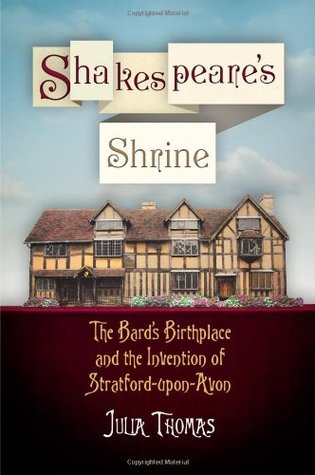
Shakespeare's Shrine: The Bard's Birthplace and the Invention of Stratford-Upon-Avon

13792737

Rating: 3 Stars

Oh you funny Victorian tourists. 

I feel like I should have liked this one better than I did. I think perhaps the reason is, is that the writing was kind of dull at times. I am not particularly interested in Victorian England, and that is really when Stratford became Stratford. So, there's that.

The book, however, does a fine job of tracing the history of the home. The author introduces us to the house in Victorian times, traces the ownership and the task of authenticating it, as well as restoration and the habits f tourists writing their names on the walls. (Yeesh!) It just was not done in a very engaging way to me, and again this could go back to the fact that the place came to be what it was during the Victorian era and nothing makes that interesting to me, unfortunately not even Shakespeare.

I appreciated the fact that there were numerous photographs, carvings, etc. It would have been nice to see these in color though, and not printed directly on the page with the text so they remained in black and white. Or, black and cream, as the pages were not white. The author also had quite an exhaustive list of notes and bibliography that runs some 40 pages. The research is there and it shows, but still it was kind of a struggle to finish this one. That bummed me out, given my Shakespeare obsession. I wanted to like this book a lot better but in the end it was just much more dry than I care for. I don't mean it was overly academic, because I do enjoy my academic texts as much as the next nerd, I really just think it is because the Victorians bore me to tears.

So, give it a go. There's tons of history and information about how that little house in Stratford-upon-Avon became what it is today. Perhaps you will enjoy it more than I did.