Showing posts with label Titanic. Show all posts

Sunday, April 3, 2022

NetGalley ARCs | OF COURSE THERE ARE NEW TITANIC BOOKS COMING OUT IN APRIL!


I received both of these books from Pen and Sword via NetGalley in exchange for honest reviews.

I will never not be a sucker for a book about Titanic. This mindset has even infected my child (big surprise!) and she constantly laments how the school library makes her check out fiction books. She told me just the other day how many Titanic books they have that she wants to read, but can't because they only get one non-fiction at a time. Honestly, it's a really stupid rule. There is no danger of my child never reading. She has TONS of books at home, so many not read yet because of our never-ending love affair with the library where we find even more fiction and non-fiction treasures. Regulating a child's reading in this way is unacceptable.

But I digress.

Titanic Day by Day ⭐⭐⭐⭐

Titanic Day by Day is not a book to be read in a few sittings. It is as much a reference book about the great liner, her passengers, and crew, as anything else, given all of the exhaustively researched details it contains.

The author is the great grandson of Robert Hichens, one of Titanic's quartermasters who was at the helm of the great ship when she struck the iceberg. Hichens would survive the sinking by manning one of the lifeboats and I think this book is a wonderful tribute to not only him from his grandson, but a greater tribute to EVERYONE who lived and died that night.

This book is incredibly unique in that we are given a look at every single person who set foot on the ship during her maiden voyage. Starting on January first, the author lists events on that day related to every passenger and crew member - those who were born that day, and those who survived the sinking but died on that particular day later on. The author also includes news articles from the day, quotes from survivors, and an assortment of facts about the Ship of Dreams. As a result, we get quite a bit of information on both the American and British inquiries in the days following Carpathia's arrival in New York with the exhausted and traumatized survivors.

I truly appreciated that the author sought out information on everyone. So often we only hear about the first class passengers who lived and died, because that is the information most readily available. But second- and third-class passengers were no less important and deserve to have their stories told as well.

This book is nothing short of a labor of love and I would recommend it to anyone with an interest in learning a bit more about those who lived and died that awful night.

Why the Titanic was Doomed ⭐⭐⭐

Full discloser, it annoys me when people say 'the Titanic'. That was not her name. Her name was Titanic, so refer to her properly please and thank you.

There are so many factors at play for why Titanic sank, that solely blaming the iceberg that tore her open is a bit silly. Over the years so much information has been discovered and made public, that chances are you have heard about everything the author discusses (if you are obsessed like I am) even if all of that information has not been confined to one book/article/etc.

There are a myriad of reasons why Titanic sank and the author posits that she was doomed before she even left Southampton on April 10th, 1912. We know about the lack of lifeboats, the rivets and sub-standard metal, the lack of wind, the missing binoculars, the lack of true watertight bulkheads (since they did not actually go all the way up to the deck above), the ignored ice warnings, Captain Smith's decision to maintain speed, and so on.

What the author has done is taken every single issue, devoted a whole chapter to its discussion, and broken down piece by piece every part of the puzzle that lead to 1,500 senseless deaths. That is the core of what the book is about, and he does not spend time recounting the disaster itself minute by excruciating minute, because that has been done several times over already. He focuses on each issue that contributed to the sinking.

The author also looks at the reasons as to why some would live while so many others would die. Specifically of course, in third class, where the majority would not make it to the decks in time to get a seat in a lifeboat.

One issue that is not often discussed is the fact that Titanic should not have even set sail in April. The original date was March 20th. However, when Olympic collided with HMS Hawke in September of 1911, many resources being used to build Titanic were shifted to making repairs to Olympic, thus pushing back her launch date. Given the weather conditions, this is huge, because warmer weather of course meant that icebergs were drifting farther south at that point than they would have been in March.

Given all the positives I have discussed, you might be wondering why only three stars. I have thought about it a lot and my reasoning for this is that there was not any new information here. I liked reading the book, it was well-researched and each flaw was given its fair share of ink. But I do not consider it a 'new and unique' look at why Titanic sank.

Even so, I do believe this would be a good book for anyone interested in looking specifically at each failure that lead to Titanic's sinking. It is clear and concise, while still offering thorough explanations.

Recommended.

Friday, July 16, 2021

NetGalley ARC | Maiden Voyages: Magnificent Ocean Liners and the Women Who Traveled and Worked Aboard Them

I received a free digital ARC from the publisher via NetGalley in exchange for an honest review.

Rating ⭐⭐⭐

I probably would have given this four stars, or at least three and a half, if I would not have had to read about the journey of the mother of the worst president in the history of the United States.

Aside from that drivel, this was a book packed with tons of interesting anecdotes and gossip and I feel the author did a fantastic job portraying life at sea for these women and how their work evolved over time.

I enjoy this period of travel. I love that the author focuses specifically on women and how they made a living on the massive liners that once ran regularly between the US and Europe.

I appreciate that she focused on a a wide variety of women, from all walks of life. We read of celebrities, artists, and the wealthy travelling for pleasure, migrants and refugees seeking safety and a new life, as well as the women who worked for the great shipping companies, sending their wages back home to help care for parents and siblings.

I found women on the crew to be of the most interest to me. I admire these women who worked these long, hard hours at sea to provide for their families. Violet Jessop is mentioned here and I absolutely recommend her autobiography, which I wrote about HERE. Not only did Violet survive the sinking of Titanic, but not long after she survived the sinking of the Britannic (Titanic's sister ship) as well. Her book is a wonderful look into her life, in which the famous and not-so-famous shipwrecks play but a small part. She had even been aboard the Olympic in 1911 when it collided with the HMS Hawke.

There were times when the narrative was very slow and felt like a slog. This could be a personal thing, as we learn plenty about those who travelled by liner because they had the money to do so, sailing back and forth between the Old World and the New. Still, it did take me a bit to finish this one and some passages and stories were not nearly as interesting as others.

There were times when the book became a bit repetitive as well, especially when stories were similar. Not always, but enough to be noticeable.

I never really thought about until this book, just how critical this work was for women who sought independence and a way to support themselves. To say that it changed countless lives would not be an overstatement. Slowly but surely, as women began travelling more, the need for stewardesses arose to help tend to them aboard the ships. That role of stewardess even evolved over time as some women were able to become conductresses and coordinate activities for the passengers. And then as two world wars came, women were able to stay aboard as nurses and continue to make a life for themselves.

Overall I appreciate the author's work and the research that went into the book. She's given a voice to many women who otherwise might remain unknown to us today.

Friday, July 9, 2021

Quick Thoughts | Titanic and the Making of James Cameron


Rating ⭐⭐⭐

The author is kind of a toad who REALLY doesn't like DiCaprio at all, or Hollywood much either it seems. The fifteen year old in me wants to fight her.

The adult in me recognizes this is decent work otherwise, detailing Cameron's passion for underwater exploration, telling the story right, and doing it well.

Tuesday, June 1, 2021

Durham Adventures | James Cameron Challenging the Deep

I have posted a time or two or twelve about a fantastic museum we have here in Omaha. The Durham Museum is housed in the former Union Station (bonus for me, I cam OBSESSED with old train stations) and is an affiliate of the Smithsonian. Year after year I am amazed by the awe-inspiring exhibits that grace its halls.

The most recent exhibit to open is one Eleanor and I have been not-so-patiently waiting for, James Cameron Challenging the Deep. Let me tell you...wow. Just wow. If you don't live in Omaha (this is mostly a good thing, Omaha sucks), then make sure you can see the exhibit on one of its future stops. It is hands-down one of the best the Durham has ever had - and that's saying a lot, considering everything that has come through in the last seven years.

For a brief recap, Eleanor's first visit to the Durham came when she was one month old. My mom and grandparents had come to visit and I was excited to see the latest exhibit featuring Sue the t Rex. I'd seen Sue in her home at the Field Museum in Chicago, but could not pass up the chance to see her again. It did not disappoint, but I did not figure to be back much in Eleanor's younger years, as this is not exactly a museum for children.

Don't get me wrong, there is PLENTY for children to enjoy. There is a massive interactive model train set, as well as train cars for guests to explore. Many sections of the permanent collection are also unique. Not to mention, many of the travelling exhibits have some component that will be interesting to kids - whether designed that way, or by sections/pieces added from the Durham's own collection. I just did not foresee that happening with my almost-three-year-old when we next visited the Durham to see one of Shakespeare's surviving First Folios. Of course I stood there over the glass case, blubbering like a baby as I read Hamlet's soliloquy and museum volunteers asked if I was alright.

After exploring the rest of the artifacts on display, Eleanor was eager to get out of her stroller and clamber aboard the train cars and trolleys. This kid was HOOKED. One a MUSUEM. And she wasn't even THREE YET. We would visit several times in the next couple months alone, even having her third birthday there, as well as her three-year pictures.

Fast forward to May, 2021.

By this point, the majority of the staff knows my daughter and I well. We've done summer camps, Christmas Tree lightings and Santa/reindeer visits, cultural festivals, and Flappers and Fizz events (Eleanor is really upset she's not allowed at these, on account of the alcohol. She gets reeeeeeal upset whenever I go to the Durham without her, which is rare), Halloween shindigs, summer story times and activities, and more. This is all in addition to regular visits. During the summer we are there easily two-three times a week. Time and again staff members have gone above and beyond for my girl and I love them all so much.

So, with this new exhibit opening, you can imagine we were pretty psyched. Though it would be showcasing artifacts related to numerous underwater explorations by James Cameron, we were of course most interested in anything Titanic-related.

Our friend Abby, who works at the Durham and is the Director of Education Services, has also been pretty pumped for the opening and I was so ready to see it after hearing her talk about it. She said it might be one of her favorite exhibits ever, which you can imagine might make it quite good, considering the plethora of others that have some through.

We'd been chatting about it on Thursday, May 20th and I was lamenting the fact that the sneak-peek member-only days always happen on Fridays. We almost never get to attend because Eleanor and I are both at school. Abby told me that due to unforeseen pandemic-related shipping delays, some of the pieces had not actually arrived until that very week, so the members-only day had been cancelled and the official opening for everyone would be Saturday the 22nd.

I knew long before this conversation that Eleanor would be visiting, but hearing Abby talk about how great it looked and how captivating it was, I registered for tickets that night. Plus, facemasks were still required for guests at that time (not until the following week would the mandate expire), so obviously Opening Day was our best choice.

Once she heard that, Abby decided she would go too, even though it was her day off and she did not actually have to be there. It's not often she gets to wander through the museum with us as a patron because she is always working and someone is always calling for her on the walkie. But this would be perfect! I felt marginally guilty because it WAS her day off after all, but...Titanic. We made a plan to meet at the museum a little before ten when they open.

But the story gets even better!

Friday night Abby texts me and starts off with something to the effect of, "I have a super cool secret thing that will be awesome for Saturday for Eleanor and I don't know if I should tell you or let you be surprised too!"

Of course I HAD to know. If it was something big, I wanted to be able to record Eleanor's reaction, because that's what parents do these days, right? Plus, if it was by chance Titanic-related...

Anyway, so Abby tells me that she's been working with a woman named Kim from the Avatar Alliance Foundation, who were partners in creating Challenging the Deep with the Australian National Maritime Museum. Abby had talked to Kim that Friday afternoon about Eleanor and I being Durham Super Fans, and Abby even showed Kim this photo of Eleanor taken the previous summer. We'd stopped at the Durham to pick up supplies from Abby for summer camps that would be held via Zoom for 2020 and Eleanor was clearly upset that she was so close...yet so far away from her favorite place in the entire world.

Abby also told Kim that we would be seeing the exhibit that next day, and would hopefully be the first ones in. At that time I did not realize, or it had escaped my memory, that the Durham was the very first stop on the tour and this was the North American Premier. Kim asked Abby to do her a favor and record Eleanor's reaction going in, because SHE WOULD LOVE TO SHARE THE VIDEO WITH HER GOOD FRIEND JAMES CAMERON so he could see who the very first visitor would be. Kim said that Mr. Cameron supports and encourages young scientists and especially young girls so they are represented in the field.

It was super hard to keep that a secret from Eleanor. I've let her watch Titanic (obviously some scenes were heavily censored, including the span of 45 minutes where everyone dies) so she knows who James Cameron is. We've also talked a lot about Dr. Robert Ballard (who is doing a virtual lecture for the Durham on June 10th and you can register HERE) and how he discovered where Titanic sank. Eleanor is pretty well-versed in her knowledge of Titanic-related people.

So, I had this big secret to keep all night and we got up bright and early to meet Abby at like 9:40, because we were determined to be first.

As soon as we reached the entry to the exhibit hall we both started recording and Eleanor was entranced immediately. There was so much to see, she could hardly focus on one thing at a time. I even felt overwhelmed, but it a completely amazing way because there is just SO MUCH. It truly is an immersive experience. We recorded for about five minutes, then Abby finally told Eleanor WHY we were recording her. Eleanor promptly shrieked and ran away. Then she recovered and told James Cameron hello and how happy she was.

There are four large screens running various short videos on timed intervals - From the Abyss, Titanic, the USS Bismarck, and DEEPSEA CHALLENGER. Eleanor ran to the DeepSea Challenger video immediately and recognized Cameron. She stood watching for a couple minutes, just trying to take it all in. Then I pointed her toward the Titanic artifacts and video. She recognized Jack's outfit right away, and the dress Rose was wearing in the scenes from the night Titanic sank. We saw props from the movie including the Heart of the Ocean necklace and Rose's butterfly comb and mirror that were retrieved from her state room. AND...the last existing copy of Titanic's script, complete with Cameron's notes scribbled all over it.


There was so much more though, SO MUCH. I had no idea just how deeply and passionately James Cameron loves the ocean. There were artifacts from his childhood that his mother had saved, drawings and models he'd created over the years.

We saw deep sea specimens brought up from the darkest depths of the ocean, as well as a wide variety of submersibles used on many of his missions. There is also a replica of the pilot sphere that Cameron co-designed and engineered himself that guests can sit in. This is the vessel he used on his solo dive to Challenger Deep, the lowest known point on earth, in the Mariana Trench.


There's just so much here, I could go on and on and on. We are actually going back tomorrow so my aunt, who is in town visiting, can see our favorite place. Then my mom is coming this weekend for Eleanor's dance showcase and guess where we are going on Sunday? I'll give ya three, but you'll only need one.

If this exhibit is coming anywhere near you on its tour, you must go see it. It will take your breath away.

And of course Eleanor and I could not leave without a few treasures of our own. Yes, yes we did both get Heart of the Ocean necklaces.

Sunday, February 17, 2019

The Other Side of the Night: The Carpathia, The Californian, and the Night the Titanic Was Lost

18882752

Rating: 4 Stars

I wanted so badly to give this book five stars because I agreed with much of it, right up to nearly the end at 82% when Butler flat out calls Stanley Lord (captain of the Californian) a sociopath. He very well may have been, but we can never know for sure. All we do know is that night, as the ocean swallowed up the grandest ship ever built, two men made very different choices. One chose to rush headfirst into danger in the hopes his ship could arrive in time to save the passengers of Titanic. The other simply ignored the information from his crew and went to sleep - and in the aftermath changed his story countless times.

Okay, so yes, when you put it that way, he sounds pretty sociopathic.

Another issue with the book was Butler's obvious bias. This did not really bother me, because I pretty much hold the low opinion of Lord that he does, but I can see how this would come across to someone who is a little more in-between or holds no strong opinion either way (except how can you not have a strong opinion about this? His ship was close enough to have rescued nearly everyone!)

This text is a contrasting study of two men, Captain Arthur Rostron of the Carpathia and Captain Stanley Lord of the Californian. Both men were informed early on of Titanic's precarious situation when they received the distress signals from the two brave young men who kept sending out signals until the very last possible moments when they too, finally had to try to save themselves.

This is a fresh perspective I believe, because Titanic is not the focus. Instead, the author looks at the actions of each captain, what those actions meant, and the aftermath of their decisions that night. While you often can get sections dedicated to this very sub-topic in books focusing on Titanic directly, this provides so many more in-depth details about what went on on either of the other ships as Titanic foundered. Butler does not spend time going over the timeline of events as they occurred for Titanic, as there are already a plethora of books that do just that (including another the author has written, called Unsinkable: The Full Story of the RMS Titanic, which is fantastic. But even better would be Walter Lord's A Night to Remember, which remains the number one book about the tragic event of April, 1912). Instead, the perspectives are strictly that of the two ships, what went on during the course of the evening on the Carpathia, and likewise the Californian. And believe me, they could not have been more opposite if they tried.

Throughout the book Butler gives his analysis of the two men, their leadership styles, and how they ran their ships. I think his insights are valuable and his arguments clear. I don't feel like he went after Captain Lord because the story needed a villain - we already have plenty of those; mainly the men who decided that fewer lifeboats (cough*Ismay*cough) were necessary because they would crowd the deck. I think his criticism is justified because Lord chose to ignore a ship in distress. Whether he was actually a sociopath and didn't care, or he truly feared ramming an iceberg himself, we can't really know. However, given documentation about his leadership tendencies recorded for posterity, I personally do not think he was afraid of anything that night. Many arguments have been made that it was not Titanic that Lord's officers and crew saw that night, but even if this is true, so what? The bottom line remains that there was a ship in distress nearby, and Lord did nothing to come to their aid. Again, I think it is difficult to declare someone a sociopath decades after their death, perhaps he really was just a coward. Or lazy. Or all of the above. Lord's actions were pretty telling. There are two logs kept by officers. One log is the official one, where final entries are made regarding the goings-on of the ship. Then there is the scrap log, where the notes and such are first jotted down, before becoming part of the official log. Captain Lord had those scrap logs destroyed before anyone could see them. Doesn't sound like the actions of a man who did nothing wrong, to me at least. The author goes into a bit of detail about these two logs, again showing why Lord's actions are so questionable:

"It is a captain's responsibility to review the contents of the scrap log daily and approve, amend, pr correct entries, after which they are entered into the ship's formal log. The scrap log is kept as a back-up, though, and rarely disposed of during a voyage...The Californian's scrap log for the night of April 14-15, 1912, had vanished, and (that) the formal log contained no references whatsoever to the ship seen by three of Lord's officers, the rockets that ship fired, or Lord's order to attempt to contact the ship by Morse lamp - glaring omissions under any circumstances" (65%).

and

"The duplicity went even further, of course, including the inexplicable disappearance of the Californian's scrap log, for example, or the impossibly innocuous entries in the formal log for the morning of April 15, 1912. Falsifying a log entry is one of the most egregious offenses which any captain can commit, yet only someone truly credulous would believe that Stanley Lord was not responsible for the alterations and omissions found in the logbook of the Californian" (82%).

Given the packed ice field that the ships found themselves in, it would have taken the Californian a bit to reach Titanic, there is no dispute there. Estimates say even if Lord had given the directives to reach Titanic, perhaps only another 400 or so would have been saved. But I am struck by that word, 'only'. Only? That's a further FOUR HUNDRED MEN, WOMEN, AND CHILDREN! That's lives saved, families relieved, what a world of difference Lord's actions would have meant to those people. This quote I think illustrates the whole situation quite tragically perfect:

Standing on an overturned lifeboat, less than fifty yards from the Titanic, Second Officer Lightoller heard a sound that would haunt him for the rest of his life: as the ship began her final plunge, he could hear people - husbands and wives, brothers and sisters, parents and children - crying out to one another, "I love you."

Quite a difference, indeed.

We see quite the opposite reaction from Captain Rostron. Immediately upon receiving the distress calls he orders the ship to change course, full steam ahead, and goes through such a thorough check list, one must wonder if he has prepared for just this situation throughout his entire career. While keeping their passengers calm, the crew of the Carpathia followed every directive, finding blankets, clothing, all manner of everyday items that someone would need if they had just lost everything in the most famous shipwreck in history and were completely and utterly in shock. So many stories have come from this night, how Carpathia passengers gave up their rooms for the survivors of Titanic, and also helped in any way they could. It is just the light needed in a story otherwise full of selfish men who thought of nothing but the bottom line. Captain Rostron took significant risks in order to arrive as soon as they did (which still took a few hours). Carpathia was pushed to her limits. Designed to travel at a maximum speed of 14 knots, she maintained an average speed of 17 knots, slipping around the icebergs that dotted her path. This could not have been an easy decision to make, to put his own ship in danger. But Rostron knew there was no other choice. Another ship was in trouble and it was his duty to provide aid in any way possible. Though Carpathia would arrive roughly four hours after Titanic sank to the bottom of the ocean floor, it was not for nothing. 700 passengers were scattered across a few miles of ocean, bobbing along in their lifeboats, waiting for a rescue they had no idea might even come. Side note about the life boats: When Carpathia arrived in New York, the crowds were puzzled when Rostron passed by the Cunard Line's berth and headed instead for the White Star Line one instead. At the dock, Carpathia's crew returned the life boats to the White Star Line, all that remained of Titanic. What a sight that must have been.

There is so much damaging information here that the author has taken from the contemporary sources. Lord was apparently a very difficult captain to work for and it seems to make sense why none of his officers or crew pushed too hard for what actions they should take when they informed him of the white rockets they saw exploding in the sky. It seems like his men were afraid of him - easy to see why when one considers the fact that it was apparently at gunpoint that they wrote affidavits of what happened that night, according to Lord's wishes.

Okay, okay, the sociopath part is becoming a little more obvious, even if I still think there is danger in diagnosing someone from an earlier time period - even if that period is not too far removed from our own.

Here are a few more quotes that I found particularly interesting:

"Yet somehow, despite Stone's report, from this moment onward, Lord never appeared to consider the idea that the rockets seen by Stone and Gibson were actually a distress signal - in fact, his actions (or more correctly, his inactions) appear as if Lord deliberately refused to entertain the idea. How or why he refused to do so would never adequately be explained, by himself or anyone else, for nearly a century" (35%).

More interesting then, that this follows:
"...The preface to the Board of Trade regulations publication was clear: 'Note - if these signals are used in any other place, for any other purpose than stated, they may be signals of distress, and should be answered accordingly by passing ships...' In other words, when it doubt, take no chances - investigate" (35%). And yet Lord didn't. The flares were going up, bright and white against the sky, and he chose to do nothing.

The Californian's crew realized what was going on, and discussed it among themselves, but none had the courage to question Lord, as he comes across as kind of a tyrant who had to have things his way, with no input from his officers. Two officers, James Gibson and Herbert Stone, reported what they saw to Captain Lord, and agreed within their own private conversation that "A ship is not going to fire rockets at sea for nothing" (36%). Both came to the conclusion that something was wrong with whichever ship they had seen. Yet Butler goes on to explain their own inaction as well:

"Gibson, a mere apprentice officer, lacking the authority to take any action; Stone, possessing such authority, but personally insecure, hesitant, and vacillating despite his experience as a watch-keeping officer; and Lord, autocratic, overbearing, passionately concerned with his own self-protection, his oppressive personality a brooding presence on the bridge that effectively crushed any initiative the two junior officers might have shown" (36%).

I do want to again return to the idea that Captain Lord was a sociopath, as Butler has boldly claimed. As I said, I think it is dangerous to apply labels to those from the past, even though Lord is in the not-so-distant past. I have discussed this so many times, particularly when current historians try to diagnose Henry VIII with all kinds of afflictions, when it really is entirely possible that he was just an asshole (either way, he was). BUT, I can appreciate the way in which the author does this, for the most part. The author goes to great lengths using testimony from the hearings to let Lord's words speak for him, as they literally should. His answers given to the Board clearly show his guilt, though he would never take any responsibility or show any remorse. I have so many quotes I could use, but this review would then grow exponentially, and I think it is best to wrap up here shortly. Still, this diagnosis is important, because it potentially caused hundreds of deaths that did not have to occur, if only Lord had done what was required of him as a merchant steamer captain. He chose to do nothing, and as a result earned a place in the immortal 'Lousy Person Hall of Shame'.

Butler explains in his analysis that Lord's "sociopathic behavior revealed itself in a number of subtle but distinct ways" (82%) and goes on to list them as first and foremost, his reaction to when Stone reported seeing the rockets fired; Lord knew he was required to do all he could to investigate those rockets, yet he did...nothing. He also knew that his officers would not question him, given his supposed overbearing and oppressive leadership style. As mentioned before, Herbert Stone could have, but chose to do nothing, perhaps out of fear of his captain's reaction, and this is exactly what Lord counted on. Then, at 83%, Butler directly addresses the idea that Lord showed no remorse for the remainder of his life about the night Titanic sank. "At no time did Lord ever express the slightest remorse or regret for his inaction in the early hours of April 15th, 1912. Not one word of condolence for the families of those lost on the Titanic ever passed his lips. Never once was there recognition, however belated, that he might have - should have, could have - done things differently that night...It was not simply a case where Stanley Lord did not believe himself to be guilty of the actions of which he was accused; to him, it was simply inconceivable that he could have done anything wrong." Butler then at the end goes on to describe how he came to the conclusion that Captain Lord was in fact a sociopath. At 98% he expresses thanks to a multitude of clinical psychologists who he discussed the information with. He lists several, as well as where they practice. He states that they all came to the conclusion that sociopathy was at work within Captain Lord, and did so independent of one another.  would be curious to know how Butler went about presenting the information, and perhaps he does address this within the notes, or an appendix somewhere that I simply missed. I would hope that he presented the behaviors, words, and actions as anonymously as he could, so as to not create a bias immediately from any of the respondents.

I will finally end with this because, though Captain Rostron, his crew, and the Carpathia passengers must be given all the praise for their heroic efforts on that traumatic night in April, it can not be denied that Captain Lord's behavior and inaction were completely unacceptable.

"For the simple truth is that on the night of April 14-15, 1912, somewhere on the North Atlantic, within sight of the steamship Californian, someone was firing white rockets into the night sky, in a desperate hope that some ship - any ship - would respond in time. The crime of Stanley Lord was not that he may have ignored the Titanic's signals, but that he unquestionably ignored someone's cry for help. This is a cold, hard truth that, no matter how much the partisans of Stanley Lord might wish to deny it, they are unable to do so. Nothing can make those eight white rockets go away; nothing can make Lord's frank acknowledgement - then and subsequently - that the signals were white rockets go away; and nothing can make Lord's refusal to respond to them go away. The chilling reality is that Lord's inaction probably cost those unfortunate people, whoever they were, their lives" (81%).

Highly recommended.

Wednesday, December 19, 2018

How to Survive the Titanic, or, The Sinking of J. Bruce Ismay


12631852

Rating: 3 Stars

Ismay is wholly unlikable, no two ways around it. The decisions he made or didn't make aboard Titanic leading up to and on the last night of her existence are what he will be remembered for. Unfortunately we only have his word to go on, seeing as how Captain Smith did not survive to confirm or refute anything.

Whether it is the movie or real life accounts of what happened in those final hours, there is a scene that always sticks out for me, and that is the one where Benjamin Guggenheim and his valet are, "Dressed in our best and prepared to go down like gentlemen" as he says in the movie. His valet looks less than thrilled, but remains with his employer. The additional words he spoke to a survivor are recorded as, "I am willing to remain and play the man's game if there are not enough boats for more than the women and children" and "No woman shall be left aboard this ship because Benjamin Guggenheim was a coward."

Contrast that with Ismay, who rather quickly climbed aboard a lifeboat, though he attempts to explain why, and what he was doing beforehand that allowed him to be in a position to even get to a lifeboat. The author definitely is no fan of Ismay, but when one looks at the course of the night and what observations and documentation we do have, it paints a fairly awful picture. Now, who is to say any of us would not do the same when faced with a literal life or death situation? No one knows how they will react until they are forced to do so and I hope none of us ever are in that position. However, I agree with a fair amount of the author's conclusions in that Ismay certainly did not do all he could in the short time he knew Titanic had left above the waves. Even so, the author does make claims that we can not possibly know for sure are true or, as the men spoken of did not survive. The author must also consider the fact that even had these men tried to get the life boats, they most likely would have been denied when there were still woman and children to load.

"On the Titanic, Ismay was the only man, apart from the Captain, the ship's designer, Thomas Andrews, and the Chief Engineer, Joseph Bell, who know that the ship would be at the bottom of the sea within two hours and that the available lifeboats could carry less then half of those on board, but he did not warn, or even try to find, Dr O'Loughlin, who had been his dining companion that evening, or Charles M Hayes, who was travelling as his guest, or Richard Fry, his valet of ten years, or George Dodd, his family's former butler, now working as a steward in first-class, or Arthur Hayter, who had been his steward throughout the journey, or William Harrison, his secretary, all of whom were to die..." (9%).

Let's also just ignore the fact that what you just read is one sentence. Seriously, go back and look. I did not notice until I was typing. Yeesh, comma overload. But still, do we know for certain he did not warn anyone? He did not even attempt to locate Hays, his own guest? I am all for pointing out the things Ismay did wrong, but it is almost like just piling on at that point.

Ismay was probably in shock, just like everyone else. How many times had people repeated the idea that she could not sink. What an awful that must have been when in fact, she could - and did? I don't doubt for one moment that Ismay loved the ship dearly. Both his writing and that of his wife say as much, as shown here:

"Men like Lightoller assumed that the owner would see his ship as no more than a description of profit and loss. But Ismay was not typical; he loved the Titanic like 'a living thing', as his wife put it. Perhaps, he later wrote to Marian Thayer, he had loved the ship 'too much', had been 'too proud' and such was his punishment" (11%).

There are other incidents outlined that show not only did Ismay recognize how much trouble this was going to cause, but he sought every avenue he could to try and get back to England as quickly as possible. Of course there would be an investigation on both sides of the Atlantic, and he wanted no part in being detained for the US one. 

"Ismay, meanwhile, was planning his return voyage. He could not face New York: the onslaught of information, the questions, the crowds, the grief, his wife's American family, the White Star Line executives, the insurers, the press, the publicity, the sharpening sense of the horror of it all. he would have to endure, he assumed, a rough few days - possibly even weeks - of media coverage before interest in the Titanic would fade away and he could get his life back" (14%). In trying to understand what made him tick, and how he ever imagined that he could go back to his normal life, I feel like he would be both proud and horrified to know how obsessed we still are with Titanic and her fate, 106 years later. I think he would be proud because Titanic was his crowning achievement, and he was so parentally (yes, it's a word) proud of her. On the other hand, he would probably also be heartbroken to know that the wreckage and the story keep us intrigued even when we think we know all that there is to know. While she was his great achievement, she was also his biggest blunder and there is no denying that. In fact, Ismay may have even contributed to Titanic's quick sinking. This has long been accepted as part of the story, though I suppose we may never now for sure. Officer Lightoller's granddaughter Louise Patten shared a story that was kept a 'family secret' for nearly 100 years in regards to that night. Supposedly it is something that her grandfather told her grandmother, and it is hard to see what purpose it would serve now if it were not true. This is not the only instance where it has been reported that the ship started up again after the collision. "Following the collision, when (Lightoller) had gone to the bridge to ask if the blow was serious, Ismay had told Captain Smith to continue moving 'Slow Ahead'. The ship, which had stopped following the collision, now started up again and continued at a speed of around 5 or 6 knots until 12:15 a.m., when the Captain sent down the order to once more stop the engines. In pushing her forward, Lightoller believed, Captain Smith had allowed water to pour through the damaged hull at hundreds of tons per minute and to burst through the six watertight compartments, one after another. Had the Titanic stood still, 'the whole ship would have assumed a fairly acute and mighty uncomfortable angle, yet, even so, she would, in all probability have floated - at least for some considerable time, perhaps all day. Certainly sufficient time for everyone to be rescued'" (40%). Patten also maintained that Ismay and Lightoller had spoken while still aboard the Carpathia, and that due to some insurance exceptions, if the White Star Line was found liable, it would all but put the company out of business and hundreds would lose their jobs. Seems an awfully hard thing to put on one man's shoulders, especially considering the fact then that Lightoller never received a command of his own, despite his unwavering loyalty to his employer.

Yet throughout the hearing, Ismay repeatedly deflected any questions regarding his role on the ship, and was merely a 'super passenger' who happened to be the chairman, who happened to know about iceberg warnings, who happened to know daily the speeds she was running at. When much was made of the fact that Captain Smith told him of the iceberg warnings, he again try to say there was no special reason that he was receiving them. As the author states, "As far as Ismay was concerned, the Captain had handed him the message for no reason, and it said nothing" (64%). It might has well have been exactly that, for all the good those ice warnings did. Not much longer later in his testimony, Ismay even went so far as to say that, "(Ismay) had insisted that he had not talked to the Captain at all during the voyage" (66%). So we are to believe that the chairman of the White Star Line ambled around the ship all day, with Captain Smith periodically handing him telegrams without either man uttering a word? That makes the kind of sense that doesn't.

There was also the fact that Ismay played this silly kind of word game that only later would we recognize as the same kind Bill Clinton played during his impeachment hearings. While maintaining the position that he held no authority on the boat, Ismay time and again passed the buck completely. He argued about whether or not he was 'giving directions' which is what those conducting the hearing tried to prove he was doing, in order to show he was not simply another passenger, but was in control from start to finish. "Calling for the women and children and then helping them in was the same thing, Ismay suggested, as giving directions" (66%). Really? I am pretty sure that if I saw and heard the chairman of the company calling for people to get into lifeboats, I would take that as him giving orders and directions. But this was a theme throughout, it feels like. He tries to muddle the situation, when it seems clear that he was more than a passenger.

Of course, anyone who knows the story knows that in the end no one was held responsible for the deaths of 1500 people who had no chance for survival due to the greed of man, the need for the rich to have more space, and the disregard for life of those who had no wealth. Through the ordeal Ismay continued to take no responsibility for anything, despite the fact that the White Star Line eventually settled and judge ordered them to pay over $500,000 for loss of life and property. This came out to roughly $30,000 per life. Sad, isn't it? Yet there was Ismay, writing to the object of his affection, Marian Thayer, who had lost her husband and eventually responded to Ismay that he misunderstood her intentions and she did not return his feelings. I find it rather insensitive that Ismay would write to her saying that the inquiry was "the most trying ordeal to go through. They had me on the stand for seven hours and I was not in a fit condition either mentally or physically to give evidence" (67%). Gee, I am sure she had tons of sympathy, seeing as how she had lost her husband that night.

The author mentions another book entitled The Ismay Line by Wilton Oldham and recounts a conversation that Ismay had with his sister-in-law, Constance, about the night he escaped with his life. "The reason, he revealed to her, that he had jumped was not because the boat was there and the deck was empty, but because he had been ordered to do so by Chief Officer Wilde, who said that Ismay's evidence would be needed at the subsequent inquiries. Ismay left the ship knowing that the purpose of his survival was to represent the Captain, the crew, and the company, to be the witness of the night, to contain, explain, and make sense of it all to the bewildered world. In exchange for his continued life, he must carry into the history books the story of the Titanic. Why did he keep this a secret?" (71%). certainly an interesting question, isn't it? I find some of this suspect, like why the chief officer would be ordering the chairman to do anything. To me it just felt like one more time Ismay was trying to absolve himself from something he would never actually be able to.

There are some issues I had with the book that made it less enjoyable than it could have been, because I typically love reading about Titanic. Throughout the book the author constantly alternated between Ismay's story and that of Joseph Conrad's character Charles Marlow. it was a constant comparison and completely slowed the book down. I completely skipped all of those parts because I felt it added nothing to the story. I started too, but quickly realized that it was not relevant, and Ismay's story was interesting enough without all of the comparison.

Another issue I had with the book is this kind of silly, flowery language used to describe this or that and it just did not fit the tone of the rest of the book. I would sometimes come across paragraphs like the one below, and wonder why oh why, what was the purpose? Here the author is describing the relationship with the Marconi device to send the telegrams and it is...silly.

"The message from the Baltic whispered to Ismay from a fork in the air, it had been hammered into solid form like the voice of a dead man being rapped out on a table-top. Marconi operators were spirit mediums and the words they transcribed were always already dissolving. The Marconigram was evidence of communication without presence; it proved the possibility of connecting with other worlds" (66%).

All throughout, the author really seemed to be biased against Ismay. Then, as the conclusion came, I read this line, "He was an ordinary man caught in extraordinary circumstances, who behaved in a way which only confirmed his ordinariness. Ismay is the figure we all fear we might be. He is one of us" (74%). So...does that mean we can/should excuse his actions that night? I am not insisting he should have gone down with the ship. But I am insisting that he should have been one of the last to leave. I think he tried to play those holding the inquiries as fools, with his constant denial of controlling anything or being in charge. OF COURSE the crew would defer to him on matters. what would you do if your boss suggested picking up the pace a bit? You would do it, because what choice did you have when you were captaining the grandest ship in the world on her maiden voyage.

Overall, I can recommend this one with some caution, if you don't mind the nonsense.

Sunday, May 1, 2016

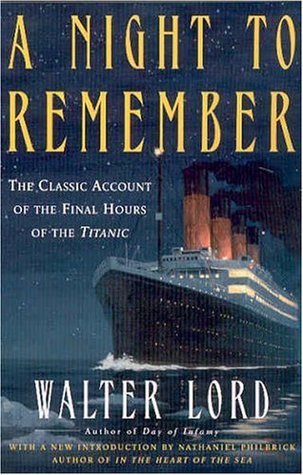
A Night to Remember

61834

Rating: 5 Stars

Review:

I am not sure what else can be said about this account of the sinking that has not already been said - aside from something personal for me in that I have no idea why it has taken me so long to read this one. I mean seriously, I have owned it for ages, at least a year. And really there is no excuse even before that, for someone who claims to be such a Titanic-enthusiast. Okay, that sounds terrible, to be an enthusiast of some a tragedy of such proportion. But if you have ever read a single other review of any book about Titanic tat I have read, I think you understand what I am awkwardly trying to get at. Basically, I should have read this one a long time ago.

There are several reasons this remains the classic account of Titanic's final hours. Lord is a very good writer and at the time this was written - in 1955 - he was able to interview over sixty survivors. That in itself is amazing to me. To gain insight and recollections from people firsthand, not simply reading their memoirs or diaries later, but straight from their own mouths. 

The shifting of points of view is important to the story as well. This is not an account of the entire voyage, but begins immediately in the crow's nest with Fleet spotting the iceberg. There's no need for superfluous prose, we are at the heart of the matter within moments and there the iceberg looms. For those of us having the luxury of reading about the event 100 years on, we can do nothing but helplessly read as the minutes tick by as the ship slowly meets her fate.

We also see the events as they occur from the perspectives of both the Carpathia and the Californian. Just an aside, the lack of response from the latter ship will never cease to be infuriating. If they knew the ship steaming past them was Titanic, something the crew even discussed among themselves apparently, then they also thought they saw the ship stopped, trying ti signal with Morse code, and firing several flares after midnight WHY WOULD THEY THINK EVERYTHING WAS OKAY??!!

The actions in those early morning hours of the Carpathia and her crew are also deserving of attention, but in a much more positive way. Too full steam ahead into an ice field, faster than the ship has ever sailed before, preparing for survivors, passengers giving up clothing, bedding, toiletries, etc. I also have always found the account particularly worthy of a mention in that when Carpathia finally reached New York, she did not dock at the Cunard pier first. Instead, Captain Rostron guided his ship to Pier 59 where the White Star Line ships were docked and returned the company's property - the lifeboats. What a wholly heartbreaking sight that must have been, when those on-shore realized what was happening.

Here we get all the standard Titanic accounts we are used to - Ida Strauss unwilling to leave her husband after so many years together, J.J. Astor inquiring if he might join his pregnant wife in the lifeboat but his request being decline, Guggenheim and his personal attendant dressing in their best to go down like gentlemen, Thomas Andrews in the smoking room in those final terrible minutes, and so on. We HAVE those stories BECAUSE of this book. Without this account, we might not know of these stories, or others detailing cowardice or bravery on the part of many crew and/or passengers.

If you only ever read one book about Titanic, it should be this one. Highly recommended.

Wednesday, December 30, 2015

100 Documents That Changed the World: From the Magna Carta to WikiLeaks

26236825

Rating: 3.5 Stars

Review:

I really love books like this, the '50 Objects..." or "12 Maps..." that 'changed the world' type books. This book is no exception, as it covered several documents that truly did change the world, for better or worse. While I disagree somewhat with some of the items included ('War and Peace' and '1984' - I do not consider books to be documents per se), the majority really do help the book live up to its name. How can you go wrong when writing about Magna Carta, the Emancipation Proclamation, the Apollo 11 Flight Plan, and Anne Frank's diary in one volume?

Turns out, you can. Or, at least not 'go wrong', but you can be lacking in detail and description at times. I understand this is not meant to be exhaustive, seeing as how it is quite slim to begin with, so I will get my complaints out of the way before I delve further in to discuss some of the specific documents addressed that I felt were among the most important. There is only one actual page of textual information devoted to each document, though that page often included a small picture of those who signed, witnessed, wrote, etc. the document. The opposite page was usually a picture of the document itself. Additionally, for a good portion of the beginning, nearly all of the documents were from Western Europe. Not all, but a good majority. Surely there were other important documents that could have been included from around the world and not just those few.

Now, to the documents I found most fascinating - it is also kind of embarrassing to admit that I did not know some of the facts I learned from this text. In my defense perhaps we were not taught those aspects in school? So many of these documents today exist now in the National Archives and I wish desperately to see them - namely the Fort Sumter Telegram announcing they were surrendering, and the Emancipation Proclamation. These were two hugely important documents that exist as a testament to the resolve of our young country - we were willing to go to war with ourselves to achieve the ends we wanted. The telegram began the war and the proclamation set us on the road to ending it. As an aside, I never knew that the E.P. ONLY freed slaves who were living in the states that had succeeded from the Union - AND applied only to those held by the Confederacy. So, apparently it was a shrug and a 'sorry' to the slaves living in areas recaptured by the Union, or the nearly 500,000 living in those border states who had not succeeded.

I am curious about the exclusion of the Gettysburg Address as an important document and thought perhaps it was excluded due to the inclusion of the Emancipation Proclamation. But both Martin Luther's 95 Theses were included, followed directly by the Edict of Worms. Those documents were separated by only four years, but concerned the same topic, so not sure why Lincoln's famous speech was not considered important enough?

Fun Fact: Apparently our Founding Fathers were not terribly responsible. The original copy of the Constitution had vanished at some point after its signing and no one knew where it was until 1846! Also, it has only been on display since 1952; I didn't realize it was such a short amount of time when I visited in 8th grade on a class trip.

A little dirty laundry gets aired here in the form of which states ratified the 19th Amendment and when - you keep it classy Mississippi, not ratifying until 1984. I am not surprised that many southern states were among the last to ratify it.

The 15 year old girl in me who will forever love Titanic could not help but be wistfully glad to see the inclusion of Titanic telegrams included as important documents that changed the world. Movie references aside, it really was a wake-up call to these shipping companies that safety measures needed to change and improve to avoid another tragedy on such a scale.

There were several documents relating to World War I and II, which should come as no surprise. The Treaty of Versailles is always troubling to me, as it basically assured that there would be another war - how could there not be? Germany was forced to take all the responsible for the Great War, only for the fact that they were the last ones standing when the war came to an end. It should shock no one that the Nazis were able to rise and grab power so swiftly; the treaty was crushing and the reparations were impossible.

When I think of a document, I think of something of the non-fiction, factual variety. This is why I struggle with the inclusion of books - manuscripts - in this text. However, I feel that Anne Frank's diary certainly deserves its place. The importance of this diary can not be overstated and if you do not believe me, try standing in the Annex and imagining living in this cramped space with seven other people, the majority of whom you struggle regularly to even get along with. It is one of the most humbling experiences I have ever had in my life and could not imagine spending two years in that place. Anne's diary gave a voice to the millions who had theirs cruelly and violently taken away. I did NOT like, however, that Miep Gies was simply referred to as the 'family friend' who later saved Anne's diary after the family had been taken away. Even with the focus being on the document itself, surely Miep deserves much more credit than that.

There were so many documents that I found interesting, I could keep writing for a while. I will finish this up with reference to a certain CIA document, dated August 6th, 2001, that stated very clearly an attack on the US by bin Laden was imminent. Unfortunately, this memo was handed to one of the most incompetent presidents in the history of our country, while he was staying at his ranch in Texas. You know, one of his 406 vacation days taken in his presidency, or some absurd number that the GOP conveniently likes to forget whenever they complain about Obama playing a round of golf. As a follow-up, the Iraq War Resolution was included but I couldn't even bother to read such garbage.

So, overall, this really is 3.5 stars. There were so many documents that belonged here, but at times their importance almost felt diminished simply because often only the bare facts were included. It is by no means a be-all, end-all for any of these documents and while I can recommend reading this one, I would also suggest further reading on any of the documents that interest you.

Wednesday, November 11, 2015

Titanic 1912

13564440

Rating: 2 Stars

Review:

Well.

I am trying to be nicer in my reviews and finding positives among the negatives. It is hard though with books like this that will just make a statement and not back it up with any evidence, contemporary accounts, etc. I am glad I got this one for free on my Kindle.

First, the positives. There were many photographs I had not seen before - and some I never care to see again (primarily the one where a body is being pulled from the ocean during the recovery efforts. Even though it was just on my Kindle and it was an old photograph, a bit blurred and all, this is just not something I care to see. However, the myriad of other photographs aided in the story where the text was lacking and I found them to be interesting. Some were repeated however, so perhaps that will be cleaned up in a new edition.

The author seems to have it in for Captain Smith from the start. He makes statements throughout that Captain Smith ignored all the ice warnings, he didn't fire the rockets in the correct order so as to signal distress, etc. While I don't think he ignored the warnings in the way that is implied here, people have to remember Titanic was one of the biggest ships in the world, captained by one of the most experienced seamen at the time. Captain Smith had years of knowledge working against him - along with the notion that the ship was unsinkable. While realistically many seafarers probably recognized that no ship is truly unsinkable, the chaotic and celebratory days of the first voyage must have made it easy for them to want to believe the hype. Secondly, every book I have read thus far of crew member accounts, plus those on the nearby California who refused to answer the distress call, recognized the flares as a distress call. I would have liked the author to elaborate and explain what he means by the rockets not being set off correctly. Unfortunately, there is none.

In addition to lack of information, this applies as well to the interesting premise the author includes early on about comparing Titanic to the Costa Concordia which sank a few years ago. Some of the parallels are mentioned earlier on, but eventually that just kind of goes by the wayside and there's no follow up. It seems kind of pointless to have included it at all, when there was little analysis. Again too, with the author's mention of the book published fourteen years before Titanic sank, called Wreck of the Titan. This was one of the shortest chapters, yet could have been so much more interesting. There were similarities to begin with between the book and Titanic, though I believe I read in a different book that after Titanic sank, a new edition was published with added details to make the sinkings even more similar. Again though, no analysis where there was room for plenty.

All in all, I did find the photographs interesting. I can't completely say don't bother, if only for those. However, this book truly only skimmed the surface and could in truth have been much longer, but also much better. I wish the author had delved a little more deeply into the topics I mentioned above, as well as a few others I've chosen not to go into for sake of brevity. It's got a pretty steep bias against Captain Smith also, and little blame put on Ismay, which I think is inaccurate. The author even says at one point that Ismay wouldn't have pushed for the ship to go faster, as passengers would then have arrived a day early and be ahead of any reservations they might have made in the city. Personally I highly doubt Ismay would have cared about that when he could have gotten major headlines for arriving early. More attention meant more people ready to spend money which in turn meant a bigger profit for him.

Anyway, if you have never read a single book about Titanic and the movie is your only source of knowledge, do not start with this book. If you have a good base, this one might be okay but you won't learn many new facts.

Friday, November 6, 2015

Survivors Stories of the Titanic

1894983

Rating: 4 Stars

Review:

I feel kind of wrong in reviewing or even rating this one. I mean, seriously, how do you review someone's recollection of what is likely the worst night of their lives? A tragedy of this magnitude can't really even be imagined by those who did not experience it, no matter how many times we might watch Jack and Rose trying to survive.

This neat little volume is a compilation of three accounts of the sinking - Colonel Gracie, Second Officer Lightoller, and Harold Bride, the assistant radio operator.

Colonel Gracie's account is first and the most detailed - also very objective. It is certainly unlike new texts written about the sinking that play on emotion. It is very detailed, and but also almost technical - perhaps that does not make a lot of sense, but it might should you decide to pick this one up. Gracie's account begins far before the sinking, and we get glimpses of several other passengers, including some brief commentary on Mr. and Mrs. Straus. They became more real - and their story that much more heartbreaking, when here we are given a new account instead of the usual anecdote about how Mrs. Straus refused to leave her husband's side and so they both perished. I have always found it especially heartbreaking that though she refused to leave him, even in death they were still separated, as her body was never recovered.

Naturally for those who do still enjoy the movie, there will always be the habit of comparing the film to real-life accounts. I found myself a little disappointed in Office Lowe based on testimonies given at the British and American Inquiries, which were relayed in at least in part in Gracie's account. In the movie, Lowe is the one to start lashing the lifeboats together and shuffling passengers in order to return to pick up any survivors from the water. But varying accounts given disagree on certain aspects - disparaging remarks made about those not 'worthy' of rescue and such. Other testimonies claim he acted with the utmost care and respect. I'd like to believe the latter. 

My thoughts as I finished Gracie's account add up to this: No matter how may times I read about it, it still infuriates me as to how few people were placed in some of the lifeboats. I hear Victor Garber's voice echoing in my head every time with his line, "Rubbish! They were tested in Belfast with the weight of 70 men! Now, fill these boats, Mr. Lightoller, for God's sake man!" I like that he used testimony from both Inquiries, and I wish Ismay had shown half the courage that Captain Smith had in going down with the ship.

I enjoyed Lightoller's account as much as I did Gracie's, inasmuch as you can enjoy the subject matter. It was interesting to have a crew member's perspective to compare to that of a passenger. I found this quote to be fitting, as I have always had a special spot in my heart for the much-maligned-by-some Captain Smith, "Captain 'EJ" was one of the ablest skippers on the Atlantic, and accusations of recklessness, carelessness, not taking due precautions, or driving his ship at too high a speed, were absolutely, and utterly unfounded; but the armchair complaint is a very common disease, and generally accepted as one of the necessary evils from which the seafarer is condemned to suffer." Though Lightoller's account was much shorter, it was still very sound and full of detail. As the highest ranking officer to survive, I think we can and should take his word at face value and stop putting all blame on Captain Smith.

The final section was brief, just a few pages. Bride was the assistant Marconi operator and his account of the night, though short, gave us a good view of Jack Phillips, who worked ceaselessly until the last possible moment to try and summon any possible help that he could. Like the stories of the band continuing to play, I find Phillips actions heroic. He continued sending out distress signals a full fifteen minutes after being released from his duties by Captain Smith. it is a shame that having survived the ship going under, he was unable to survive the night. But, we have Bride's account here to ensure that his bravery is not forgotten.

I definitely recommend this collection for those who love Titanic history. It was a refreshing change of pace to read survivor accounts as opposed to the rehashing of the tragedy by historians today, who are quick to quote survivors and then put their own spin on the information.

Sunday, September 13, 2015

Titanic Survivor

684897

Rating: 4 Stars

Review:

In the past I have often had an issue with a book presenting itself as one thing, then becoming something entirely else. This is one case where I am utterly okay with that scenario. I was expecting another recounting solely of Titanic sinking, and was much looking forward to it. Pretty much all the accounts we have of survivors come from passengers, yet here finally was an account of the sinking from someone who worked on the ship. Yet, there are only three chapters actually devoted to the sinking, but I could not put it down. What a remarkable and adventurous life this woman had! And it makes it all the more remarkable in that her travels occurred in a time when travel was not easy. 

Violet was born in Argentina, then moved with her mother and surviving siblings after their father's untimely death. Violet writes of these early events with some detachment, though she does give more space to her father's death than that of the siblings who died young - three, if I recall correctly. These events are reported on simply as, the baby died, for example. Perhaps it is the difference in time periods, but it just seems so detached.

After moving home to England, Violet and her younger sister Eileen are educated in a convent, a place Violet clearly loved very much. It must have been so difficult for her to leave this place and her dear sister when it became necessary for her to find a job to support the family. The majority of the memoir then covers Violet's life at sea and all he adventure and danger she found on her many voyages. Titanic is only a small piece of this woman's remarkable life and the book is well worth the read. In fact, I read it in only a few hours total.

The one thing I could do without is the editor's annoying and often useless commentary. I found it disrespectful that he would contradict Violet, for example when she talked about the moon being out the night Titanic sank. As he was merely the editor, and not the author, I was not reading this to get his opinion on what Violet recalled from her life at sea. I was reading it in order to understand and learn about her experiences. I quit reading his "contributions" pretty early on, as they did not add anything of value to an already interesting manuscript.