Showing posts with label Old Money New York. Show all posts

Monday, January 2, 2017

The Santa Claus Man: The Rise and Fall of a Jazz Age Con Man and the Invention of Christmas in New York

25453087

Rating: 4 Stars

I received a digital copy of this book via NetGalley in exchange for an honest review.

Okay, truth time: I had this books for MONTHS before I finally finished it, back in July. I am not quite sure why it has taken me so long to review. Maybe because it took me a bit to get into in the first place. Once the author got into the story specifically about Gluck and the Santa Claus Association, my interest was piqued and I could not put it down. It just took a bit. And I understand the WHY, as we had to get to know who Gluck was before swindling money out of the New York City elite, but it still was not nearly as interesting as the scheme he ended up running.

To be totally honest, you kind of have to admire the lengths that Gluck went to in order to run the Santa Claus Association as a legit operation. Yes, stealing money was wrong and he deserved the consequences of his actions, but the association itself seemed to really do a lot of good for the children they served - while he unfortunately lined his pockets with fundraiser money. I don't understand why any of the wealthy people who donated to Gluck's association for postage - giving more than enough to cover postage for the season - never noticed or asked why he continually asked for funds for postage. I mean, come on. That should have been the first red flag. I suppose people only wanted to see the good Gluck was doing in providing toys and gifts for the poor children of the city, and did not want to believe he would use the association to then enrich himself. There came a point even when Gluck had grand plans to build a new massive headquarters to house the Santa Claus Association and all the volunteers who helped out, yet he had just been $3,000 in debt. The author states, "At such a thrilling time in New York City, it did not seem ridiculous to trust the Santa Claus Man but rather, ridiculous to doubt him" (40%).

I would agree with the author's statement that Gluck did not solely care about the money itself. Instead, he wanted to be perceived as a great man. This is why he added 'Esquire' to his name, the extra L to Duval, and so on. Unfortunately to be a 'great man', he needed money to help give the illusion of greatness.

There are so many twists and turns to this story, you may not even believe me if I were to include them all here. Gluck went all out in order to fund-raise for the association and it is sometimes jaw-dropping to see what he got away with. It took 15 years for the Santa Claus Association to come under intense scrutiny and investigation. And yet again, as the investigation went on, no one who donated money to the building fund asked why no progress had been made, despite a number of years passing since Gluck's announcement of his intention to have a new headquarters. Literally nothing had been done, despite huge donations pouring in.

In addition to focusing on Gluck and his scheme, this book is an interesting look at how Christmas really came to be celebrated in the US, starting in NYC. We see this, as well as the first Christmas tree for the entire city and Macy's first large parades. There is much to learn here about how we came to celebrate in the way we do today.

The text ended at 81% and the rest of the book contained a timeline of Santa Claus in New York, as well as tidbits about Santa and NYC starting in 1804. After the timeline, from 81% to the end, contained a lengthy notes section. The author clearly did his research about all aspects of the subject and it shows. Definitely recommended.

Saturday, October 29, 2016

Local Glories: Opera Houses on Main Street, Where Art and Community Meet

23461210

Rating:  3 Stars

I received this book as an ARC via NetGalley in exchange for an honest review.

...And man, did it take forever to struggle through.

In the end, I am kind of confused still about the author's intent for this publication. Overall I found the book disorganized and all over the place. As such, my review might be the same.

At its heart, the book is meant to be about the development of opera houses across America and how they grew to become a hub of cultural activity in the cities where they were located. The author focused on a few specific states and tracked how they grew, changed, fell into disrepair, and ultimately how some were saved, but more still are merely shells of their once-great selves.

It took me a long time to get into this one. And this happened over and over. My interest would be piqued, then it would meander around and kind of lose its way, then I would stumble on an interesting part again. This went on for a while. That's not to say I didn't learn anything about opera houses or their uses. Quite the opposite, I can readily admit. For example, I learned that most of Andrew Carnegie's libraries also had music halls, because he considered those to be just as important to the cultural well-being of the city.

I was really interested as the author began tying in theatre to the opera houses. There was a comparison of how theatre developed in the north vs. the south. With the north being ruled by New England, the Puritans, and the Quakers, theatre was outlawed for a long time, but this was not so in the south, where it flourished. The issue here is that while the author discusses traveling theatre troupes at length, yet theatres and opera houses were often separate venues. It felt to me like the focus in these sections was more on the cultural and societal opportunities, and not the opera houses. A lot of the time, it did not make a lot of sense to included the information about the activities that took place out of the opera houses. From there the author jumped to riverboats, also called "entertainment boats" and it was again confusing.

At this point I was not sure I could finished the book because it was just so over the place and was about so much more than what the title implied. In reading the title, I thought the book would focus on opera houses as hubs of activity, as implied by the subtitle of art and community coming together.

One of many examples of how the text seemed to jump around: at about 32% there was a very specific section about the adaptation of Uncle Tom's Cabin from the book, then to a random paragraph about opera houses burning down. The book skipped around in time as well, not just from topic to topic. Then we get information about indoor bicycling in another section that was all over the map and it was almost too much. It became literally just paragraphs of all the activities held at the opera houses, by town - bands, roller skating, school debates and graduations, boxing matches, etc. While this information was exactly what I was expecting from this text, I feel like a different way of organizing the facts would have helped the book immensely.

As I look back on my notes, I see time and again places that I marked as being very scattered and almost mishmash. In addition, the text got very repetitive. Around 50%, there was a point where within a few paragraphs the author stated three different times that many opera houses were destroyed by fires, natural disasters, etc.

There are some positives here that I would like to point out. First and foremost, I am always a fan of using contemporary sources not just a research of course, but as visuals or direct quotes. The author did this; for example, at 14% there was an article from a Kentucky newspaper from 1890 in relation to the topic.

Another positive that I personally found of interest was that the author spent considerable time talking about Nebraska. It was interesting to see how the population of the state changed and as people immigrated here, how they used the opera houses. If the book did anything, it at least got me interested in seeing the opera houses that still exist here and learning more about their specific histories.

The text itself ended at 85%, and was followed by an appendix of opera houses that still exist, state by state. As I had an ARC, this was kind of jumbled. Hopefully that problem was sorted out for the final print copy. Some states also simply said "no data", and the author pointed out the list was not an exhaustive one. It would be good if she had been able to locate at least some information on opera houses still in existence in those states. The notes section ran from 90% to 94%. The bibliography takes up the remaining 6%. As I said before, there is substantial research, it just did not always fit together in a way that made sense.

In the end though, what it feels like happened is that the author had too much information and did not know how to organize it. There are so many chapters, but it feels like she makes the same statements and tells the same stories over and over. She might have been better served to have organized the chapters by the specific opera houses she was looking at, with perhaps a more 'general information' chapter at the beginning. The book was so all-over-the-place that it ended up taking me sixth months to get through - and even longer to get the review written. I think I would still recommend it, but with some reservation. The history itself of these beautiful buildings, and the conservation going on today to save many, is worth the read. You will, however, have to meander your way along with the text to get to that history.

Monday, September 5, 2016

The Richest Woman in America: The Life and Times of Hetty Green

13330601

Rating: 3 Stars

I went back and forth on this one for a while. At times I felt like 4 stars were deserved, but after taking some time away from the book I really can't give it more than three. That reason stems from the fact that there are factual inaccuracies that I noticed and if there are ones that I noticed, it is usually safe to say there were others I did not know were inaccurate, because I do not have as much knowledge of Hetty as I do of her contemporaries.

The biggest thing that stood out to me was the on page 173. There it was stated that McKinley was in the White House in 1896. But previously in the photo section, the was a picture with the caption stating that she was 26 and on her way to a dinner party at the home of former President McKinley. Yet, Hetty could not have been 26 and McKinley a former president at the same time. Hetty was born in 1834 and died in 1916. McKinley began his term in 1897 and was assassinated in 1901. He never had the chance to be a former president because he was killed while in his second term. It makes me wonder which former president she was actually visiting, and how such an obvious and glaring mistake could have escaped the attention of editors. To some this may not seem like a big deal, but as someone who reads non-fiction almost exclusively, it is huge. I have thought about this a long time, thinking perhaps I am the one who is in error, but I don't think that is the case. And if something so easy to fact-check is wrong, how many other errors are there that are not as obvious and may be accepted as truth?

While the issue above is huge for me, that is not to say this book was awful. One thing the author did very well, that I appreciated, was that it was just as much about the time that Hetty lived, as Hetty herself. I appreciated this because it really set the tone for the story and painted the backdrop of New York in the Gilded Age. I can see how some would not like that as much as I do, especially those looking for a biography solely of Hetty. But to understand her, you have to understand her era and why she was unique and worthy of future generations knowing who she was.

As for Hetty herself, what a character. Her childhood was not one that anyone would want. Her parents did not want her, as she was not the boy they longed for. Her dad was just such a jerk, but again, the mentality fit with the times. Hetty learned early on that the only way she was going to prove her worth was to amass a fortune based on the investing rules set out by her father. Hetty followed those rules exactly and grew her own fortune very quickly. She was very independent and did not follow the rules that everyone else on Wall Street seemed to. When people were panicking and selling, Hetty stayed calm and bought more and more shares. She was intelligent and capable of managing her money, even when her own husband made several bad decisions and investments - using some of the very money that Hetty worked so hard to earn. While they never divorced, Hetty kicked him to the curb for a time, though they remained friends and close in their old age.

Hetty was fiercely independent and did not care one iota about what the newspapers said about her or society, for that matter. She cared about the money she made and ensuring that her children were taken care of after her death. But unfortunately her two children had no heirs of their own and the great fortune (estimated at $2.5 billion today) she worked so hard to amass was divided as her will stipulated.

One of my favorite quotes came at the very end of the book, the last paragraph in fact. It sums up Hetty quite perfectly:

"Hetty Green's money is long gone, and with it, her fame. what remains is her legacy: a woman who stood her ground, who defied the crowd and refused to follow its whims. Making her way in a hostile male world, she was never hesitant to look a man in the eye, never reluctant to say what she thought, never afraid to act as she saw fit" (page 228).

Following the main text of the book was a section called 'The Wisdom of Hetty Green', which includes some of the rules of money-making that she followed, and her general thoughts on investments, deals, etc. I found these interesting and a good addition to the text. Some were scattered throughout the text itself but it was nice to have them all in one place, quotes that could be directly attributed to Hetty.

The Gilded Age and New York are endlessly fascinating to me. It was refreshing to read about Green, when I have read so much already about the Rockefellers, Vanderbilts, Astors, Morgans and so on. My concern of course is the accuracy of the facts presented, given the glaring inaccuracy about McKinley. However, she is a worthy subject and I will be looking for more information about her. Give this one a try, but be cautious.

Friday, July 8, 2016

The Bowery Boys: Adventures in Old New York: An Unconventional Exploration of Manhattan's Historic Neighborhoods, Secret Spots and Colorful Characters

26196406

Rating: 5 Stars

(I really, really, REALLY hope I win the Goodreads giveaway for this one. Like, desperately. It's a rare book that I actually say I MUST own. This is one of them. So, Goodreads, please pick me.)

Love. Love. Love. I loved this book. I loved it so much I don't even know if I can write a proper review of it because all I am going to say is how much I love it. This is exactly the kind of book I was looking for about New York City. I love city biographies and this was phenomenal. Easily one of the best books I have read this year. Loved it. Just loved it.

But I suppose that's not enough, is it? I should probably show you why I loved it so much, so you can go out and buy it or check it out from the library and love it too. Man, this is a daunting task.

This book was very slow-going for me, but in a very positive way. It is so filled with interesting facts that I found myself constantly pausing to take notes on what I was reading, or to go to Google Maps and Google Street View when I came to the 'Stand Here' section in each chapter. I took so many notes, in fact, that I think I set a new record - 43. It only took me three days to read, and I could have zoomed through much more quickly than that even if I was not stopping to take said notes, but then I would not have been able to look back at it now and appreciate everything it has to offer. I like to take notes in general when I read so I have some idea of what I am going to write in my review, but this time it was so much more. I have never been to New York City and it is my dream to visit there some day with my daughter and drag her along to all the historical sites that we can possibly cram into a week's visit. Normally I have very specific time periods I am interested in, whether it be Anglo-Saxon England, Roman Britain, Biblical Middle East, etc. But New York City is the one place that, no matter the time period, I want to know about it. From its early days as the Dutch settlement of New Amsterdam, to the bustle and blinding lights of Times Square now, I want to know about all of it. All the secrets of the neighborhoods, all the stories, I want to know it all.

I have often wondered where this obsession came from, and sadly I think part of it came from the September 11th attacks on the World Trade Center. Around the country and around the world, we watched this city of millions come together as one and rise up from unspeakable horror. The City that Never Sleeps became a symbol for what it meant to be an American, to be resilient in the face of tragedy, and soldiered on. Then, in 2004 the Beastie Boys (one of my favorite groups EVER) released their album "To the 5 Boroughs", with 'An Open Letter to NYC' and I wanted to be a part of that. I wanted to not only visit New York, but to live there, to become a New Yorker and BE there.

While that has not exactly worked out the way I wanted for the time being, I have to be content with planning trips and reading books like these to help plan said trips. This is the perfect guidebook without actually being a guidebook. It touches on so many well-known and obscure details of the city and I learned so much more than I even thought I would. It is written in such a way that is easily accessible for any reader and educates without being pompous or overly academic. That doesn't mean you won't learn anything, you will learn TONS. But it won't feel like you are. The authors do a fantastic job keeping the book almost conversational without dumbing anything down.

The book begins with a map of Manhattan. In a section they call "Situate the Reader', this map is broken up into numbered sections which correspond to the subsequent chapters in the book. The authors start us out in New York Harbor in chapter 1, and we meander north through Battery Park, Chinatown, Little Italy, SoHo, the Bowery, Greenwich Village, Gramercy Park, Times Square and Rockefeller Center, Central Park, and finally end up in Washington Heights - but not without seeing all the amazing and historical sites in between. On top of that, interspersed throughout the book we also get sections titled "A Brief History of..." and are given glimpses of the remaining four boroughs - Staten Island, the Bronx, Brooklyn, and Queens (I really, really hope these guys write four more books. Look, four boroughs, four books. Hmmm. But please write them, okay guys?)

The set-up for each chapter is relatively uniform. While they may not be exactly in the same order, they contain the same sub-sections. Each chapter starts with a map that shows points of interest, preceded by a brief summary of the area called 'Situate the Reader'. Then there is a main article related to the area, followed by short paragraphs related to the points of interest on the map at the very beginning of the chapter. There's literally so much information, I was constantly flipping back and forth as I read, first to look at the map to figure out where on Manhattan it was, then looking up further information on my computer, then back to the book. The authors also make a note of each point of interest and its location today, or also let the reader know if it no longer exists - but usually still give the cross streets of where the landmark stood at one time. As mentioned previously, there is also a section called 'Stand Here', and the authors explain their reasoning for a particular view of what they want you to see (this is one of the many reasons why this is the perfect guidebook). Throughout each chapter then are also shorter articles in addition to the main article. These shorter articles often pertain specifically to a point of interest and are a bit more in-depth. There are also many black and white photographs included throughout. While I am normally a stickler for photos, and color ones in particular, in this text I found that the black and white photos were very fitting. I think color photos would have been out of place. The beginning of each chapter also included a photo, as well as some kind of quote from a contemporary source of the period.

There were a lot of points of interest that I knew about, but still learned so much more. A prime example is the disaster of the fire/sinking of the General Slocum. I knew the basics of the tragedy - families out on a Sunday cruise and a fire broke out. The crew panicked, the people panicked, and in the end over 1,000 people were dead - mostly women and children. The fire hose had rotted, as had the life vests. The image of mothers strapping their children into these vests and putting them into the water - only to watch in horror as their children sank in the water and never came up - is horrible. I do not know that I learned about this in school - it is possible but I do not recall. It saddens me that there is not a better, more prominent memorial to these victims. The authors address why this may be - whether it had to do with the nationality (mainly German) or social class (poor) of those killed that June day in 1904. I'd think now though, in 2016, surely a better memorial could be built to honor them. Why more people don't know of this event, I do not know for sure. But this book goes a long way to start educating. I would hope at least that students in New York learn about this events that have impacted their city, even if the rest of the country may not.

Other events were news to me too - like the Astor Place riots, or the Civil War Draft Riots. The former occurred because of class differences (and theatrical preferences), the latter due to, more obviously, the Civil War and thus, race. So many events like this, totally unknown to me before. Hopefully not so to the youth of New York City.

There were also many events and buildings and neighborhoods I did know about - including my personal favorite: St Marks (and for an in-depth look at St Marks Place, you should definitely read 'St Marks is Dead: The Many Lives of America's Hippest Street' by Ada Calhoun). But in addition to St Marks, there was Strand Bookstore (imagine seeing Book Row, wow!), the Triangle Shirtwaist Company fire, the Stonewall Riots, the Cunard and White Star Line piers (Piers 54 and 59), the Flatiron building, the Cloisters...I feel like I could go on and on naming the places and events of interest to me.

One thing that kind of disturbs me is the amount of cemeteries that were turned into public parks, or just completely plowed over when people realized what prime locations the cemeteries were using. One example (of many) is the James J Walker Park. The only thing remaining in the now-park to show it was ever a cemetery is the Firemans Memorial Stone. When the city turned the land into the park, they removed the headstones and left the bodies buried. Seriously creepy.

One last place and event I think warrants a mention - Penn Station. The loss of this building seriously makes me terribly sad. I love train stations and the idea of this kind of travel in the late 1800s/early 1900s. The train station here in Omaha has been turned into a museum, and is a place my daughter and I enjoy very much. The high ceilings, the benches and waiting areas, the original ticket counters and such - I love it. I'm so glad that many of these places have been preserved and the authors note that Penn Station kind of became the tipping point where people realized these structures needed protection and saving. They write of Penn, "the station is often credited with being the martyr that saved other jewels from similar destruction" (page 308).

There is something about New York City that speaks to my soul and calls to me. I don't think I have articulated it in quite the right way and mostly I am coming across sounding like a loon, but I think it is possible to be in love with a city (It's true, because I love Edinburgh, Scotland in much the same way I love the idea of New York and I hope the real thing lives up to the idea of it I have built up in my head).

Books like this are such fantastic resources in two ways - first of course being the wealth of information they provide themselves. The second way is the sources the authors used that they then pass on to their readers. At the end of the book is a section titled 'Bowery Boys Bookshelf'. I added nearly all of them to my Goodreads to-read list - all the ones not already there, anyway. I was pleased to see so many already were and also to find some sure-to-be gems that I will have to find ASAP. In addition to the many books the authors offered, they included a list of favorite websites, including many blogs dedicated to the history of New York City. You can be sure I have checked out most of them already.

I wish I had a time machine to go back specifically to Gilded Age New York. Can you imagine seeing those mansions lining Fifth Avenue, or the ladies shopping on Sixth, all the department stores and everyone dressed up just to shop? Oi. I can't even. What a sight that would be.

So in the end, I think it is pretty clear that I very highly recommend this one. It has so much to offer, whether you are obsessed with New York like I am, or are just a general lover of history. I have decided it is definitely one I have to own. Then I will highlight and make notes and plan all the places we will see when we visit (So please, Goodreads, choose me for the giveaway!)

Vanderbilt's Biltmore

30841022

Rating: 3 Stars

I have a problem when I see a book about a topic I am extremely interested in - I pretty much buy the book without much thought, if it is what appears to be a decent price. This one looked like a steal for $.99, but ended up only being 17 'pages' long. So really, probably not worth it to most people, and realistically I should probably be mad and feel duped and dumb for spending that much on it.

I don't really mind though, honestly, because the Vanderbilts are an endless source of intrigue for me, as are all the of the families we consider 'Old Money' (but were called 'New Money' at the time). There is something about the robber barons/Gilded Age that holds endless fascination for me. The fact that so many of their summer homes still exist (especially when their 5th Avenue mansions do not) makes my heart so joyous and some day I will take a trip to the East Coast to see all of them.

Biltmore is a bit different though, as it was built by George Washington Vanderbilt II (youngest son of William Henry Vanderbilt and grandson of the Commodore, Cornelius Vanderbilt) as a summer home - but not in the typical location. Instead he opted for Asheville, North Carolina while his brothers and sisters built theirs in Newport and Hyde Park.

I guess my only problem with the volume is that it is so short. I was looking for maybe a combination history of the home and Vanderbilt's life? This was his home after all, you'd think that the two would be a little entwined. But this was a very brief introduction of the property. It was not a terrible book by any means, and there was a lot of interesting information but this read more like a souvenir guidebook you might buy at the property than an actual book. And maybe that is what it is meant to be. I should have paid a little more attention when BookBub tempted me with it, but all I could see was the word 'Vanderbilt' and it was over. Still, I'd recommend it for those interested in the property. It is quite beautiful and one I hope to visit in the future.

Wednesday, June 1, 2016

The Astors

26010921

Rating: 3.5 Stars

I really am kind of obsessed with the Astors. And the Vanderbilts. And the Rockefellers. And all the other families who made their fortunes primarily in the Gilded Age, and/or are who we think of as having the robber baron patriarchs.

I debated between three and four stars, mainly because there were some typos in the text. It was nothing major, sometimes a word misspelled due to an incorrect letter, or a number missing from a year, but it occurred often enough to be noticeable and for me to take note as I was reading. I ultimately decided on 3.5 - not because it was in the middle of the two, but because at one point the author referred to Elsa Maxwell as "the fat, ugly, energetic party organizer of the interwar era" (72%). Not cool. Not cool at all. I dig Elsa Maxwell and her story is equally as interesting. So, 3.5 stars.

This text is dated, having been written in 1979. This might be the biggest issue I really have with it, since Brooke Astor passed away a few years ago now. The book was republished recently by Endeavour Press, but the author was killed in a car accident in 1983 (and already in her 70s by that time), so the likelihood of it being updated is probably slim. But it would nice to have additional information about those Astors who have descended from such interesting founders.

Really, that is almost how they seem to be, as characters, despite the fact that they were actual real people who lived and worked and died, making and keeping a vast family fortune. From the very first John Jacob Astor and down the line, I feel like the book was generally very well-researched and the author provided me with so much information about the family that I did not previously know. There are more books about the Astors on my to-read list that I will be getting to shortly, but I feel like this was a great introduction and overview of the family as a whole.

A place where the author excelled was in the use of contemporary sources. The book is full of newspaper articles, book excerpts, letters, and so on from the time - both of members of the Astor family and those on the outside. I always appreciate when a text makes use of contemporary sources and quote them directly. You really get a sense for the time and the people that way and this book is no exception. One kind of source that I felt was missing though was photographs. It is hard enough to keep track of all the John Jacob Astors, let alone all the brothers and nephews and such, photographs would have been nice - as would a family tree. However, with this being a Kindle edition that might not have been as helpful anyway, as it is much harder to go back and forth between pages this way vs. reading a physical copy.

Fun fact I learned about Vincent Astor, the son of John Jacob Astor IV who perished with the Titanic: "He hated the school so much that he tried to burn it down, but apparently even this heinous offense was overlooked if one was an Astor" (62%).

As I mentioned in a recent review of The Phantom of Fifth Avenue about the life and death of heiress Huguette Clark, it bums me out that all these mansions are gone now. All these ridiculous palaces built by these outrageous fortunes must have just been a sight, and the photographs just do not do them justice. Same with the original Waldorf-Astoria, and other buildings of the era. They would be so amazing to see now, but of course progress means they're all gone now.

Overall, I would recommend this one to anyone interested in both the family and the eras where they lived and thrived. The text is not without some issues, but this is still a worthwhile read.

Sunday, May 29, 2016

The Phantom of Fifth Avenue: The Mysterious Life and Scandalous Death of Heiress Huguette Clark

18453221

Rating: 4 Stars

Basically this book shows you that everything you think is probably true about people that you wish was not actually true, is true.

Is that a sentence?

At least it makes sense in my head. People are selfish and manipulative and will do whatever they can to cash in on an inheritance that does not belong to them, all under the guise of 'caring for a family member'. What bullshit.

Having first read Empty Mansions by Bill Dedman, I feel like both are well-written and engaging. I don't really recommend one over the other and think that if you are interested in the strange life and sad death of Huguette Clark, you should read both.

This book doesn't just cover the end of Huguette's life when she voluntarily chose to leave her number of homes and live in Beth Israel Hospital. Instead, the author traces Huguette's life from the start - her life in Paris, growing up in Butte, Montana, the family's home in Santa Barbara at Bellosguardo, and the main residence on Fifth Avenue that stood for only eleven years before being torn down after her father's death. By all accounts, Huguette was an active social - albeit shy - young lady who  enjoyed the life that her robber baron of a father provided with his copper fortune.

So what changed?

First, Huguette's beloved older sister Andree died of meningitis at 17, when Huguette was only 13. I feel like this was really the point that changed Huguette and her mother. Then her father passed away in 1925 - but not before imparting this gem on his youngest daughter: "No one will love you for who you are. They will love you for your money." It seems like a harsh lesson to have dropped on such a 16 year old, but he was not wrong. As Huguette neared the end of her life, family members from her father's first marriage seemed to come out of the woodwork to get their hands on her inheritance - despite the fact that they had all already received their shares of the family fortune. Not that anyone else in Huguette's life was any better. Her nurse, doctors, the hospital, her lawyer, and accountant - all of these people just wanted her money and it was painfully obvious that the only two people in her life who were not gold diggers were her goddaughter Wanda and her assistant Chris. I get the fact that there was concern about elder abuse, that Huguette might be a hostage of some kind and being coerced into giving her money to those around her. However, her money-grubbing family members had no footing on which to claim they were looking out for her best interests.

There are so many aspects of Huguette's life that are intriguing and tragic and heartbreaking. The whole 'eviction' notice from her father in his will was awful. So, basically Clark spent a ton of money to build this house that everyone said was ugly. I thought it was beautiful, and wish all these old mansions still existed as a testament to this bygone time.


"The public be damned - William Clark was happy with his new home" (page 82). I'd agree with the sentiment.

Huguette and her family lived in the house for only eleven years and then it was demolished to make way for apartment buildings. Huguette and her mother moved into an apartment and slowly but surely withdrew from their once active social lives. They stopped visiting Bellosguardo in the 1950s, but continued to maintain the home at a cost of $1 million per year. Were they just so dependent on one another, or was it more so that Huguette was terrified of losing the last person she loved and cared about, and so they kind of wrapped themselves in this cocoon and never went anywhere or saw anyone because they were so afraid of losing one another? I don't know. And now, after Huguette passing in 2011, we will never have the answers to any of the questions we might have about what made Huguette behave the way she did, make the choices that she did, and ultimately end her days in a hospital as a healthy individual who could have gone home.

In the early 1990s it was discovered that Huguette had skin cancer and she was taken to the hospital, from which she would never leave. This is another issue that will never really be resolved - why would she refuse to go home once she was cancer-free and healthy again? The author contends that while change was difficult for Huguette, once she discovered this new world she could live in and have limited contact with other people on her own terms, she did not want to return to her home.

The problem became that everyone she came in contact with after her arrival and subsequent stay in the hospital, they are wanted her money. It is absolutely disgusting how these people behaved. Huguette's close friend Suzanna helped to hire a full time private nurse named Hadassah, who for many years worked 12 hours a day, seven days a week to be with Huguette at the hospital. So apparently, because Hadassah agreed to Huguette's outrageous terms, she felt entitled to every penny she could get out of her employer? Whether that was the intent or not, that is exactly how she comes across - especially with the issue of this check for $5 million that she felt she was owed because Huguette has promised it. THEN she and her husband had the nerve to be pissed that they did not have the money when they wanted it. It's all just so gross.

If you are in any doubt about how yucky these people were in grubbing for Huguette's money, here are a few gems from the book:

"What Hadassah learned was that if she simply mentioned her problems to Huguette, her wealthy and healthy patient would reach for her checkbook" (page 245).

"The secret of Hadassah's salesmanship was that she never had to directly ask for anything. All she had to do was discuss her concerns over the high cost of private school (and the college) for her three children; Huguette began paying not only the tuition bills but the cost of after school activities" (page 245).

The hospital staffers were no better, from the CEO to her doctors, they all wanted money for the hospital. They were constantly coming up with ways to mention to Huguette that the hospital was in need of donations; one doctor even used his own mother to spend time with Huguette in order to try and get money that way. All of these people were taking advantage of her kindness, and had not done anything to deserve the thousands and thousands of dollars she gave to them. At first they were keen to send her home, but when they realized how much money she was worth, it is pretty clear they wanted her to stay to keep the money coming in.

"The nurse was not alone in seeing dollar signs above Huguette's hospital bed; the administrators and doctors running Beth Israel Hospital wanted their share, too" (page 264). Except, wait, they were not entitled to her money just because. Again, so disgusting.

So many of Huguette's actions I simply do not understand. Perhaps it is because she had so much money her entire life to do whatever she wanted with, that $1 million meant nothing to her? For example, she never took any legal action when she was wronged. Was it really that terrible to have her name in the papers, that she would rather just let the money go than claim what belonged to her? At one point, "Even when she was wronged, she refused to sue. Citibank had informed the heiress several years earlier that more than $5 million worth of jewelry, including her mother's wedding ring and a magnificent bracelet adorned with sapphires and diamonds, had been pilfered from a custodial account at a bank branch" (page 259). How does this happen? I don't understand. THEN, on top of that, the remaining pieces that had not been stolen had been put into a new safety deposit box, which was 'inadvertantly' listed as abandoned and the rest of the contents sold at auction. These were family pieces that Huguette had thought were safe, and twice she was robbed. But again she did not choose to sue. Instead she accepted a monetary settlement for far less than the pieces had been worth. It's just so sad that all these terrible things kept happening to Huguette and she continued to just grin and bear it.

So, in the end, the book paints a pretty grim picture of a woman who was completely surrounded by vultures. Even so, she continued to spend her time as she wished, creating grand art projects that occupied her time up until the very end. Perhaps she did not mind people constantly asking for money? Perhaps it really meant nothing to her. When her attorneys continually tried to get her to sign a new will (her previous one left her inheritance to her mother), she was reminded time and again that without a new will, the descendents of her half-siblings would get her money. And still she refused to entertain the idea of a new will. It doesn't make it right that they all came after her money anyway, but still.

Anyway, Huguette Clark is a fascinating figure. The people around her will infuriate you with their greed. I would like to think that she was mentally competent to be signing these checks, and that all the money really did mean nothing to her. Above all, I hope she was happy with her choices. Highly recommended.

Friday, May 27, 2016

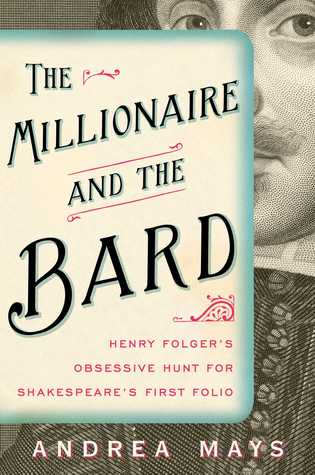
The Millionaire and the Bard: Henry Folger’s Obsessive Hunt for Shakespeare’s First Folio

22609466

Rating: 4 Stars

I first have to note that I picked this book up at the museum here while the First Folio was on display as part of it's tour for Shakespeare400. It is the most beautiful book I have ever seen in my entire life. Unfortunately we were, of course, not allowed to take pictures, but you can bet I was standing over that glass case every chance I had that someone else was not waiting to view it. It was open to Hamlet's "To be or not to be" soliloquy and I must have read the words a hundred times in the two visits I made to the exhibit. If it has not yet come to your state and will be soon, you must see it. It is completely worth whatever museum admission fee you might pay. It is absolutely breathtaking.

More than anything, this book makes me want to see the Folger Library and bask in the glorious beautiful of so many Folios in one place. Unfortunately they are not accessible to the public and that is terribly disappointing. I do not think I qualify as a special enough scholar with the exact credentials needed to gain access. What a pity.

I understand being obsessed with things, being so obsessive that I have to collect everything possibly related to whatever the subject is. Unfortunately, I will never have the funds to fuel any kind of obsession the way Folger did. He was able to spend obscene amounts of money to secure more First Folios than any other collector in the world, on top of playbills, paintings, and all sorts of Shakespeare-related items. Not only that, but he then proceeded to construct a temple to house his treasures that still stands to this day, one of the foremost authorities on the greatest writer to ever live.

The book begins with a jaunt through the life of Shakespeare, which of course makes sense. Without him, Folger might instead have been collecting the works of Jonson or Marlowe. The bulk of the text though relates to that first purchase that Folger made, then his subsequent quest to collect every Folio he could find - regardless of condition. Like Folger, I am of the mindset that condition does not matter. To have as many copies as possible would be the ultimate goal. Not to mention all the lose pages - it's even mentioned at one point that it may be possible to create another two or three Folios just from said loose pages. This is completely fascinating to me, to see all of those documents and books together in one place.

While I enjoyed the book over all, the actual portions dealing with the acquisitions of the each major Folio were a bit dry and took me the longest to get through. I'm not quite sure why, it is not a poorly written book and the there is no sudden change in style. Perhaps it is again that aspect of money, and knowing that there is no way I will ever be able to indulge myself in anything of interest quite the way Folger was able to in his lifetime? Who knows. But, either way, this section did take me the longest to get through and it has never taken me so long to read a book related to Shakespeare before.

The text really picked up for me again once Folger began planning his grand library and I was anxious to see how it would turn out. The fear he would pass away before it was complete unfortunately came true as I worried it might. But, his wife Emily was there to carry on the dream and I was at least glad to see that the library was completed in her lifetime. I do not find it strange, as the author kind of thought people might, that Henry and Emily Folger are interred in the library that bears their name. it makes complete sense to me that this would be their final resting place, surrounded in death by the collection that was so important to them in life.

One issue I take with the book is the idea that Folger was 'rescuing' the Folios. First and foremost, Shakespeare belongs to England. To think that he and his words would be better taken care of here in the US than in his native England seems kind of pompous. I do not think that was Folger's intention, to be that pompous. Or maybe it was, but as the text states, "His was a selective and singular madness" (page 276) and I think his intent was solely to collect s many as he could. I can understand why the English took issue with the great robber barons of the day rummaging through the cabinets so to speak, and carrying off anything of value that they could find.

Two more quotes I found interesting:

"At the library that bears his name, there is little remembrance or recognition of Folger's other life, the one that paid for it all" (page 273)

and

"In a library filled with signs and symbols that evoke the age of Shakespeare, there is none that evokes the industrial age of Henry Folger" (page 273).

It is unfortunate that in Folger's triumph in giving the world this library, he himself is largely forgotten. We tend to look back now on the industrial age somewhat negatively, to look at the likes of Rockefeller, Vanderbilt and Morgan as these robber baron-esque types who were only concerned with making money for themselves. While Folger certainly was part of that age (he worked at Standard Oil for Rockefeller), he was also a philanthropist and his library is the proof. He could have kept his collection private and never shared it with the world. He chose not to. And so, his and Emily's legacy will live on. Highly recommended.

Sunday, April 24, 2016

The World of Gloria Vanderbilt

8014810

Rating: 3.5 Stars

Review:

This will be a shorter review, as this book is shorter on text than my usual fare. it is also harder to review, as there were tons of photographs along side the text. 

First though, I don't know how it has escaped my attention for the last decade or so that Anderson Cooper is a Vanderbilt. I can see why he would not want people to know it immediately - not because he was ashamed, but because of all the 'baggage' he rightly claims that comes with it.

I'm terribly intrigued by Old Money New York of the Gilded Age. The Vanderbilts, Rockefellers, Morgans, etc. What I especially found interesting about this books is it gives an account in photos and text of the life of a Vanderbilt in the modern era. Gloria Vanderbilt is certainly an interesting figure, from her many marriages, her multiple careers, and the tragic suicide of her son, Carter.

I must confess: Everything I wrote prior to this sentence, I wrote a few days ago. I saved this review as a draft and have just now come back to it. I can not for the life of my explain why this review has been so much harder for me to write than others. At first I thought as I struggled with this one on Friday night, that it was because I was just in a reviewing slump, that I know I am 8 books behind in my 2016 Challenge if I want to get it completed, this, that, whatever. But it can't really be a slump OR the Challenge, if I managed to write three reviews since then for three other books I had just finished recently, right? I don't know what it is, but for some reason I am just struggling with this one. And that is certainly not fair to the book, because I enjoyed it. Every book deserves a fair review and not one that is half-hearted.

So, here is what I will say: The text was lacking in detail of Gloria's life, because I do not think this was meant to tell her life story in words. Certainly, she has written her autobiography and there are other books that do so as well. This was meant to tell her life in pictures and there it was successful. Personally, however, I just could not get over the fact that in so many rooms she was pictured in later in life, the walls are quilted. It is just weird to me. I do recommend the book, especially for those interested in the remnants of days gone by and seeing how the children of the Gilded Age grew into adulthood, and what it is like to be a Vanderbilt now.

Sunday, January 17, 2016

St. Marks Is Dead: The Many Lives of America's Hippest Street

25622226

Rating: 5 Stars

Review:

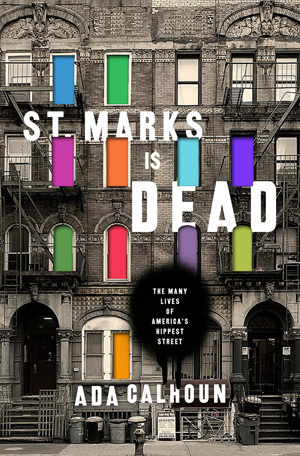
Ugh. Everything about this book is so beautiful and ugly and traumatic and hopeful. I don't even know where to start. So, let's just appreciate that cover for a moment. I love it. Gorgeous. Plus, with an endorsement from King Ad-Rock (my most favorite of the Beastie Boys) on the back once the book was actually in my hands, I knew this would not miss. I was not disappointed.

There are a few things that have fueled my obsession with New York over the course of my lifetime: 1. my general love of history and the fact that NYC is one of the oldest cities in the country 2. Two of my favorite movies that take place there (The Godfather and Newsies. Yes, my tastes are eclectic.) 3. My love for the idea of hanging out in The Village, sitting on a couch in a coffee house with my Friends for hours without a care in the world. I am not sure I can truly convey the powerful hold the idea of New York City has over me. I have never visited the city and the closest I've been was a quick layover in Jersey upon my and my mom's return from Amsterdam in 2010. Somehow, it just wasn't quite the same as walking the streets of the historic neighborhoods, being immersed in the culture of the city. I often wonder if I have built it up so much in my mind that the reality could never live up to the idea I have in my head, and that is a depressing thought.

The first time I ever heard of St Marks came in season 9 of Friends when Ross mentions being at St Marks comics prior to his being mugged in his youth (by Phoebe). I was delighted then to find it is/was an actual place on St Marks, as the author offers a list of pop culture references to the street. The listings are grouped by song mentions and movie/tv mentions or as the location of filming. Incidentally, Friends is not on this list, which is kind of ironic seeing as how it was my first introduction to the famous and infamous street. The book was just published, so I can not see why it would have been overlooked. But I digress.

I guess I should talk about the book itself now; I've talked about myself long enough. The first thing I appreciate about books like this is the author herself. This was not someone who chose a topic to research on whim or because an editor thought it would be a great read. I mean, those things could ALSO be true, but the author is a child of St Marks, having grown up there and experienced living their first hand. Who better qualified to write a history of such an iconic place? Calhoun is a talented writer and it is clear she has a lot of love for the street and the city.

Calhoun begins with 400 years ago, on Peter Stuyvesant's farm and from there weaves an engaging story through time, following the path as Manhattan grew up around it. I loved not only learning about St Marks, but other tidbits along the way. I loved seeing how the names evolved over the years from Bouwerie and Breukelen then to Bowery and Brooklyn now. I also was finally able to discover where the term 'knickerbocker' came from (because I was too lazy to Google it I suppose, or did not realize how much I wanted to know where it came from until I read this). I won't spoil it, the answer is on page 6.

The book flows well and is a quick read. You will cross paths with the likes of The Beastie Boys (only about a page though, my biggest complaint!), Andy Warhol, Leon Trotsky, The Ramones, and Allen Ginsberg, just to name a few. Time and again, the theme is that the street is dead, always proclaimed by the generation that leaves and a new wave takes their place. From a Dutch colony, to the Beatniks, anarchists, punks, drag queens and so on. However, as you will find, that is not actually the case. Each new group to take over St Marks leaves a piece of itself before moving on, contributing to the legend of the legendary street.

I know even as I am writing this, the review here does not do the book justice. All I can say is to read and enjoy for yourself. Only seventeen days into the new year and I think this will be a top 5 book of 2016 for me. Highly recommended.