Showing posts with label Richard III. Show all posts

Thursday, July 16, 2026

NetGalley ARC | The Worst Medieval Monarchs


I received a a free digital ARC from the publisher via NetGalley in exchange for an honest review.

Rating | ⭐⭐⭐

The book covers the usual suspects when we are talking about the worst of England's kings: Stephen, John, Edward II, Richard II, and Richard III. I personally think a case could be made for Richard I, but for a much different reason - he simply did not GAF about England and literally would have sold the country if it would have helped him raise money for Crusade. He maybe spent a total of six months there the entire time he was king. BUT, the kings discussed here are viewed as the worst for different reasons - mainly because their reigns were constantly marred by conflict both within and beyond the borders.

It's the king or queen's job to protect their citizens and all failed quite spectacularly in that regard. Civil wars or wars with other countries decimated the population and land. Not to mention the fact that John was a freaking psychopath and Richard III had his nephews killed so he could take the throne.

For all their massive failures, each paid a heavy price:

1. Stephen's stolen crown passed to Henry Plantagenet when he died, thus ushering in the start of the Plantagenet Dynasty. Don't even get me started on how Stephen never should have been king in the first place, usurping the throne that rightfully belonged to his cousin Matilda that she should have received when her father Henry I died. The 18 years-long civil war was directly his fault.

2. Edward II never really stood a chance and is honestly the one I genuinely feel bad for. He was never cut out to be king and would have been quite happy on an estate somewhere doing his commoner things like ditch-digging and roof-thatching. He was most comfortable with those considered lower class and that would have been just fine had he not been the king. Whether he died of natural causes in captivity, or was murdered by order of his queen, Isabella and her lover Roger Mortimer, we will likely never know. I wish he could have just abdicated and lived a quiet life that he was really meant for.

3. John was THE WORST. Like, just all-around a terrible person, never mind a terrible king. He was a lazy, cruel, spoiled baby and never should have inherited the crown. Richard I had to go and get himself killed though, so here we are. He wasn't particularly skilled in any aspect of kingship so he will always belong to the worst of the worst lists. Plus, Geoffrey's son Arthur should have gotten the crown before John. But John had him killed, maybe even did it himself, so again, here we are. Imagine being the youngest of five boys (William, Henry the Young King, Richard I and Geoffrey came before him), getting a shot at the crown that never should have come your way, and completely messing everything up so badly that England will NEVER have another king named John EVER.

4. Richard II is a bit of a conundrum because he could have been a great king, but we will never know for sure because of a number of factors. He came to the throne young, so had several councils rule for him during his regency. This was led by his uncles John of Gaunt and Thomas of Woodstock. The Peasants' Revolt pretty much solidified Richard's place as a 'worst' considering how brutal the suppression of the revolt was. Then there was his delayed revenge on the Appellants, and his disinheriting of John of Gaunt's son (and Richard's cousin) Henry Bolingbroke. That Richard thought he could do this with no repercussions was insane, and it cost him his throne and life.

5. Then we have Richard III, who I completely despise. We have a theme though, as he is yet another usurper, and typically those have not fared too well (Stephen, always looking at you. Henry VII, you got very lucky). Richard had his nephews murdered, and he knew people were talking about it. All he would have had to do was trot them out at court, let everyone see they were alive and well, and he might have then had a successful reign. But he couldn't do that, so he lost his crown and his life as well, the last king of England to die in battle.

Overall I would say this is a good assessment of the men and their times. The author explores how they were viewed against standards of their own time period compared to the following centuries up to today. He also discusses how the kings have been portrayed in fictional works, from Shakespeare to the screen, and how that impacts their reputations up to today. I don't think any of them can or should be redeemed, except maybe Edward II.

The author suggests that Richard III does not belong on this list but I disagree completely. Richard murdered his nephews to seize the crown. Had he just locked them up, that would be a different story because evidence suggests he actually could have had a decent reign. Murdering the boys, however, ensured that he would always remain the villain in the story. Given the time period however, Richard knew he had to get rid of them, otherwise there was potential for revolt and for Edward V supporters to place him back on his rightful throne. Like with John having his nephew murdered, they absolutely belong on this list for those acts alone.

Something I think would have been important is discussing how each king was raised - like John, not all were raised to be king in the first place but they managed to grab the throne anyway. Background of their life before becoming king would be good to cover as well - particularly for those who do not have a lot of background information on these men already. This was not an issue for me for the most part, but could impact other readers' experiences.

Overall it was a decent read and well-researched.

Recommended.

Saturday, November 13, 2021

NetGalley ARC | Usurpers: A New Look at Medieval Kings


I received a free digital ARC from the publisher via NetGalley in exchange for an honest review.

Rating ⭐⭐⭐

Short version: Yes they're all usurpers and you don't need to read this book to know that.

Long version: 

I really struggled for a bit with how to rate this one. The title is a bit misleading if you go into it thinking there will be new ideas or documents or things of that nature. However, if you take it at face value that this is simply a new book on a set of kings who were absolutely usurpers, then the title fits. Every single one of the kings discussed in the book took a throne that was not rightfully theirs. So, I appreciated another look at the people and periods, because those eras of history are most certainly my jam, but there is nothing new actually added to the conversation.

The author looks at six kings: William the Bastard, Stephen of Blois, Henry Bolingbroke (Henry IV), Edward IV, Richard III, and Henry Tudor (Henry VII). Anyone with knowledge of those periods can without a doubt say that yes, everyone single one of these men took a crown that was not theirs.

1. William took the crown from Harold II (Harold Godwinson), who had been chosen by the Witan upon the death of Edward the Confessor. Sorry, not sorry William; forcing people to swear oaths under duress makes them not binding, you big jerk.

2. Stephen of Blois took the crown from his cousin Empress Matilda, whose father Henry I had twice made his nobility swear to support her claim after the death of his only legitimate heir William Adelin aboard the White Ship - or rather, in the water when the White Ship sank and though he had initially survived, he attempted to rescue his half sister. His small boat was swamped and he drowned along with everyone else, save one cook.

3. Henry Bolingbroke, son of John of Gaunt, took the crown from his cousin Richard II when Richard II was deposed.

4. Edward IV took the crown from Henry VI, lost it to him, then took it back again and had Henry VI murdered in order to retain it for good. Major dick move, but not unsurprising for the times. Henry VI is the king I have always felt the most terribly for, having never done anything to warrant his murder.

5. Richard III, don't even get me started on this guy. He imprisoned his nephews, including the RIGHTFUL king, Edward V, and likely had them killed. Margaret Beaufort wasn't behind their deaths, fuck off with that nonsense.

6. Henry Tudor's army faced Richard III's and we all know how that turned out. Richard had it coming, but even after his death on the battlefield, Henry did not have a strong claim. The actual next in line who should have been crowned was Edward Plantagenet, Earl of Warwick. You know, the kid who had been imprisoned because his claim was stronger, who was eventually executed along with Lambert Simnel on Henry's orders. Warwick was the son of George, Duke of Clarence - brother of Edward IV and Richard III who was murdered, on his brothers' orders for plotting treason against Edward.

As you can see, there is a TON of history here, and a lot of it overlapping in the last three chapters of later years (Edward, Richard, Henry) because of how entwined their stories are. Yet the author never really digs too deeply in and the text did become repetitive at times because of how connected they were. But there is also no new insight or analysis either. It's a straight-forward history, but lacking depth.

For a book that was aiming in part to look at what chroniclers of the time said about each of these new kings seizing a throne, there was actually very little from any chroniclers, if at all. I find that very curious, seeing as how those who wrote of each court would certainly have had strong opinions whether they were in favor or not. Thomas More is a prime example of the propaganda machine at work for the Tudors - though again, let's be realistic: if it looks like a horse and sounds like a horse, Richard had the boys murdered. More certainly embellished quite a bit; Richard was a product of his time, but with the murders of his nephews he went too far. Rumors spread around London very quickly once the boys were no longer seen. There is no way Richard did not hear those rumors. All he would have had to do is produce the children in order to stop the gossip. He didn't, because he couldn't.

That was a tangent I realize, but true nonetheless. As for chroniclers in the previous eras, they all had opinions too, and were quite overlooked. I find this curious, and altogether odd. The men (always men) writing at the time produced much in the way of, well, chronicles. Not including passages is weird.

Overall, it is not a terrible read. It is one I think I would suggest to someone who doesn't have much knowledge of the periods and is looking for a starting point. Especially during the Wars of the Roses, things get quite complicated so who knows, the repetition of material might help sort things out. But for those like me who already have a firm background, this is a pass.

Wednesday, July 14, 2021

NetGalley ARC | The Killer of the Princes in the Tower: A New Suspect Revealed

I received a free digital ARC from the publisher via NetGalley in exchange for an honest review.

Rating ⭐⭐⭐1/2 

Slogging through the writings of most pro-Ricardians is truly a chore and that aspect was no different in the case of this book. 

Side note - Matthew Lewis is the ONLY historian I consider it not a chore to read. His work is balanced and thoughtful. Plus he doesn't sob on television like Philippa Langley when it was discovered Richard really did have scoliosis, and weep and carry on as though she were in love with him. Good lord, she is awful.

Anyway.

In what is destined to remain the greatest unsolved mystery of all time unless QEII finally agrees to DNA testing, we have another author taking a crack at the disappearance of Edward IV's sons, Edward V and Richard, Duke of York.

The author is off-putting from the start and his arrogant tone was enough to make me roll my eyes a good many times. I seriously do not get what makes many Ricardians SO crazy about defending Richard III. The bottom line is this: Richard III knew there were rumors going around London that the boys had been murdered. There's no way he dud not hear them. If the boys were alive, all he had to do was trot them out, remind everyone they were declared illegitimate, then lock them back up again. He couldn't, because they were dead.

And yet, despite all the blow-harding about how terrible the Tudors were (seriously, chill), I find the author's theory terribly intriguing.

The mother of the princes, Elizabeth Woodville, had every reason to fear for their lives. The fifteenth-century England was used to thrones being stolen from their rightful heirs. That she would finally agree to send Richard (York) to Richard (soon-to-be-III) after he had custody of Edward (V) doesn't make sense to me, but perhaps she trusted he would not harm them, especially with the public so keenly aware that the boys were in his custody and should anything happen to them, it would be clear who was guilty. Honestly, I don't know. That is the one aspect I can't work out because at the end of the day...if it looks like a duck and walks like a duck, Richard III ordered the boys killed so he could take the throne.

After Richard stole himself a fancy new crown and was declared king in July of 1483, the boys disappeared from view and were never seen again.

The main suspects remain: Richard III, Henry VII, and Henry Stafford, Duke of Buckingham.

Side note - please STOP with the Margaret Beaufort nonsense. You're being offensively silly at that point.

This book takes the approach of a police procedural and looks at all the historical evidence available to us.

Shakespeare and Thomas More are quoted often, though both had agendas of their own as they were writing and had to be very careful about what they said. Yet even as he does so, the author is extremely critical of both men and their writings.

When the author stuck strictly to the facts, I found it easy to move through the text quickly as he examined each suspect - usual and otherwise. When it boils down to the very basics of a procedural, one must have means, motive, and opportunity. Though the author is heavily biased in favor of Richard, if you are not careful he will have you believing there is no possible way any of the usual three could possibly be guilty.

It is at this point the author arrives at a suspect that I am thoroughly intrigued by, though I am still weighing how possible this would actually be.

With the author's new suspect, there is one glaring problem, however. There's the pesky old fact that there is actually very little known about this man or his life except where he might exist in court records, and hardly anything at all from his own hand. In the end we have no way to further examine this most interesting of suspects aside from look at what happened with Edward and Richard...as well as Arthur Tudor, Henry Tudor's heir. The connection here is tantalizing, but we have no way of ever knowing if there really is a link.

A few things didn't work for me. First and foremost as mentioned before, the author writes in a way I am not sure can be described in any other way than as pure cattiness at times. It is one thing to look at both perspectives, but it is entirely another to write off anything that disagrees with your point of view, only because it disagrees with your point of view.

The second thing, and even more pressing, is the complete lack of notes. I need documentation. I need sources. Especially in an instance like this, when you have a 500 year old murder mystery and there is so little to go on to begin with in some instances.

I would still recommend this one for those who are interested in the period and this murder mystery especially - just be aware that the author is not exactly diplomatic when dealing with anyone or anything that is not pro-Richard.

Thursday, December 19, 2019

Book Review | Crusaders: The Epic History of the Wars for the Holy Lands

43899574


Rating: ⭐⭐⭐⭐⭐

Obviously, right?

And no, I do not give all of Dan's (we are still BFFs, after all) books five stars just because he is my fave. I give them five stars because they are worth it, because he is a historian who does not act and think like the historians of old, who safeguarded their knowledge so that only the elite could access it. Jones does not do that, and I have said before - and will say again in the future for the next book and the next book and the next book - he writes in a way that is fully engaging without dumbing anything down.

I have read my share of history books on a huge range of topics. In fact, I have probably read a lot of peoples' shares of history books. It takes a lot to bore me, but also takes a lot to wow me, and Jones manages to do that with each new offering. It began with my reading of The Plantagenets: The Warrior Kings and Queens Who made England (where I met my girl Eleanor of Aquitaine for the first time, and subsequently gave that name to my baby girl who was born about a month or so later). From that for introduction aboard the White Ship, I was hooked. Jones weaves together stunning and spellbinding stories and soon you've read your way through the entire book in a few hours, wondering how that just happened.

I will admit, I mainly wanted to read this one first and foremost to see what thoughts Jones would put forth about Eleanor's time on Crusade with her first husband, Louis. This will neither surprise nor offend Dan. He knows I am obsessed with her. Here is a picture of us discussing Eleanor in St. Louis in 2017:


I was happy with the attention she received, but when those sections were over, I was never tempted to put the book down, because I was still interested in the content. I truly thought this one would probably be the hardest for me to maintain an interest in, ONLY because I struggle in general with military history of any kind. I do not care to read about it, regardless of the war, or who is involved.

Given the fact that we're talking a couple centuries' worth of fighting and bloodshed over the Holy Lands, it was a tall order for Jones to deliver on in less than 500 pages. In the hands of a lesser author, this would have been a clusterfuck. So many names and dates to remember, yet the text is not overwhelming because Jones has a tendency to know just what would be most captivating to readers, while remaining highly important to the narrative, and what he can spend less time on. We get all the information we need, know the names and dates we need to know, and still come away feeling as though we had a conversation about a subject we are interested in, not a subject we were lectured at about for hours.

As you might have guessed from the title, this book is not about the Crusades. It is not a detailed blow-by-blow account of every single battle that took place, nor is it confined to those battles only taking place in the Holy Lands. Instead, Jones focuses on the people, the Crusaders - those who were, for better or worse, the reasons the Crusades happened, succeeded, or failed (all subjective terms of course, depending on your viewpoint). After Eleanor of Aquitaine (of course) I was most interested in what I learned of Anna Komnene. Hers is a name I was familiar with, having read other books about the various crusades, and her family's empire, but here Jones gives her the attention she deserves. She is best known for her written work on the life of her father, Alexios, and it is from this record that we get so much information about the events in her lifetime, and in her father's. She is definitely another medieval figure who I am greatly interested in learning more about.

Presenting the history in this way, by focusing in on various individuals within their larger roles as leaders, rulers, pilgrims, soldiers, makes this such an important offering. The centuries in which the Crusades occurred were tumultuous, dangerous, chaotic, and complicated. It would be easy to get tangled up in the web that connects all of these people, places, and events together and that is why this approach works so well. You still learn about the various Crusades, but the people Jones presents make it all the more real.

I am kind of embarrassed to admit that there were some Crusades that I knew nothing about - those that had nothing to do with Jerusalem, Antioch, Acre, and the like. I learned so much more about the time in Egypt, but those that were spread out across much of the known world - Sicily, Spain, the Baltic, and so on.

I don't think it will surprise anyone that I highly recommend this latest from Dan Jones. He writes in an engaging style and there is always that well-timed dash of humor he uses so well. Jones has proven once again why he is one of the best historians writing today, given his extensive knowledge and commitment to doing the research necessary in order to take on such a complex span of time.

Monday, October 22, 2018

The Survival of the Princes in the Tower: Murder, Mystery and Myth

35888548

Rating: 4 Stars

I read this one a while ago. A good long while. In fact, if Mr. Lewis recalls just how often I posted about it before and during my reading, he may wonder what the heck happened to take me so long to finish my review. The reason is, because this is one I really had to think about for a while. Not because I didn't know how I felt about it (I really liked it, obviously), but I did not know how to properly convey the fact that I really liked a book that I pretty much disagree with. So, here goes!

I think it is important that people understand it is entirely possible to enjoy a book while disagreeing with it. This is not the first book I have read by Matthew Lewis and it will not be the last. He is a fantastic historian, makes more than ample use of contemporary sources, and uses them to their fullest value. I admire his commitment to various positions on historical events, and the work he puts into showcasing those events and his interpretations. I was, however, bothered by the lack of footnotes. I feel like with a case such as this, even though it is easily one of the most identifiable cold case mysteries in the history of, well, history, those footnotes and resources become doubly important. That they were lacking in this text seemed unusual to me, and there were many times throughout that something was not attributed to a contemporary source, and it bothered me.

I will be very clear now that I am in no way a Ricardian, and I find some of the lot frightfully thick-headed. There's rehabilitation of character, and then there is going overboard and making the person into a saint when they were not. Richard was very much a product of his age, and in the likely event that he ordered the murder of his nephews, while we abhor the thought today, rival claimants were eliminated time and time again by kings who had a tenuous (and sometimes not so tenuous because, seriously Henry VIII, you killed A LOT of people you didn't need to) hold on their throne. This does not make Richard any more of a monster than King John, who may have actually murdered his nephew, Arthur, in a violent rage with his own hands. Though, to be fair, John was a really shitty king and a really shitty person for multiple reasons besides the fact that he was a nephew killer. The difference there of course is that Arthur was actively leading troops against John in a fight for the crown (Arthur's father was John's older brother Geoffrey, who had died in 1186. Many thought Arthur had a better claim, but Eleanor of Aquitaine most certainly did not and she backed John, helping him secure the throne). Edward and Richard were young boys, 12 and 10. It is a little harder to stomach the murder of two boys who must have felt very scared and very lonely, given the fact that they hardly knew one another at all by the time they were locked away in the Tower together.

Lewis does not solve the mystery of what happened to the princes. He also does not claim to do so and that is not his ultimate goal. What he does instead is present some alternative theories, some of which definitely merit a second look. Some of the theories are not new, particularly those covering the so-called pretenders, Lambert Simnel and Perkin Warbeck. (Truth be told, if we are betting that one survived, I would put my money on Perkin Warbeck having been the real Richard, Duke of York. You can't look at his portrait, and one of Edward IV, and tell me there is no resemblance. On the other hand, perhaps that was the intention of the artist who sketched Warbeck, and the likeness is not actually true to reality. That is what makes this one of the all-time great mysteries. There are so many threads hanging loose and when you pull one, you never know where you might end up next.) I appreciate the fact that Lewis has no illusions about the possibility of solving the mystery. it simply can not be done at this point, unless the bones discovered in the 1600s during Tower repairs were ever permitted to be tested. Until that happens (which I fear it won't in my lifetime), there is simply no way to know.

I personally have been of the mind for many years that Richard ordered the murders to secure his throne. Rumors were going around for months that Richard had had the boys murdered. He could have swiftly put an end to all of it by producing the boys and proving they were still alive. He chose not to, and I believe it is because he couldn't. I also think that Henry Tudor knew of the murders after he won the crown at Bosworth and he thus knew he could re-legitimize Elizabeth and her sisters without fear of the boys then coming back to claim the throne. That did not stop the pretenders of course, but there was not much Henry could do about them except deal with them as they came.

The reason I want to make my own position clear on the matter is because that, though this is a book that explores alternatives to the princes being murdered, its purpose is not to do so in order to rehabilitate Richard. If you are the most die-hard believer that Richard was terrible and murdered with reckless abandon, this is not a book you should avoid. Sometimes the 'what-ifs' are as intriguing as the truth and I have always enjoyed the game, especially in regards to some of my fave periods and people in history. Lewis will be the first one to point out that Richard just as easily could have killed them as not, but some of the other theories are just as tantalizing in their own right.

There are many theories put forth here and while some might seem wholly far-fetched (Holbein's More family portrait dissection was a bit much for me), Lewis points out that when dealing with a mystery of this magnitude, with little evidence to go on, we must look at what he describes as the 'black hole effect'. He explains this by saying that black holes can not be seen, but we know where they are based on how things near them react. So, even though the boys were never seen from the Tower windows after 1483, we must look at the actions and words, or lack of action and words, of those who were closest to the action and most impacted by whether the boys lived or died (aside from the boys themselves of course). There are certainly instances we can look at, which Lewis does, that make one pause and wonder. I do not want to share those here, because they will make you pause, and it is something I want to leave for you to discover yourself.

I do find it intriguing the theories of both boys not only surviving Henry VII's reign, but living on into Henry VIII's and beyond. What makes this all the more fantastic is the possibility that the Tudors kings and queens KNEW this, knew the boys were alive, had grown into young men who had new names and identities created for them. They grew up, got married, and had children. I do not buy into the idea that Edward V became the grandfather to Guildford Dudley (as Edward Guildford), thus engineering a potential Yorkist heir's return to the throne through the marriage of Guildford to Jane Grey. Still, I'd encourage anyone interested in the various theories to give this one a read and make up their minds for themselves. Lewis certainly won't attempt to do that for anyone, which I found rather refreshing. It is not simply a rehashing of the usual suspects and why it wasn't Richard, it was Buckingham, or Margaret Beaufort (seriously, can we give this one a rest already. she DID NOT HAVE THE BOYS KILLED! That much I am certain of). After all, since there is no definitive proof the boys died (as some believe), why is it so wrong to look for evidence that they lived?

Saturday, September 22, 2018

Cecily Neville, Mother of Richard III

39718894

I received a free digital ARC from the publisher via NetGalley in exchange for an honest review.

Rating: 3 Stars

Cecily is such an interesting figure and I was so excited to be approved for this one on NetGalley. She was the mother of two kings, Edward IV and Richard III, as well the wife of a man who could have/should have been king, Richard, Duke of York. Yet we know remarkably little about her, as per usual. As with other women from this period and before, she is well-known without actually being known. For generations Cecily has been known as both Proud Cis and the Rose of Raby, yet here today we don't actually know if either moniker fits particularly well. We don't even know if she was really born at Raby Castle, or if the vanity and temper she has been identified with for so long is actually an accurate description of her character. We know the basics, that she lived in a dangerous time when the throne was changing hands between the Yorks and Lancasters at a sometimes-alarming rate. She was the grandmother of Elizabeth of York, the Princes in the Tower, and Henry VIII. What bothers me about books such as these is that sometimes so little is known about a figure, we have to do exactly what I have just done, and frame her life in relation to those around her - and those relations are 99.999999999% of the time male. Look at the subtitle even, 'Mother of Richard III'. So, I am torn on books like this. I want to know all I can about women who survived and thrived in that period, but I also want to know about them on their own terms, and not simply who they were in relation to the men in their lives.

I can appreciate the work of the late Dr Ashdown-Hill, who passed away in May of this year. I enjoy reading his work, though we do not always hold the same position, particularly where Richard III is concerned. Still, I knew going into this one that regardless of what information he presented or the conclusions he came to, that they would be well-researched and factually sound. I value his work and the fact that he chose not to focus too often on the maybes and such. There will always be supposition in books such as these, but I feel Dr Ashdown-Hill always does a rather good job of keeping that to a minimum, and giving thorough explanations for why he believes what he does. The issue with those unknowns again though, is the fact that sometimes there is simply not enough proven, factual information about someone's life to warrant a full-length biography. I feel like that happened a bit with this one. Where information on Cecily was lacking, those gaps were then filled in with information about other members of her family in that particular time. There is nothing wrong with this, and to think that one could ever write a biography about anyone without including info on those closest to her or him, is more than a bit silly. But there is also a certain point where one has to decide if there really is enough information to go into a full-length book. Sometimes, no matter how interesting the person is, the unfortunate answer is that there is not.

Even so, I would still recommend this title to anyone with an interest in Plantagenet history and this period in particular. The book is academic without being boring, and even a reader with casual interest in this branch of the family tree will find it a good read.

Monday, February 1, 2016

Kings & Queens of England, a Dark History: 1066 to Present Day

4953656

Rating: 1.5 Stars

Review:

I will keep this short and not so sweet because this book was not good. I try not to, but I sometimes can not help but take offense when I see historical figures I love so dearly and/or highly respect either much-maligned or simply presented wholly inaccurately by an author who could not bother to do five seconds of research. I like the 'Dark History' series in general, though it is nothing spectacular and you will find no new information contained in them. But what I found here was worse. This book was gossipy and sensationalized. it was poorly written and riddled with inaccuracies. There is nothing 'dark' about this history that is flat out wrong in many places. She refers to Catherine Parr as Henry VIII's "Finally, an enduring love" as one heading, which is laughable, considering she wanted to marry Seymour all along. Anne of Cleves was apparently "ugly, skinny and loud-mouthed" - news to me since I did not know you could be a loud-mouth in a country where you did not even speak the language. She is especially nasty to two Scots in particular, Mary and then her son James VI. First, Mary is described as being an, "ignorant, foolish, indiscreet airhead" who "managed to do almost everything wrong and was certainly not the queen 16th century Scotland needed." This could not be more wrong. Without a doubt, Mary made some very stupid decisions. But by all accounts in the short years she did rule, she worked to maintain a balance between her Protestant-turning country and herself. Much has been written about Mary not enjoying her studies but that does not make her an airhead and she was still well-spoken and educated. Her son James does not fair much better. The author refers to him as "creepy", with "spindly legs" a tongue "too big for his mouth...He drooled. He did not wash very often...He looked scruffy because he dressed so badly." It has been documented time and again that James looked oddly in his dress due to the many layers he wore to protect against an assassin. Yes, apparently his tongue was awkward and he was awkward but come on. All this book amounts to is a trashy gossip magazine in hardcover form. PASS!

Sunday, January 31, 2016

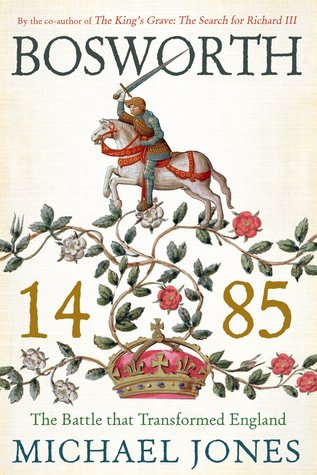
Bosworth 1485: The Battle that Transformed England

25317189

Rating: 3 Stars

Review:

Eh.

I am always looking to read anything I can about this time period, whether it is from the perspective of the Tudors, or "Ricardians", those kooky Richard III apologists who think that by re-envisioning history, they can rehabilitate the image of this king.

I enjoyed Jones' portions of "The King's Grave" - had that awful Philippa Langley written that whole book there is no way I could have finished it. I can not take someone seriously who is so obviously in love with the subject of her search. That is one of the reasons I then picked up this one, written some years before the discovery of Richard's grave.

I was never entirely clear on the allegations of Edward's birth, so this seemed to clear up how they came about and that Cecily herself first came forward about them after Edward married Elizabeth Woodville. I had always been under the impression that Richard had made these accusations after usurping the crown from his nephew Edward V. I did not know that it was Cecily herself saying these things, perhaps in an attempt to undermine the popular king's support. I am still not entirely convinced though, that it was not all Richard's doing. However, Jones makes an interesting case and one I am willing to consider, despite my firm belief that he did have his nephews murdered. The problem with this, and other pro-Richard books, is that his supporters are so eager to 'clear his name' that they only look at the facts that fit their own narrative. I don't believe we will ever know what really happened, but I also think that the most likely suspect is the guilty one - and that is Richard.

The murder of the princes is not all this books covers however - though it is an important aspect. If you are not one who normally reads battle history and were put off by the title, don't be. I also do not enjoy battle or military history. Very little of the book deals with the battle itself, where Henry Tudor would win the crown and become Henry VII, bringing an end to the Plantagenet Dynasty. Instead, this is a look at the events leading up to (and including) the battle. Hence, the discussion of Edward's real parentage, who the rightful successor was to Edward IV, and this mysterious pre-contract to Eleanor Butler before Edward married Elizabeth - and conveniently enough, the pre-contract was never brought up until after Edward died.

Besides the issues of accuracy and whether or not the interpretations by the author can be correct or make sense, there are some other problems I have with the text too. First and foremost, the author routinely throws around statements about how Shakespeare has influenced what we think of Richard III. This was an irritant, as Richard III is one of the few Shakespeare plays I have not actually read or seen. The author does not seem to give his audience much credit, almost like we only get our facts from pop-culture and not from academic sources. For me personally, all of my knowledge of Richard III has come from factual, historical research - both those for and against Richard III.

Additionally, the author mentions in the preface to this new edition the fact that Richard's body was recently discovered, so I have to wonder why the text itself could not have been updated? On page 219 Jones mentions at one point not knowing where Richard's body is and is adamant that Richard was not 'physically deformed', as the Tudor propaganda machine insisted. Based on the discovery of his skeleton though, he did in fact have a curvature of the spine (Philippa just HATED this), so naturally his enemies exaggerated. I feel like portion of the book could have been easily edited to account for the discovery, as it makes the text look outdated. If one can take the time to write a new preface, surely a few paragraphs could have been edited.

Overall, there is nothing terribly new. It is a look at the events from the side of Richard supporters, how they interpret events, documents, and so on from 500+ years ago. Take it or leave it.

Tuesday, January 19, 2016

Cold Case Reopened: The Princes in the Tower

19055218

Rating: 2.5 Stars

Review:

I wavered back and forth between a two and three stars. While I disagree whole-heartedly with the author's conclusion that Henry VII had the princes murdered, that is not the issue for me. That the author is very up front about not being a historian or a writer, I can appreciate; the writing is not great, very basic, but gets the point across. So, it's not that either. I guess what makes this one so not good for me is the application of modern thought, morals (so to speak), etc. on a completely different time period. Additionally, there are some pretty big jumps to conclusions (Richard loved his two nephews and took care of them, he would never hurt them, etc.) that I just can not overlook. The author does politely ask that, due to his not being a writer/historian, that reviews not be scathing, so I will do my best to be as gentle as possible in ares that sorely need attentions.

As I said, I believe his conclusion is wrong. It was widely believed during Richard's own reign that the boys had been murdered on his orders. Whether it was Tyrell or Buckingham, whoever actually committed the crime we do not know. And while we do not know 100% Richard did...I mean, come on. You hear hoof beats in the park, think horses, not zebras. The most logical answer is USUALLY the right one. So, logically, Richard makes the most sense. When Richard moved to have the princes declared illegitimate, that would have negated their claims on the crown. When the rumors started, had Richard cared so deeply about his nephews as the author claims, he would surely have brought them out so people could see they were still alive. It would have greatly enhanced his image and his subjects would likely have given him more support. With the princes declared illegitimate, I don't believe anyone was going to risk being on the losing end of an uprising to place Edward V back on the throne. Instead, Richard let rumors swirl and as a result, he lost support throughout the country and of course the idea of a new king gained traction quickly. The author also points to the issue of Warwick being left alive by Richard as a clue to the fate of the princes. There is a problem with this though also. While Warwick would have had a claim to the throne as Edward IV's (and Richard's) nephew (his father was the executed Clarence), his claim would have been behind Richard's. If given the choice, Parliament was always going to put an adult on the throne in place of a child if there was a question of the succession - in Edward V's case there was no question, he was the rightful heir and king as Edward IV's oldest son. Thus, Richard had every reason to remove Edward IV's sons from his path. Warwick was irrelevant to the situation.

Another issue arises for me in the form of the author's focus on Elizabeth of York as the possible murderer of her brothers. Not only that, but inaccurate or unsubstantiated information regarding her characters. We really do not know a lot about her - despite Weir's biography. Yet here the author refers to Elizabeth having "shown a tendency for manipulative and unscrupulous behaviors." I double checked just to make sure the author was not talking about her mother, Elizabeth Woodeville, who also gets a lot of flak. But no, he was talking about the princess. Then there is the matter of Richard planning to marry Elizabeth of York - his niece. The author refers to this several times as a possible motive for Elizabeth, that by her having her brothers murdered, it would secure the crown for her and whoever her husband would be - either Richard or Henry. While this has been suggested many times, there is no actual proof that they were having an affair before Queen Anne died, or after. Yet the author states that, "A number of notable historians do suggest that Richard and Elizabeth were sleeping together on a regular basis." WHO?! Which historians are saying this? At first the author seems to just be suggesting this affair as a possibility, but later he asks, "Would Elizabeth of York have offered her affections so readily to Richard III if she believed he had murdered her brothers?" Uh, yeah? Once she had left sanctuary, what choice did she have but to return to Court and act as though everything were okay? It's not as though she could run through the streets shouting that he murdered her brothers, if that is what she thought happened. The Elizabeth theory just doesn't make sense and I can see why historians do not give much thought to it.

Another issue I have is with this idea involving Thomas More and how, because he was apparently such a huge prankster (?), that he somehow had the skeletons planted beneath the stairs in the Tower - either as a joke, or to give more weight to his work depicting Richard as a murderer (which he very well could have been - is it a distinct possibility that he was in the room when poor King Henry VI was murdered in captivity on Edward IV's orders and could even have committed the murder himself). Back to the topic at hand though, this idea that More somehow planted the skeletons - how would this even happen? The skeletons were found at least ten feet below the ground. It is almost impossible for the work this would have taken to have gone unnoticed. You don't just start digging around one of Henry VIII's residences without someone noticing.

So, here's my own final verdict: I think this was an interesting perspective with which to look at this mystery from. The author is/was an investigator. He looked solely at the only facts we really know (though some of these facts really are questionable). The problem is he is looking at this with modern eyes, and not in the mindset of the time, as a historian would do. That's not to say this is the worst book you will ever read, it is certainly interesting - though some of the theories are incredibly far-fetched. If you already know a lot about this subject, it is not likely your mind will be changed upon finishing it. Might be worth a quick look, at 84 pages.