Showing posts with label Medieval England. Show all posts

Thursday, December 26, 2024

NetGalley ARC | The Eight King Henrys of England


I received a free digital ARC from the publisher via NetGalley in exchange for an honest review.

Rating ⭐

So this review will actually be pretty brief because I will be honest that I did not finish the book.

Shocking, as it covers some of my most favorite time periods.

But a terrible slander occurred attempting to - either accidentally or on purpose - stain the reputation of my beloved Eleanor of Aquitaine. At best it was poor research; at worst it was lazy research. Neither of which I can abide.

I made it through the reign of Henry I, chugging along nicely. Then came the chapter I was most excited about, because Eleanor was sure to receive several mentions over the course of Henry II's reign.

Yet one of the very first appearances of Eleanor early on in Henry II's chapter mentions Eleanor on Crusade with her first husband, Louis VII. The author states, "Her alleged sexual relationship with her uncle, Raymond, Prince of Antioch, led to the end of her marriage."

Nope nope nope.

First, there's no actual evidence that she had an affair with Raymond. He was the only family she had left besides her sister, and they had not seen each other in several years. These rumors did not start until a couple decades later, likely because we do not know what actually happened that made Eleanor refuse to leave Antioch in the first place. Had the two really had an affair, it would have been an immediate scandal. They were far more closely related than Eleanor and Louis (third cousins, once removed). Some contemporary chroniclers were already hostile to Eleanor, even in her lifetime and more most certainly after her death. Despite my love for the Middle Ages, it - and the entirety of human history - reeks of misogyny, and almost all of the chroniclers were men. Women who did write mainly lived in convents and wrote of their religious experiences. Even Christine de Pizan came along a couple hundred years after Eleanor.

Secondly, even if she had had an affair with her uncle, that is not what ended her marriage to Louis VII. Eleanor did not want to leave Antioch. She wanted Louis to join forces with Raymond, but he refused. She was forced to go by Louis, with some accounts stating he forcibly put her on the boat himself. When they returned from Crusade, Eleanor wanted nothing to do with her husband. It certainly did not help that she learned her uncle had been captured and beheaded at the Battle of Inab. They were guests of Pope Eugenius III after a slog of a trip to get back home.There had already been talk of getting the marriage annulled prior to this, and it was brought up once again. The Pope refused the request and at one point threatened excommunication if they did not attempt to work things out. He insisted they sleep together while there and of course Eleanor ended up pregnant again. She gave birth to their second daughter in 1150, and two years later was finally able to shake herself free from the marriage.

If you do not write accurately about someone I know so much about, how am I to know if you are writing accurately about others I know less about? It is hard to trust someone's words when events are massively misconstrued and no context or detail is given.

So is this continuing in the vein of those chroniclers from hundreds of years ago, or just lack of interest in further research? Yes, the book is about the eight Henrys, but Eleanor of Aquitaine was no small player in history.

Either way, not interested in anything else this book has to say.

Tuesday, January 3, 2023

Book Review | Heroines of the Medieval World


Rating ⭐⭐⭐⭐⭐

Another essential read from the author on one of the most extraordinary periods in history, showcasing  a wide variety of women who were just as extraodinary. Connolly introduces many women both famous and obscure and shares their stories. Despite the fact that it was supposedly men who ruled the world, these women prove time and again that they were not merely subservient to the men in their lives. The choices these women make not only alter their own paths, but the wider world around them, some even changing so far as to change the course of history.

Connolly has organized the women by theme and I really liked this approach. I like that this lead to some overlap sometimes, because it shows how so many were connected. Themes include Heroines in Religion, the Medieval Mistress, Scandalous Heroines, Women Who Ruled, Captove Heroines, and the Survivors. There are others as well that I will leave you discover, just as I will let you discover these heroines and who Connolly chose to include. There were many women I was unfamiliar with, or only knew of in passing where they fit into someone else's larger story. As a result there are many more women I will seek out further books about.

Connolly is incredibly knowledgeable of the women and their world. This is a well-researched text with notes and references to back up her work. Despite not being organized by woman, there is still so much depth here that we get to know the women very well. She brings the women to life and does so in an informative but still accessible way.

I enjoyed this one quite a bit. It's a fantastic read and I hope that Connolly at some point produces a second volume because there are so many more women who also deserve their moment in the spotlight.

Highly recommended.

Saturday, June 19, 2021

NetGalley ARC | The Brothers York: An English Tragedy


I received a free digital ARC from the publisher via NetGalley in exchange for an honest review.

Rating ⭐⭐⭐⭐

Despite the claims of this bringing new information to light, or being a new look at the House of York, I don't think that is accurate. There was not really anything new here for me. Nevertheless, it is a fantastic look at the lives of the men who would practically tear England apart in order to claim the throne.

In the beginning Edward (IV), George (Duke of Clarence), and Richard (III) looked invincible. Brothers who would fight for one another in order to secure the crown. The House of York appeared unstoppable. Yet within a span of approximately thirty years it would all come crashing down. Everything we would expect in the fifteenth century played out in real life - rebellions, usurpers, executions.

The dynasty they'd attempted to carve out lasted but one generation before coming to a bloody end at Bosworth when Henry Tudor would emerge victorious. That in itself is the real tragedy. I enjoys the what-ifs and there are plenty to think about when it comes to this branch of the family. However, it also must be remembered that Edward IV took what was not his to begin with - Henry VI was the rightful ruler. Going back in time even further, what might England have looked like had Henry VI not been murdered, and his son eventually come to power?

Unfortunately we will never know, but it's fun to think about.

Despite not really giving new information, this is an incredibly in-depth analysis of the three brothers who would all come to untimely ends. The research is impeccable and the author plays it straight I felt, not biased in one way or another. A good 15% or so of the book is sources in fact, so the time spent on that part of the writing process is obvious. The facts are the facts, regardless of the motivation behind them. He presents those facts here and the reader may do with them what they wish.

My only real issue with the book is that it is not entirely about the three brothers. Edward consumes much of the book. George shines brightly for a time and is just as swiftly snuffed out. And then there's Richard. Ugh.

Side note: I think I have a bigger issue with certain Ricardians than I do Richard himself - looking at you, Philippa Langley. Getting all emotional and weepy just because it was discovered that he did in fact have scoliosis is fucking ridiculous. Ranting about him being treated unfairly for his supposed role in the murders of his nephews is also ridiculous. It is awful, and if he ordered it, he deserved his death at Bosworth. BUT. He was also a product of his time. Violent overthrow of a rightful king was no unheard of. What makes it so ugly was that they were children. Stop embarrassing yourself.

I do think Richard had them killed. The majority of Londoners thought the same thing once the princes were no longer seen. Richard would have heard these rumors. All he had to do was trot the boys out to show they were alive and well. He never did, because he couldn't. The Tudor propaganda machine was strong, but was not in high gear until later, long after people already believed Richard had ordered it. So, whatever.

Anyway.

As I was saying, much of the book is focused on Edward IV. This makes sense, as he ruled the longest. George and Richard are there in the thick of it, but never the focus until Edward's death when Richard made a play for the throne and it worked. I don't consider that much of an issue, as he was king for twenty years compared to George's zero years and Richard's two. On the other hand, Richard's reign is complex and deserves thorough examination. The death of the princes is touched on, but barely. They simply disappear. I feel like this is the defining thing, what people always associate with Richard, and should have been given more room. We truly do not know what happened despite dozens of theories, but it is possible to explain the events and still conclude we will likely never know.

The book does get slow; it took me months to read. Part of that is due to the fact that this is one of my least favorite eras in England's history. The Wars of the Roses in simplest terms is a bunch of jerks trying to steal something that is not theirs. And everyone dies.

The other part is that there is SO MUCH information, and so many important people to talk about in their relation to the three brothers.

This period was complex and complicated. The book can be dense at times. It is incredibly in-depth and you will be reminded of details you may have forgotten. So even though there is not necessarily any new content, it is still a very worthwhile contribution to books on this time and place.

Recommended.

Saturday, July 14, 2018

Queens of the Conquest

34276987

I received a digital ARC free from the publisher via NetGalley in exchange for an honest review

Rating: 3 Stars

When I first got back into reading a few years ago, I was at first quite taken by Weir's books. I loved them, and read as many as I could find at my library. But...

Frankly, as I have branched out and read works of the same period by different historians, I am not as impressed as I used to be. The biggest issue I have had with Weir is not the content, she is a skilled historian. But it is her lack of footnotes and citations that have really become apparent as I have become more aware.

On one hand I am glad that Weir has used this format - a biography of multiple queens instead of just one. There is simply not enough known information about these women to justify a full-length biography dedicated to each, and it was a wise decision on Weir's part to flow from one reign to the next. As one would expect, there is a far share of conjecture, as there is so much we simply don't know. I don't mind this when there is a basis for assuming something, some precedent set elsewhere that we know of. But I take a much bigger issue with it when it seems like author-bias. And that is the thing to be aware of with all historians, not just Weir. Historians often write about people they admire, so it is unsurprising that those such people would portrayed in as positive a light as possibly supported by the evidence. I am guilty of it myself when writing of Eleanor of Aquitaine.

The book follows the lives of five queens of England - four of them named Matilda. So as to differentiate a bit, Empress Matilda (daughter of Henry I, mother of Henry II) is referred to as Maud. She is the final queen we meet, following Matilda of Flanders (wife of William the Bastard), Matilda of Scotland (Henry I's first wife), Adeliza of Louvain (Henry I's second wife), and Matilda of Boulogne (usurper King Stephen's wife). Chronicles of the time are relied on quite a bit throughout the text, though readers must keep in mind the bias of those writers as well, in the period they lived and wrote in. This makes some of Weir's statements contradictory then. She addresses the issue of some of these hostile chroniclers and how we can not trust them 100%, but then goes on to state that Adeliza must have been truly beautiful, because the chroniclers all said so. Yeah, that's not really how this works, since nearly everyone queen was referred to this way at some point. No one went around calling queens ugly, so again, the trust/mistrust contradiction comes out at times.

While I do still have issues with Weir's citing, she does seem to include more than the usual amount of information in the Appendices and such. She also included many contemporary sources - letters and chronicles (that again, can not always be trusted with accuracy). Another issue regrading available info is the fact that when there was nothing to speak of for a queen at a certain point in her life, we are told her story through the connection to her (usually) husband, the king. That bothers me.

The most interesting aspect of the book for me were the chapters detailing The Anarchy, as the country descended into a terrible civil war between (usurper) King Stephen and Empress Maud/Matilda. Maud is easily my favorite queen of this bunch, and Weir honestly does not seem to care for her all that much. Stephen was not the rightful ruler; Henry I had made his barons (including that weasel, Henry's nephew, Stephen) swear and oath of loyalty to Maud on a few different occasions, when it became obvious he was going to die without a legitimate male heir - he had plenty of illegitimate male heirs, but his only legit son, William, died when the White Ship sank years earlier. I did not appreciate the obvious comparisons Weir made between Matilda of Boulogne (Stephen's wife) and Empress Maud (Stephen's cousin). One Matilda was 'good' and one was 'bad', even if those exact words were ever used. And see what I am doing right there, how I am also identifying the two in regards to their relationship to a male in their life? It happened a lot in the book too. And honestly, I would have much preferred a shorter book that ONLY focused on what we know about these women, instead of also filling the pages with what the men in their lives were up to also.

Thursday, April 27, 2017

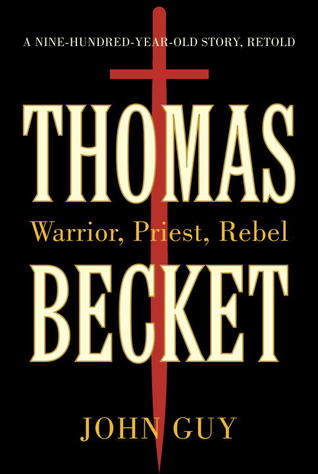
First Line Friday: Thomas Becket Edition


Okay, so sue me, in a not-so-roundabout way this post is ALSO an 'Eleanor Edition'. While I am still in the early chapters of my own book, concerning Eleanor's early life and journey to Paris, Thomas Becket would be a key figure in her life later on.

This week my first line is from this gem:

13152216

And I highly recommend the book. It is FANTASTIC.

"Archbishop Thomas Becket, who for four centuries after his gruesome murder in Canterbury Cathedral would be nicknamed 'lux Londoniarum' (the light of the Londoners), was the only surviving son of Gilbert and Matilda Becket, born very probably when the wreck of the White Ship was still the hottest news in town."

For those unfamiliar with the White Ship and the havoc it played on England in the ensuing years, a recap: Henry I (son of William the Bastard/Conqueror) lost his heir Prince William when the White Ship sank on November 25th, 1120. Only one man survived of an estimated 350 (crew and passengers). William likely would have survived, as he was launched out onto the water in a dinghy, but he returned to the wrecked ship to save a half-sister. That very decision, one that cost William his life as the dinghy was swamped, put Henry II - and Eleanor of Aquitaine - on the throne in 1154.

With William gone, Henry I had only one surviving, legitimate child, Matilda. Before his death, he repeatedly made his barons swear an oath of fealty to Matilda and protect her claim as rightful heir. One who swore that oath was Matilda's cousin Stephen, who might be an even worse king than Henry I's great grandson John. Naturally, Stephen stole the throne for himself with Matilda out of the country when her father died. A long, chaotic, brutal civil war followed and was finally put to an end when Stephen agreed for Matilda's son, Henry, to inherit the throne even over his own son Eustace. And thus, the Plantagenet dynasty was born.

Now, you might be wondering what all of that has to do with Thomas Becket. For that I say, please do read the book.

Leave me a comment on your own line this week, or your thoughts about some of my most and least favorite people in history. Then head over to the blogs of my fellow First Liners and see what they have waiting for you this week.


Rachel - Bookworm Mama


Lauraine - Lauraine's Notes

Andi - Radiant Light


Robin - Robin's Nest


Kathleen - Kathleen Denly


Jessica - A Baker's Perspective

And a very happy welcome to the newest participant Trisha at Joy of Reading!

Happy Reading!
Sarah

Wednesday, December 21, 2016

Summer of Blood: England's First Revolution

29807075

Rating: 4 Stars

(Before we start: this book was originally published in the UK in 2009. I am reviewing the edition published here in the US in November of 2016.)

I fear that if I fangirl over Dan Jones too many more times on Twitter, he is going to get a restraining order. But it is super easy to be totally into your favorite authors, then also kind of in awe about the fact that many of them really do run their own social media accounts. They actually take the time to respond to their fans. To me that is one of the the coolest things an author can do, so yes, I have stupid-happy fangirl moments when my favorite authors, Dan Jones of course among them, acknowledges my existence.

Let's take a moment and admire that cover, shall we? I talk a lot about cover art and how it is crucial. Judging books by covers is totally okay in some instances and this would be one of them. It is striking. I love a good cover, especially when it is a subject I am highly interested in.

One of the things that makes Jones just the author for subjects like this, is that he has the ability time and again to take something that could be considered boring to some, and weave the facts and figures together in a narrative that is appealing to a variety of people. Namely, both those like myself who are on a mission to read every book about the Plantagenet dynasty possible, and those who might have a passing interest because they saw The Tudors on HBO and aren't the Tudors and Plantagenets the same anyway? (Not kidding, someone really said this to me. I had to just shake my head no.) There seems to be this prevailing attitude among my generation and perhaps at least the one after mine that considers history dull old stories about people long dead, so why should we care? I can't even tell you how many times I have been asked why I read so much non-fiction, and history in particular - especially history of a country that is not even mine. While all of Jones' books are very well-researched and detailed, the story-telling aspect is what can keep even those less interested in the subject as a whole engaged. It is a handy to skill to have.

I like to consider myself fairly well-read when it comes to this era in England's history. I am partial to earlier Plantagenets and Plantagenets-by-marriage (hey Eleanor, I see you girl!), but find the many colorful personalities highly entertaining. This specific event, however, is one that I did not know nearly as much about, so to find a book dedicated solely to the revolt, its key players, and its aftermath was indeed helpful in clarifying things. I know a fair amount about Richard II, but only of his later rule. As Jones points out, it is easy to see how the entire event impacted him (he was only 14 at the time) and shaped his outlook and rule over his kingdom and subjects for the ensuing 19 years. While previous uprisings (such as the events that lead to Magna Carta in 1215) were spearheaded by the aristocratic class, this was something entirely different. In this revolt, often referred to as the Peasants' Revolt, the Great Rising, or Wat Tyler's Rebellion, it was the lower classes who rose up to fight the taxes and statutes passed by their rulers - the council ruling for Richard until he came of age. Time and again throughout the rebellion, they insisted they were loyal to the king, but sought to rid him of those around him who were actually in charge. No person was more hated I believe than John of Gaunt, Richard's uncle. The Duke of Lancaster was the wealthiest man in the land, had properties all over the country, and sometimes fought unnecessary and coffer-draining battles. The thing here is that he was not even in England at the time, yet he remained a target as the rebels descended on London and destroyed his residence, Savoy Palace. As an aside, it totally kills me that some of these grand palaces (think Nonsuch, Woodstock, Savoy, to name a few) are gone now, and we do not even know for sure what some of them looked like. I had this grand idea in my head for a minute to take my daughter Eleanor to Europe when she is older so we can visit any place still in existence that is connected to Eleanor of Aquitaine, before my brain said, "Hey dummy, most of those places are gone now. Have fun in France at Fontevraud seeing the effigies of Eleanor, Henry II and Richard I, even though those other dummies scattered all their bones during the French Revolution."

But I digress.

There are several great quotes that I have included here that best sum up the events of the summer in 1381 better than I can:

"As if from nowhere, a huge army of farmers, bakers, brewers, and churchmen drawn from all over England rose up and attacked their masters. They nearly brought down the government. Several of the country's most senior officials and hundreds of other people were murdered before the rising dissolved into chaos and official retribution. Those who survived were deeply scarred by what they witnessed" (page 3).

Jones takes us through the events leading up to the rebellion, making sure to note it was not ONLY about taxes. Instead he says, "...the only way to unravel the rage of the rebels in 1381 is to examine a little more closely the changes that had taken place in English society during the previous thirty years. There was no single event to blame for the revolt but several burned fiercely underneath. And the most important was the arrival of the most ruthless killer England had seen then, or has seen since: the Black Death" (page 13). The nation was completely devastated by the disease, which gave way to a depleted labor force. This in turn allowed said laborers to increase prices on their goods/services, which of course was not going to go over well with the aristocracy who needed them. It goes without saying that there was a drastic difference in lifestyles from one group to the other, but the work force saw the opportunity to change that. It didn't work out for them, as could be expected, due to the taxes levied and statutes coming from Richard's council.

As mentioned before, John of Gaunt was easily the #1 target of the rebels once they were able to get into London. They had it in their minds to destroy the men they perceived as their enemies and destroy any ill-gotten wealth they could find. While this idea is kind of admirable, I found it disturbing that while ransacking and destroying Savoy, a man was caught trying to pocket a belonging of Gaunt's by other rebels and was promptly thrown in the fire that burned the palace down.

Aside from looking at the event as a whole and its aftermath, this can also be considered somewhat of a study of Richard himself in the final pages. Though he was only 14, age can not excuse the huge mistake he had made at Smithfield in telling the rebels they could go about catching traitors and turning them in for a trial. How he could have thought that would work is beyond me, given the violence that permeated the entire uprising. If he had simply left his message that day as one of forgiveness and telling everyone to go home, who knows how may lives might have been saved? But, as history would show, Richard would not become one of the great Plantagenet kings. After more years of missteps, and outright contempt for the powerful men around him, Richard was captured by his cousin, Henry Bolingbroke (John of Gaunt's son) and imprisoned at Pontefract Castle where he was (likely) murdered, thus paving the way for his cousin to become Henry IV.

At length, Jones addresses this in the epilogue in just how much of a disaster Richard's reign became: "At the root of many of these problems was the emerging nature of Richard's kingship. The young king had come of age at Smithfield, giving on that perilous afternoon a glimpse of the selfless bravery for which his father and the best of the Plantagenet dynasty had been famous. But in the aftermath he had shown the dark inclinations of his family's character that lay buried in his breast (page 200)...Richard was restoring his royal power not through reform or assertion of the rule of law, but by a barely legal terror in which viciousness had replaced wisdom, and blind fear stalked the troubled land (page 201)...Richard's personality and judgment had already been badly warped. He emerged from childhood, and 1381 in particular, with a profound distrust of his subjects and in particular his nobility. He grew up paranoid and vindictive, incensed at any attempts to guide him or to reform his rule (page 205)...Richard's first and greatest misfortune was that he lacked any effective role model for kingship. When he was a child he saw his grandfather, Edward III, at his worst: senile and surrounded by grasping acolytes. His father did not live long enough to shape Richard in his own mold. In the end, Richard's real role model was his uncle Gaunt, as disastrous a study in rule as he could've had. The boy picked up all of Gaunt's worst faults, without displaying any of his talent. He was a bully, but not authoritative; aggressive in defending the rights of the Crown, but with no true comprehension of its awesome responsibilities; eager to pick and maintain a quarrel, but guileless in making peace (page 206)."

Whew. Yes, I realize it is a long slew of quotes strung together, but I really think it sums Richard and his reign up perfectly. If you ever needed a speedy-quick run-down of Richard II, there you have it.

In closing, I first must say that I highly recommend this one, as has been my stance on the previous books he has authored. He is able to take a complex, well-researched story and still make it accessible to anyone, regardless of academic background. I shy away from calling it 'popular history', as to me that implies this kind of quickly-consumed-and-forgotten nonsense that seems to be so, well, popular at times. It is definitely anything but that.

Lastly, I will leave you with one final quote, despite the possibility that I am drowning my own review in an overabundance of quotes. (This is easy to do when you have a highly quotable book!)

"But of course the rebellion of 1381 was not just a tax revolt or a revolt against poorly considered labor legislation. It was the first sign that the ordinary people in England were politicized, and could be made angry enough to rise against bad leadership. They cared about foreign policy, and corrupt ministers, and bad laws...There was a profound sense that those high up in society were failing in their godly duties to protect and defend those lower down. Tyler's rebels were really very conservative. Only a few would have believed in Ball's doctrine of total egalitarianism; most simply wanted society and social relations to operate normally again" (page 207).

Saturday, August 27, 2016

Women in the Middle Ages


487339

Rating: 4 Stars

I have read several books by this husband and wife team and enjoyed them all. This one is no exception. Though it was written in 1978 and comes across at some points as dated now, it is a thoroughly researched and well-written look at the lives of women in what we refer to as the Middle Ages, roughly 600 AD to 1600 AD. Of course there is always debate as to when the actual Middle Ages occurred - some dismiss the term 'Dark Ages' completely now, others say this time period begins with Alfred the Great and ends with Richard III's defeat at Bosworth. A strict start and end date is of little consequence to this book, as the authors look at seven women who lived in the centuries from roughly 1000 through 1400. And, though Eleanor of Aquitaine is not one of the women profiled in the book (sad face), she does make an appearance and I quite enjoyed that she is given brief but proper due in the chapter dedicated to Blanche of Castile (her granddaughter): "Heading the party was John's mother, and the princesses grandmother, Eleanor of Aquitaine, an almost fabulous queen who had astounded her contemporaries 50 years earlier by coolly deserting one king (Louis VII of France) to marry another (Henry II of England and Anjou), and who, at the age of 80, still played an active role in politics" (page 97). Page 99 then shows a photograph of Eleanor's effigy at Fontevraud Abbey, next to her favorite son, Richard. As an aside, I am forever amused that she was laid to rest next to her son, instead of Henry II, who was also entombed there. Whether this was purposeful planning or not, one would assume she would not want to spend eternity next to the husband who imprisoned her for years due to her habit of helping their sons rebel against him. While Henry was a great king, he was not a great husband (as viewed from our century, at least, though it would have been of little matter in the 12th century).

Now, back to the book...

Question: Even in the Middle Ages, people knew the world was not flat. And this fact was about them knowing this was known in 1978. So why the heck were we still taught in the 90s that people in that time thought the world was flat? It makes no sense.

I like that the authors use the first section of the book to give background and general information, not only about women in the Middle Ages, but in history as well. For readers who do not know much about this time period, this is valuable to give some insight into life for women in a time so different from our own - or even those in 1978 when this was first published.

The second section is devoted to seven specific women, spanning the centuries of the Middle Ages. I loved that the authors profiled women from all over Europe, not just England (though I do love England quite a bit). Here we meet Hildegarde a German nun who lived in the 1100s; Blanche of Castile (Eleanor's granddaughter), who became queen of France; Eleanor de Montfort, youngest daughter of King John (and another granddaughter to Eleanor of Aquitaine - are you picking up on her importance yet?);Agnes li Patiniere, a textile worker who lived in Flanders in the 1200s; Alice Beynet, who lived in England; Margherita Dantini, an Italian woman whose home, built by her husband (an Italian merchant) still stands today - or least did so at the time of publication; and finally, Margaret Paston, of whom we know so much about because of the multitudes of correspondences between her and her husband and sons that survived the Wars of the Roses.

These women are so fascinating because of the varied lives they lived. From peasant women, to the granddaughters of queens. The authors present these women as they deserve. They are made real, not just distant figures in time, as people who might have existed. There are existing documents that prove as much. It was great to see these women stand on their own and not be defined by the men in their lives, whether that be their fathers or brothers or husbands. This is important, because when we think of that time period, we don't think of women being successful in their own right in a very male-dominated society.

The only thing that bothered me was the photos. They're all black and white, and directly on the page with the text - no fancy glossy paper stuck in the middle of the book here. I would have loved to see some of these paintings in color, they would have been beautiful On page 35 there was also a chart of consanguinity from the 13th century which I would love to see in a more clear photo. You can't read the writing at all, so it would have been helpful to have not only the full photo, but then a close-up of the writing so it would actually be legible.

Otherwise, I have no real complaints. Frances and Joseph Gies were fantastic and thoughtful researchers who were thorough in their work. Both have passed away now, but have left many books behind to introduce the new readers to the world in the Middle Ages. Highly recommended.

Saturday, August 6, 2016

Magna Carta: The Birth of Liberty

24611571

Rating: 5 Stars

I heart Dan Jones. He is my favorite historian and if he wrote a book about watching paint dry, I would read it because he is the kind of writer who could make it so engaging you would not realize how boring the topic actually is.

Luckily, he writes about people and things that are already very decidedly NOT boring - namely my two favorite families - the Plantagenets and the Tudors - and the eras in which they lived.

Magna Carta is perhaps the most misused document in the history of the world. It had nothing to do with democracy, as Jones makes very clear, and everything to do with the rights of the barons who were opposing King John at an incredibly tumultuous time in the kingdom. Yet in the 800 years since its initial issue, it has threaded its way through a myriad of other documents, most notably the Declaration of Independence in 1776. As Jones recounts, even in 2014 then-Prime Minister David Cameron pledged that all the children in the UK would study the document because "...its principals shine as brightly as ever, and they paved the way for the democracy, the equality, the respect an the laws that make Britain" (pgs 198-199). Yet studying the actual text of the document itself (which you can do without going to DC or England, thanks to the fact that the original 1215 charter is included in its entirety in Appendix A) shows that was not its purpose at all. In fact, many of the clauses did just the opposite and its purpose was to limit the power of the king, as well as certain groups of people such as women and Jews (page 198). Yet this great myth has been perpetuated for years and years that Magna Carta is the basis of democracy, something the authors of it would definitely disagree with, and the idea would have been completely foreign to them.

Th author does a fantastic job taking us back in time to 1215 to see why the document was even written in the first place. Due to John's complete lack of ability to be a good king, the aristocracy took it upon themselves to put John in his place, so to speak. Naturally, John had no intention of adhering to the agreement signed that day at Runnymede. Perhaps this quote from the book best sums up John, better than anything I have read before:

"People loathed John. For all the attempts that have been made by historians to rehabilitate his reputation, any study of England's third Plantagenet ruler must account for the fact that he was a cruel and unpleasant man, a second-rate soldier, and a slippery, faithless, interfering, uninspiring king. It is true that at times John was no less ruthless than his brother Richard, nor any less manipulative than his father, Henry. Kings in this age were not supposed or expected to be nice...But if John's relatives shared some of his worst traits, he shared almost none of their best" (page 28).

I loved this book for many reasons. In addition to its in-depth look at the events leading up to, and after Magna Carta was first signed, I greatly appreciated the nod to Eleanor of Aquitaine. Some historians are quick to downplay her importance or dismiss her altogether, but Jones does not do that. Instead he says, among other things, "On March 31, 1204, John's spirited but ancient mother, Eleanor of Aquitaine, died at eighty-two. Her formidable presence had kept some order in the empire's south, but her death prompted the King of Castile to invade Gascony" (page 33).

Another historical figure who is finally getting his due in general is that of William Marshal, who I also find highly fascinating. I am always curious how the early Plantagenet rulers can even be discussed without mention of the greatest knight in England's history, but Jones makes sure to note his presence and importance whenever necessary. He served five kings and did his best to ensure order was kept (or restored when John did something stupid) - Henry the Young King (crowned while Henry II lived, but never given any real power, thus leading to his rebellion. He died before his father though, and would never see his way to the throne), Henry II, Richard I, John, and Henry III.

Despite the short length of the book, 200 pages exactly of text discounting the appendixes, it is packed full of information. The pages are peppered with footnotes, with additional notes after Appendix C and before the substantial bibliography. There are two maps: one showing England in John's time and the other detailing the whole of the Plantagenet empire in what is now France, both at its height in 1189 and then after John lost several territories by 1215. Appendix A is Magna Carta 1215, Appendix B lists "The Enforcers of the Magna Carta" and gives a brief one-paragraph summary of each of the 25 baron who were supposed to enforce the charter as it was written, and Appendix C is a timeline of important events in the 900 years since Henry I became King of England and first granted a charter which listed similar clauses as Magna Carta. It also details some of the critical events leading up to 1215, as well as various events in the aftermath, including reissues of the charter by Henry III and Edward I. Also included are references to the charter in the following centuries up to 2015, the 800th anniversary.

While highly informative, this is still an easily accessible read. Dan Jones is a fantastic writer who conveys the importance of what he is writing without dumbing anything down. Highly recommended.

Saturday, June 25, 2016

The Last Knight: The Twilight of the Middle Ages and the Birth of the Modern Era

569356

Rating: 3.5 Stars

While this book is not without its flaws, I feel like other readers and I must have read a completely different book. I found it to be a good read about a highly important historical figure who sometimes is forgotten - though I am not sure how. it so happened that a publisher had offered me a copy of another book about John of Gaunt so I read them around the same time and recommend both, as each has kind of a different focus. While they are both at the core biographies of John of Gaunt, the subtitle is important for this one. it is much more about the time period and the great changes taking place, as it is about the Duke of Lancaster.

Norman Cantor is still a well-known medieval author, despite him having passed away in 2004. I enjoy his works, have read some and have many more on my to-read list. So, I know that he has the knowledge necessary to write about his topics. Even well-versed authors are not completely immune to suppositions, and there were quite a few, but I couldn't not keep reading the book. One reason for all those suppositions is that, despite the fact that we have pages and pages, roughly 500 or so, of Gaunt's business letters and documents,there is not one single personal letter of his that has survived to come down to us through the centuries. The author also makes the point on page 81 that, "There is no evidence from late medieval England that aristocrats wrote personal letters at that time." It doesn't mean they didn't, it just means that so far none have been found. Such a shame that if they did so, we will never have these personal letters to read, to better understand the people we admire or disdain from afar (Believe me - what I would not give for an authentic cache of letters to be discovered somewhere in England or Aquitaine penned by Eleanor herself, detailing events in her life that took her from Louis' side as Queen Consort of France to Henry's side as Queen Consort of England!)

FYI: I am almost embarrassed to admit this, and maybe it is just because my head is so full of Henrys and Edwards and such, that I can't keep all the family trees straight (especially when they overlap multiple times), but I don't know how it never occurred to me before that Prince Henry the Navigator was Gaunt's grandson. I don't know why it took so long for me to make the connection. Yikes.

The book is not organized in a way that some readers might enjoy. Instead of being a straight biography of John of Gaunt, the Duke of Lancaster, his life story is told by topic. So, yes the book jumps around in time quite a bit, but you also have to keep in mind that subtitle I mentioned. It is about Lancaster, but also about the world he grew up in and the changes that took place to begin ushering in the modern world. Topics include the broad 'Old Europe', then the great families of the age, women, warriors, peasants, politics, and eve a whole chapter revolving around Chaucer. I liked the organization, because one chapter you get a sense of general life in that time, as well as how Lancaster fit into the world and how the various topics impacted him, and he them. That background information is especially important for those who have little knowledge to begin with, while still focusing on the subject of the book.

As I said before, the book is not without its flaws. There is a lot of supposition throughout. It is his final book published before his death (both occurred in 2004; a book about Alexander the Great was published posthumously in 2005) and I still found it to be adequate. I don't know that I would call it his best book, but Cantor had the ability to make even uninteresting aspects of the Middle Ages engaging. There is one quote though that I had a good chuckle at, not because it was ha-ha funny, but because it was just kind of a silly statement: "Undoubtedly Gaunt would have loved to wear the crown. But that was outside the realm of possibility. Above all Gaunt was a Plantagenet who wanted to maintain the dignity of the bloodlines of his family" (page 197). I mean, I seriously almost snorted at that line. While it is likely true that the Duke of Lancaster secretly coveted the throne of England (and really, he was already the richest man in the country and wielded about the same control), he would never have really overthrown his nephew Richard II, son of his elder brother, Edward the Black Prince. In all honesty he probably should have, because Richard II was not the greatest of kings, but that part might be true. The second part is what had me chortling, the 'dignity' of the Plantagenets. Just look at what Eleanor and Henry II's sons did in the many years their father was on the throne! They rebelled against him how many times (twice - guided by Eleanor herself) in order to get more power. Richard practically hounded his father to death for the crown after Henry the Young King (older brother) and Geoffrey (younger brother) both died, and John was easily one of the worst kings in the history of England.

Even with that quote, I can still say that I would recommend this volume. Cantor has written numerous texts about the Middle Ages and knows what he is talking about. It is fairly short, the hardcover volume I discovered at half-Price Books is only 241 pages. Give it a go and see what you think!

Friday, June 17, 2016

Quick Recommendation!

The Greatest Knight by Thomas Asbridge is on sale right now through Amazon for $1.99 - saw it on BookBub this morning. It is the story of William Marshel and his remarkable story serving five kings of England - Henry the Young King, Henry II, Richard II, John, and Henry III. One of my favorite books of the period, and easily one of the best books I have read in the last two years. Such a great read, go get it!

Saturday, June 4, 2016

1215: The Year of Magna Carta

3252574

Rating: 4 Stars

I really enjoyed Danzinger's book 'The Year 1000', so I had high hopes for this one for a number of reasons. First, I like his writing style. it is conversation without being condescending about academics. Secondly, I was hopeful (and correct) that Eleanor of Aquitaine would play a role in the text. Some historians are dismissive of her, in saying she was not that important. I beg to differ - how else would Richard have been freed from Leopold, how might John have further ruined England had he usurped the throne with Richard locked up? She was badass and I dare anyone to say it to my face that she wasn't. (I mean, it's not like I would punch you if you said it to my face, but be prepared for a verbal tongue-lashing. And a zillion facts for why you are WRONG.) Anyway, also bonus points for references to William Marshal, arguably the greatest knight to ever live. Without he and Eleanor working behind the scenes (and sometimes quite visibly) it can be alarming to think of what other havoc John might have wrecked.

But, on to the book.

I believe that some readers did not read the title fully. I know this happens, as it is something I do all the time. I focus on a word or two in the title and then get all upset when the book is not what I think it is going to be or supposed to be. The book is not about Magna Carta. it is about the year 1215 (and surrounding years, actually), the year this fascinating and incredibly important document was signed. Now, realistically, Magna Carta was not important in the way we think it should have been - John certainly did not take it seriously and almost immediately broke the agreement. It was rewritten and reissued several times, but did not fully function as it was intended, mostly because John was a weasel. I guess it is not entirely his fault, he was the baby of the bunch, called 'Lackland' because he had no inheritance to speak of while his older brothers lived, and was forever in the shadow of Richard. Still, he was a weasel for whatever reason and that comes through in the text.

Unlike Danzinger's previous book I mentioned that was broken up by each month in the year 1000, this one is divided into topics pertaining to the year 1215 and the early part of the century, really. We are introduced (or revisiting, if you are like me and already familiar with the era). The author presents information about life in towns, the countryside, schools, the Church, tournaments and battles, and so on. There is also a chapter devoted entirely to John, then the charter itself 'The Great Charter'. Something I found to be interesting was that at the beginning of each chapter, a quote relating to said topic was pulled directly from Magna Carta. It's a good way to get an understanding and become familiar with the document before actually diving in to the bulk of it.

As always, I am big fan of authors using contemporary resources. This book makes use of many of such documents, besides Magna Carta. There are clerk records, letters, diaries, purchase records, and more. I love this, because I love reading original material in the language of the time. It is not always easy, and sometimes I might have to read it a couple times to understand, but it is worth the time. Then, of course, the author includes the whole of Magna Carta, every single last clause that makes up this world-changing document.

As an aside, I was really happy to see the full text included here. In 2009, my mom and I visited Scotland and (very briefly) England (mostly just to see Wicked on Mom's birthday, the bulk of the trip was Scotland because it was Mom's dream vacation). For the one full day we were in England, I had booked a day trip that included visits to Bath, Stonehenge, and Salisbury Cathedral. But when we arrived for check-in, we were informed Salisbury had been closed for the day and we would not be able to see Magna Carta. I was so bummed. Windsor Castle was substituted, which would have been great - Henry VIII is buried there! Except...Queen Elizabeth II was knighting people that day so many parts of Windsor were also closed. It was some bad luck, but the perfect excuse to go back. And believe me, that trip will definitely happen.

Overall, I highly recommend this little volume. it is a small book, and a short book, but one well worth the read.

Saturday, May 14, 2016

She-Wolves: The Women Who Ruled England Before Elizabeth

8474660

Rating: 4 Stars

I am almost embarrassed by how short this review is going to be. Typically as I read, I update my progress on Goodreads and make notes of things I want to be sure to mention when I review a particular book. There are some books that are so inaccurate or terrible that I am constantly stopping to make a note of this or that. There are some books that bore me so much, I end up just turning pages without REALLY reading just to be done.

And then there are books like this, stories that I am so familiar and comfortable with, I breeze through and am done with the book in no time. Sadly still though, without hardly a note to speak of.

If you have been reading my blog for a while, or know me at all, you might recall that Eleanor of Aquitaine is a heroine of mine. She is the first reason I picked up this book. The second reason is that it is always refreshing to me to see strong female rulers BESIDES Elizabeth getting the credit and spotlight they deserve. Despite the fact that save for one, Mary I, none of the women ruled on their own, they still wielded great power and contributed to the making of England.

I must first point out, the title is not something I care for. Perhaps this is because I associate the term 'she-wolf' with Isabella, wife of Edward II. She has been referred to through the centuries as Isabella, She-Wolf of France, and not always in a very nice way. Now to be fair, she and her lover Roger Mortimer did have Edward deposed and murdered so it is kind of fitting, but thus it is not how I want Eleanor of Aquitaine referred to as well. Eleanor might have incited her sons into rebellion against their father. More than once. But she did not have him murdered. Okay, so he basically died because Richard all but hounded him to death, but it is not exactly the same. It's not.

Anyway.

It might surprise some readers then that the book begins, not with any of these she-wolves, but with a fifteen year old boy. Edward VI is dying, slowly and painfully. The Tudor dynasty that Henry VIII literally killed for is on the verge of collapse because it just can not be accepted that a woman might be able to rule the country. At least, not an independent, adult woman. Readers are introduced to the whole background, how Mary and Elizabeth were excluded from the succession in Edward's last days, how Jane would be proclaimed queen, and the country saved from a return to the old faith. And yet, despite the fact that these men surrounding Edward feared what might happen were a woman to rule, we then step back in time to see that this did, in fact, happen already and in some cases, quite successfully.

First there is Matilda, daughter of Henry I who lost her brother when the White Ship sank and Henry found himself without a legitimate male heir. Despite demanding loyalty be sworn to Matilda as next in line, the moment Henry had passed those loyalties quickly shifted and suddenly Stephen, Henry's nephew was proclaimed king. The result was a bloody and violent civil war that raged for years and all but tore England apart. It only ended when Stephen agreed that Matilda's son Henry would succeed him in place of his own son. It helped that his own son passed away and would therefore been unable to rule, on account of the being dead and all.

As with other books of similar content, it took too long to get to the section about Eleanor, and even as I was reading it flew by too quickly. But that is a personal thing, as anyone else who might be far less invested in Eleanor's story will not think so. We follow Eleanor from her days in Aquitaine, to the court of France where she first became a queen, then back to Aquitaine after her annulment and quickly on to England where she arrives as queen of England to Henry II. There is a reason her chapter is titled, "An Incomparable Woman". In fact, there are many. But you'll have to find those reasons for yourself, as her story is so remarkable that justice is not done to it when hearing only the summary.

After Eleanor comes Isabella, as mentioned above. Her story is an interesting one to be sure, another I know well. One can hardly fault her for eventually resorting to the violence that she (likely) ordered. From the start, Isabella was treated as though she were in the way in her own marriage. Edward II was nothing like his father Edward I. He spent his time with hobbies deemed below his station - I mean, he was the king, shouldn't he be allowed to do whatever he wants? But no, everyone was up in a huge tizzy because he enjoyed what were referred to as 'rustic pursuits'. Things like swimming, rowing, digging ditches, thatching houses, etc. The digging ditches thing always confused me, I mean what did he do, just go around the castle grounds digging random ditches? This part is never really explained in any book I have read of them thus far, but come on. Let the king do what he wants, as long as his mind is also on the keeping the realm safe. The problem was, Edward II was not really interested in battles and military; he preferred hanging out with his favorites and this left little room in his life for Isabella, who suffered great indignities at times for the sake of these male courtiers.

The last she-wolf we meet before Mary I is Margaret of Anjou, who was in the unenviable position of being married to King Henry VI. He'd not have been such a terrible king had he been mentally stronger than he was. But during the periods of time when he lapsed into a king of trance and didn't emerge for months, it was easy for usurpers to claw their way toward the throne. Their collective story remains one of the saddest for me in the whole of England's history. In those times that Henry VI was basically a vegetable, Margaret had to work twice as hard to hold the kingdom and her son's inheritance together. Then Henry would become lucid again, but never exhibited the strong characteristics needed in such turbulent times. Eventually Margaret would lose both her husband (likely murdered on Edward IV's orders) and her son (battle) and end her days living in Anjou once again without anything to show for having once been Queen of England.

The text then ends where it began, with the death of of Edward VI. The discussion turns to Mary, the challenges she faced both before and during her rule, and finally her death and a brief look at Elizabeth's rule. If you are interested in further reading specifically about Mary - which I highly suggest, as she has gotten the short end of the stick for the last 450 years - check out the books I have reviewed about her located under the Tudor tag here, or on my Goodreads Tudor shelf. She deserves a second look, for certain.

Additional material that I find especially helpful were the family trees located just before each section. Even someone with a lot of background knowledge of the rulers in each period still might find it easy to mix up siblings and cousins and such. New readers will also find it helpful to see how these women were all related to one another either by marriage or blood, down through the centuries. It really is amazing how much we are able to know about so many people who lived so many centuries ago. Almost 1,000 years separates us from Matilda and Eleanor. While there are many things we will likely never know, there are still documents and decrees and such that find their way to the light for eager amateur and professional historians alike. We are also given maps of each period, in order to show how England's claim to continental lands grew and shrank over the centuries. Again, a very helpful resource especially for those new to the subject.

Overall, this is a highly engaging, well-written account of women who ruled in a time when that was all but unheard of. These women faced major obstacles time and again; some they overcame, some they did not. But their stories are worthy of being told. Highly recommended.

Saturday, March 19, 2016

John of Gaunt

27394452

Rating: 3.5 Stars

Review:

I received a copy of this text for free directly from the publisher, Endeavour Press, in exchange for an honest review.

I am wavering back and forth on this one a bit, three stars or four. This was an incredibly informative read, in particular when it came to the Duke of Lancaster's military exploits (and unfortunate lack of success in most cases), but it was lacking in the areas I was most interested in - his personal life. I wanted to know more about his relationship and eventual marriage to Katherine Swynford and while the book touched on it, it never got quite as much attention as I would have liked. However, one must remember when reading this book, that it was first published in the early 1900s. Times have changed and new information may have come to light in that time that was not available to the author then. Or, perhaps more likely, the author was less concerned with that aspect of Lancaster's life. Either way, the book is heavy on the details of battle plans, which is not necessarily my area of interest. I kept reading though, because the book is still a well-written of a most interesting life, John of Gaunt, Duke of Lancaster - founder of the House of Lancaster and what would eventually lead to what we call today the War of the Roses.

Early on, the book is just as much about Lancaster's older brother Edward, the Black Prince, as it was about John. One would expect as much, seeing as how Lancaster was the fourth son (but third to survive to adulthood) of King Edward III and as a son so far down the line it was never expected that he would eventually play such an important role behind the throne. It is easy to understand then why there is not nearly as much information about him as we may like, and what we see from that time comes in relation to what is known of his older, just as famous, brother.

As an interesting (to me, at least) aside while on the topic of the Black Prince, I recently read an article concerning the siege at Limoges - where in the book it is discussed that the prince had roughly 3,000 thousand men, women, and children massacred. It actually may not have happened that way. New documents that have been discovered indicate that after the siege, this massacre may not have taken place but instead 300 hostages were taken. While we may never know for sure, it is an important point to make when reading older texts such as this that new information is being discovered all the time. And I would like to believe it did not happen, but the Middle Ages were quite a different world altogether and it can not be dismissed entirely; massacres like that occurred often in battle.

One of the most interesting sections to me occurred when it came to the non-battle-oriented aspects, such as the management of Lancaster's lands, who was in charge of what, etc. While this information was specific for Lancaster, it also could have been about any other noble with large landholdings, and I could appreciate the information as being just about the time period in general as it was about him. I love the Middle Ages and there are certainly times where the book focuses more on the period itself. I feel like maybe that was due to the fact that there were simply times in Lancaster's life that could not be accounted for, so generalities had to take the place of Lancaster-specific info. I am not entirely opposed to that practice, but there does need to be a balance between subject and general information.

I also enjoyed the sections detailing Lancaster's retreat and seeking refuge in Scotland. I do not think most people (who know of the time period) realize quite how many times Lancaster had to defend himself against his enemies who sought to bring him down. Many thought he was angling for the throne himself, which may well have been true. But time and again when he could have gone after it, he did not. It is intriguing to think about how different England might look today had that happened and he been successful. Or maybe not, seeing as how his son Henry Bolingbroke would go on to become King Henry IV anyway. Or, history could have gone a completely different direction had any of the Edwards (Edward III, Edward the Black Prince, and the Black Prince's son, also Edward) managed to live just a bit longer. Richard II might never have been king at all and that would be something to contemplate.

After I muddled through the Castile battles and plans and the like, I was excited to see a chapter regarding Katherine Swynford. I thought finally, what I have been waiting for. But alas, it was not solely devoted to this aspect of Lancaster's life and so I was a bit disappointed. I wanted to know so much about their life and their children, and perhaps I simply have to seek other books to find more information on this topic, for reasons I addressed above.

Overall, I can say that I would recommend this book to anyone interested in the Middle Ages and the larger-than-life figures who lived in that age. This text will be of special interest to those who are keen on military information and the Hundred Years' War, as well as Lancaster's forays into Castile and Leon. Despite its age, the book is still very informative and would be a great addition to a medieval books collection.

Monday, February 1, 2016

Kings & Queens of England, a Dark History: 1066 to Present Day

4953656

Rating: 1.5 Stars

Review:

I will keep this short and not so sweet because this book was not good. I try not to, but I sometimes can not help but take offense when I see historical figures I love so dearly and/or highly respect either much-maligned or simply presented wholly inaccurately by an author who could not bother to do five seconds of research. I like the 'Dark History' series in general, though it is nothing spectacular and you will find no new information contained in them. But what I found here was worse. This book was gossipy and sensationalized. it was poorly written and riddled with inaccuracies. There is nothing 'dark' about this history that is flat out wrong in many places. She refers to Catherine Parr as Henry VIII's "Finally, an enduring love" as one heading, which is laughable, considering she wanted to marry Seymour all along. Anne of Cleves was apparently "ugly, skinny and loud-mouthed" - news to me since I did not know you could be a loud-mouth in a country where you did not even speak the language. She is especially nasty to two Scots in particular, Mary and then her son James VI. First, Mary is described as being an, "ignorant, foolish, indiscreet airhead" who "managed to do almost everything wrong and was certainly not the queen 16th century Scotland needed." This could not be more wrong. Without a doubt, Mary made some very stupid decisions. But by all accounts in the short years she did rule, she worked to maintain a balance between her Protestant-turning country and herself. Much has been written about Mary not enjoying her studies but that does not make her an airhead and she was still well-spoken and educated. Her son James does not fair much better. The author refers to him as "creepy", with "spindly legs" a tongue "too big for his mouth...He drooled. He did not wash very often...He looked scruffy because he dressed so badly." It has been documented time and again that James looked oddly in his dress due to the many layers he wore to protect against an assassin. Yes, apparently his tongue was awkward and he was awkward but come on. All this book amounts to is a trashy gossip magazine in hardcover form. PASS!

Thursday, January 21, 2016

The English and Their History

25893691

Rating: 3 Stars

Rating:

This book is exhausting. So exhausting, in fact, that I am not even sure I can review it properly. I have read more than my fair share of books. One might say reading is my 'thing'. I am especially fond of that little island now called England and its amazing history, going way back to the Iron Age people, through Roman Britain, the Anglo-Saxons, the Normans, the Plantagenets, and the Tudors. Beyond that, my interest starts to wane. In the past with books about the history of England, I have always given up a bit after James VI/I. Sometimes I make it through the execution of his son, Charles I, but rarely. I vowed this time, with this one, to make it through. And so I did. Barely.

So, this one began in what is typically still referred to as the Dark Ages, despite our knowledge of the time growing more clear all the time with new discoveries. The Anglo-Saxons and Alfred are possibly my most favorite of the eras in England's history, so it is always nice to see him given his due. Alfred is, after all, the only king in the country's history to be called 'the Great'.

My concerns with the book come very early on though, as I feel there were many aspects of England's history that were glossed over or not mentioned at all from those early years, in favor of much more material covering the last two hundred years. For example, while we see Edgar Aetheling mentioned, there is almost zilch about his grandfather Edmund Ironside and his brief co-reign with Cnut - it is generally thought that Edmund was murdered by or on Cnut's orders so he could assume complete power. Subsequently there is nothing about Ironside's sons who were spirited out of the country and Cnut's reach. That in itself is a fascinating story and deserved a place. The course of history might look very different for England had someone aside from William I become king. There were many other times that this lack of detail jumped out at me - perhaps because these are among the time periods I know best. The author calls the circumstances of William II's (William Rufus) death 'mysterious', but does not fully elaborate. It is considered mysterious for a number of reasons, considering he was shot in the chest with an arrow and the culprit left the scene immediately - while Henry I (his younger brother, the youngest son) headed straight for the treasury to secure it and the crown, effectively stealing it from Robert who was next in line. Further more, it was strange to me that the author considered Matilda (Henry I's daughter) the antagonist in the civil war between her and her cousin Stephen. When Matilda's brother Henry died on the White Ship, she became the only legitimate heir. At least twice Henry I made his nobles swear an oath to support Matilda's claim as queen, but given the fact that there had never been a queen who ruled in her own right, as soon as Henry I was dead they naturally (for the time period) looked elsewhere. Stephen was the usurper, the antagonist, though Matilda certainly did herself no favors by alienating some who she needed support from. In the end, Stephen agreed for Matilda's son to become king as Henry II, despite Stephen having a son of his own. So began the 300 year rule of the Plantagenets.

There was very little attention given to another of my favorites - Eleanor of Aquitaine. She is hardly mentioned, and only as Henry II's wife. We get a glimpse but that is it and no where does it say that without her gathering the ransom, her son Richard I would likely never have been released from prison. While Richard cared very little for England and preferred his lands in Aquitaine, or the Holy Land on Crusade, him being overthrown by John even earlier could have caused even more destruction.

By the time we get to Elizabeth, all of my favorite periods were covered. This amount to roughly 200 pages out of nearly 900 (1,000 if you count the end notes, index, etc). For the rest of the time it was pretty rough going for me, because it just does not hold my interest the way early England does. I truly don't even understand it myself, how I can be totally enthralled by the first 1,600 years and not care one iota about the last 400. But I was determined to slog on through. As a result, it took me a while and I frequently set it aside for something else. I have to be quite honest and admit I skimmed the Industrial Revolution. Glad it happened and all, but it is a terrible snooze to read about.

I found the Victorian era more interesting to read about this time around, so perhaps there is hope for that in the future. World War I and World War II were great reads from the English perspective, as anything I have read about them in the past have been strictly from an American viewpoint. Throughout the book there were tons of maps to aid the reader with the text, which I have always found especially helpful when discussing battles and troop movements. My only real complaint about WWI material involves the omission of Gavrilo Princip. You may not recognize the name, as so often he is simply referred to as 'the assassin of Archduke Franz Ferdinand'. I feel like it is a disservice to history that his name is routinely ignored. Like it or not, for better or worse, hi actions set of a chain of events that culminated in The Great War, which in turn lead directly to WWII.

I can't speak for the accuracy of the rest of the text due to my limited knowledge of those eras, but I at least found them somewhat engaging - enough to continue reading anyway. This is certainly not a book I would consider as my first if I knew nothing about England's history. It is quite the endeavor and not one to enter into lightly if you are looking for a quick read. On the other hand, if you are more interested in the time periods after the Tudors that are less interesting to me, then this may just be the book for you, as that is the bulk of the material.