Wednesday, January 3, 2018

Long Road to Hard Truth: The 100 Year Mission to Create the National Museum of African American History and Culture


32021155

I received this ARC free via NetGalley from Proud Legacy Publishing in exchange for an honest review.

Rating: 5 Stars

This is yet another ARC that I had put aside in 2017 when life was crazy hectic and I wish I had not. This book is so important to our nation's history and the specific struggle that our African American brothers and sisters have endured in fighting to be recognized as citizens in their own country. This book needs to be taught in all high school history classes.

In this text Robert L. Wilkins tells the story of how the National Museum of African American History and Culture finally came into being, after decades of starts and stops, permeated by the latent and outright racism of several players in this saga. Judge Wilkins writes not of the museum itself and the numerous artifacts, oral histories, and exhibits, or the celebrities who lent their time to its creation, but of what it took to actually get the museum built in the first place. He has exhaustively searched archives and all possible repositories of knowledge to find every single instance of attempts to create a museum of African American history and the multiple reasons those plans were halted. This became a kind of obsession for Judge Wilkins, first leading him to cut back on his time as a public defender to devote time to his goal of seeing a museum dedicated to the sacrifice and struggle of African Americans and their place in US history. I think Wilkins job as a public defender really helped him realize his greater purpose and it is something the author touches on at various points. He mentions that the majority of his clients are young black and Hispanic men, many of whom he says don't see a future for themselves when he asks where they see themselves in five years. The heartbreaking answer is that some do not even see themselves as being alive in five years. These young men, many still teenage boys, did not care much to know the history of the Civil Rights Movement, how people died for their right to attend proper schools and get the education they deserved. But, Wilkins also discovered something else: when many of these same boys and young men were incarcerated, they started reading because they had nothing else to do. When they truly learned about all that it took to get the access to that education, it opened their eyes to opportunities they had wasted. Wilkins saw the museum as an opportunity not only to showcase the achievements and contributions of African Americans, but to be an inspiration to the young men and women who saw only a bleak future for themselves.

Through this book Judge Wilkins chronicles the attempts by various groups to create a space to honor African American history. it begins with the exclusion of black troops being honored after the Civil War ended. Various excuses were made as to why the troops were not invited, and none were acceptable. To rectify this, on the 50th anniversary of the original Review, again when African American units were excluded, supporters first attempted to create a monument to these men who fought for the Union and were all but erased from history. Through the era of Jim Crow, which saw lynchings become a disgusting sport, these advocates sought to create a national museum. Decades of obstacles followed, including the back and forth on whether the Smithsonian should be involved, should it be located on the Mall, and so on. I was so very disappointed to read of the specific lack of interest from the Smithsonian in the creation of a national museum. As I was reading I did not understand the hesitation, as I hoped that surely such a bastion of culture and knowledge could not also be so deeply entrenched in systematic racism. I was disheartened to see an institution I held in such high esteem could be on the wrong side of history. Yet, it was.

In his quest to see this vision come to fruition, Wilkins was named as a member of the Presidential Commission. The commission was tasked with writing the plan to create the museum, the space to be used, and so on. Wilkins poured over every single document related to the attempts to create a museum in the past, also taking note of what the reasons were for the project not moving forward. All of this culminated in a report that was finally accepted and 100 years after this journey first began, Congress finally authorized the museum. The National Museum of African American History and Culture opened in September of 2016.

As I wrote earlier, this is a book that must be taught in high school history classes. Until we as a nation confront the fact that so much of our history is steeped in the horrors of  slavery and discrimination, from the rise of the KKK to Birth of a Nation, and everything beyond, this is a very real part of shaping our nation even today. It took so long for this museum to become a reality, far longer than it should have. Not until a bipartisan effort of both Democrats and Republicans, an effort also supported by George W. Bush, did this happen. This is something important to consider, and is worth reflecting on. Why did it take so long? I think the answer is a hard truth that we don't want to see.

While the text itself is not terribly long, there are extensive notes (12% of the ARC) that highlight the numerous sources the author drew on in his quest to see this project through to the end. I highly recommend this to all.

Monday, January 1, 2018

A Beautiful New Christmas Gift

I just HAVE to share one of my Christmas gifts that I am super excited about. This New International Version that my mom gave me for Christmas has beautiful verses and designs to color. Seeing as how we've already reached the high of -5 today and it will only get colder from here, I think today is the perfect day to stay in and add some color to my new Bible.


Happy New Year!

Happy New Year!


Here's hoping you have a happy, safe, and healthy 2018.

Cheers!
Sarah

Sunday, December 31, 2017

Dawn of Infamy: A Sunken Ship, a Vanished Crew, and the Final Mystery of Pearl Harbor

33152438

I received this ARC for free via NetGalley from Da Capo Press in exchange for an honest review.

Rating: 3.5 Stars

I have a slight obsession with reading anything I can get my hands on about Pearl Harbor. I think part of the reason is because I have been there, been out to the USS Arizona, and seen the memorials. It is a humbling experience and one not to be taken lightly. My grandma and I went to Hawaii a few years ago and we incredibly lucky to have two great tour guides from Home of the Brave Tours (one of whom was the owners' son) who took us to Pearl Harbor, Wheeler Airfield and Schofield Barracks, the Punchbowl, Fort Shafter, and a few other sites before the tour concluded at the museum run by the company. Just an aside, the tour was amazing and I highly recommend this tour company. Lots of high-interest sites and very informative - plus the museum had tons of great artifacts; Grandma and I had such a great experience. All photos belong to me and were taken in June, 2010.

No automatic alt text available.
Arriving at the USS Arizona

No automatic alt text available.
At Wheeler

No automatic alt text available.
At the Home of the Brave Tours museum

Now I suppose I should get on to the book, eh?

On December 7th, 1941 as the attack was getting underway by the Japanese on Pearl Harbor, one of the enduring mysteries of that day was unfolding. An American cargo ship, the Cynthia Olson, was hauling lumber from the Seattle to Honolulu for the Army. Somewhere in between, the ship was fired on by a Japanese sub. After sending off one wireless message about an attack, the radio on board went silent. No one knows for sure what happened to the ship, how long she took to sink, if multiple subs were involved, or the fate of her 35 crew members. While the captain of I-26, the sub who fired on the Cynthia Olsen, has passed away, along with everyone else who was involved (either American or Japanese), we will never know for sure the true story.

"The humble Cynthia Olson - old, slow, and of virtually no military value in the greater scheme of things - was destined to die simply because she was in the wrong place at the very worst of times" (36%).

We can, however, make our best educated guesses based on the information we do have - though unfortunately certain ship logs that might shed light on the mystery have long-since disappeared, reported as destroyed.

Sounds like something we should have learned about in history class right? And we would have, had the full-scale attack on Pearl Harbor not also been happening at roughly the same time. And that is actually part of the mystery. There is kind of a muddle of information that does not make it clear when the warning shot was first fired at the ship. The sub's commander insisted he did not fire the warning shot until 8:00 AM Hawaiian time, when the first wave was to descend on Oahu. However, that may not have been true, and he may have ordered the first shot up to half an hour earlier.

I wavered between three and four stars on this one for a while, and really only because the beginning started off very slow. Truthfully, I even skimmed a lot of that because I wanted to get to the real point of the book. Prior to that though, we are given the entire history of the Cynthia Olson which, while important, made for heavy reading very early on. Given the fact that we really don't have answers, perhaps the back story was included to give some meat to the text, as I honestly do not think there was enough information to really flesh out the story. I think overall this is an important event though. These men deserve to have their stories told, at least as much as we can tell of them, given the information still available. Unfortunately for the men who hailed from the Philippines, with lack of contact information for their next-of-kin or descendants, this story will never really have an ending.

As mentioned above, the beginning of the book, perhaps about 1/4, is devoted to the history of the Cynthia Olson. We learned about her construction, the company that owned her, and the crew who were aboard the ship on December 7th. The problem again is that there was so little known about most of the crew, that they never really seem real. The crew was comprised primarily of Scandinavian-born naturalized US citizens and Filipino merchant marines who retained their citizenship in the Philippines. There was a bit more information known about the captain, Carl Carlson, and his officers, but other than that many times even the ages of the crew were unknown. These men mattered, their story matters, but we never really get to know them and there is no chance of that happening.

So, we are left to focus on what we do know and the story does pick up its pace as the ship and sub cross paths. I-26 is commanded by Minoru Yokota, and we get his background and resume as well. We are told that the Cynthia Olson sent a distress call after being stopped with a warning shot. Japanese accounts then state that Commander Yokota gave the crew time to abandon the vessel, it being an unarmed ship, and both lifeboats were swung away, the davits empty in ensuing photos taken from the sub. Then, after the men were off the ship, the Cynthia Olson was slowly but surely sunk to the bottom of the Pacific. There is not clarity about how long the sinking actually took, and accounts contradict one another. At one point in later interviews, Commander Yokota says it took several hours to sink, yet this would not have been possible when the search vessels arrived to assist the Cynthia Olson crew. Unsurprisingly, they find nothing, no debris, no crew, no bodies, nothing. Other accounts state that a second sub, I-19 (later to actually be identified as I-15), came upon the crew in their lifeboats and gave them some additional provisions. The current and winds would have carried the lifeboats away from the location of the sinking, making any hope of rescue impossible. We are privy to this fact based on the coordinates of the rescue ships and the vast area they covered in their box search.

The final section relates to what the author considers the three essential questions revolving around the mystery of the lost ship. First is a question of timing and whether or not the Cynthia Olson was sunk before shots were ever fired on Pearl Harbor. Secondly, whether news of the attack have been enough of a warning that more was coming. And last, the most important, what happened to the 35 men who woke up to a new day on an uneventful routine sea voyage that would ultimately be their last?

In the end, we will never have concrete answers to these questions, except perhaps question number two. Even if Commander Yokota had ordered his crew to fire that warning shot, it could not have been more than 30-45 minutes before the rest of the force attacked. And really, would he have jeopardized the bigger mission, for surely he would have thought that rescue ships and/or planes would have come to the Cynthia Olson's aid. As for the fate of the crew, the author presents us with four options:

1. There was no warning shot and the ship was sunk with the crew on board, violating international treaties in regards to unarmed ships

2. The crew was able to get off the ship in the life boats, and then were killed by I-26

3. The crew was killed by the second sub, I-15

4. The crew perished in the lifeboats, either from starvation, dehydration, exposure, etc.

The author does point out, logically, that scenario one and two don't make a lot of sense. This primarily rests on the fact that the wireless operator, Sam Ziskind, had time after the sub's appearance to send both the auto alarm and the follow-up message with the ship's coordinates. As such, one would have to wonder what the point would have been for the commander to allow the crew to board the boats, only to kill them in the water. It would have seemed to be a waste of precious time, especially as the rest of the country was finding out what was happening on Oahu.

Further digging into the possibility of scenario #3 indicates that neither I-15 nor I-19 could have come into contact with the Cynthia Olson lifeboats. This is according to records and the author's research into those records.

The final scenario then seems the most likely, though we will never be certain. It is most likely that the men drifted on the open water, exhausting the provision each boat was equipped with, eventually succumbing to the conditions. This is the conclusion the author states can only be the true, logical conclusion to this tragic story. While I do not share his conviction 100%, it does make sense.

Though I mentioned before that there truly was not enough material here to make this a full book, I do have to admire the research the author put into this text. It appears he searched through every archive, spoke to every person he could, to glean any scrap of info possible about the ship, her crew, and her final hours. The Notes section runs from 79% to 92%, noting several contacts around the US, as well as a few other countries. Primary and Secondary Sources then run from 92% to 96%.

Overall, I can recommend it for those who truly have an interest in WWII and Pearl Harbor in particular. For those who may have only a passing interest in the subject, the massive information dump in the beginning may be off-putting. Still, I do see the value in this story being told. It is the least we can do for the crew of the Cynthia Olson.

Reading Goals for 2018


You'd think that with my complete and utter failure of my 2017 goals that I would be a little smarter about what I choose to accomplish this year. Not going to happen, unfortunately, because as of January 1st, 2018, I am all about these lofty goals that I SWEAR I WILL ACCOMPLISH THIS YEAR!

So, here we go:

1. 2017/2018 Presidential Reading Goal

I am going to be more serious about this goal in 2018. I thought I had all the time in the year to get this one done in 2017 and then BOOM! A new writing project happened and all my time was directed at that project. This year, though, will be different. My Goodreads Challenge goal will coincide with this and my attempts to read more quality books, as there are so many great titles about these past leaders who, for better or worse, set the path which we now travel today.

2. Goodreads Challenge: 150 Books

This goes back to that quality over quantity thing mentioned in my first goal. I read a bunch of shorter books that really shouldn't count, but I did and now I will try to rectify that problem this year. I have to focus on my own writing as well, and realize that this may be the year where I do more writing and editing than actual reading. That thought is actually terrifying to me. Reading is what soothes me when life is crazy and I need to re-center myself. If I do not read for at least an hour a day, I get jittery. It's a legit addiction folks, but hey, it could be a lot worse.

3. Give NetGalley Attention!

2017 is the year I was reeeeeally lax on my NetGalley reading. Part of that again had to do with my Eleanor of Aquitaine project, but it also had to do with my obsession with BookBub and it just got way out of control. I have about 25 galleys on my Kindle awaiting to be finished - some even waiting to be started! It is my goal to put these books at the forefront of my reading in the start of the new year (or even here at the of 2017 still) and get that feedback provided. All are published now, but I can still review them and get the word out about the ones I really loved. This goal is a MUST! Aaaaaand it will totally help me get back above 80% again. Right now I am hanging right at 80%, which is just not good enough for me. Or major publishers who only look at that percentage and thus will not give me the books I so desperately want. (Case in point, Dan Jones' Templars book. It even says right there in my profile that Dan Jones is the bees knees and my fave historian, but I was denied a galley. My guess is that is was that pesky percentage. No worries though, I bothered Dan about it on his Facebook page and voila! A couple weeks later the galley was mine!)

4. Write a Damn Book Already

Okay, so technically yes I am doing this as we speak. I started back in February of 2017 and got lost in the readings and the articles and the primary sources and it has been wonderful. I am learning so much more about the period as I go - a period I thought I already knew so much about. I have the first few chapters written, and there will be much editing in those alone, while I am also delving into the meatiest part of Eleanor's life - her marriage to Henry Plantagenet, Henry II of England, their 'demonic' off-spring, her imprisonment, and finally the moment when Eleanor takes her rightful place on stage as one of the most powerful women in Europe while Richard is off at war (and then requires his mother to save him on his way home). My specific goal this year is to get the first draft done and submitted by August 1st, 2018. It is kind of scary to type that out, but I am also taking into account the fact that I do not have the luxury of sitting home and writing all day. I am still currently an educator in a very demanding and exhausting position working with emotionally disturbed 3rd/4th/5th graders. There are days I can not write because I am too tired to even think. But I have to power through because I know that this path is the best one for me, and in turn is the best one for my daughter. I hope future projects will follow, but first I have to get this one out there.

5. Buy Less, Read More

I have a serious BookBub addiction. Or, HAD, I should say. No joke, I had to quit using BookBub about two months ago because my Kindle was out of control. I have 700+ books on there right now, in addition to an out of control physical bookshelf (that I reorganized on Christmas Eve, to better help me accomplish my president goal. All the president books were blocked by all the Amberley books I have ordered in the last six months, so I will pretend that is the reason I failed at that goal for 2017: I couldn't SEE the books). I have far too many books to continue acquiring new ones at the rate I was there for a while. And I am supposed to be an adult who is fiscally responsible, so I'm just going to read what I have, sell what I want to, and THEN get more books. This will probably be the toughest for me, because turning down a deal on any book, physical or digital, is TOUGH.

What are your reading goals for 2018?

Happy Reading and Happy New Year!

Sarah

Saturday, December 30, 2017

2017 Neglected Galleys That I MUST Read ASAP


NetGalley


When I discovered NetGalley back in 2015, it was a dream come true. All these wonderful, beautiful books could be mine BEFORE publication! I could get access to titles I had been not-so-patiently waiting for and be part of initial chatter about the books I loved and shout about them for all to hear.

Then 2017 came and man, I crashed haaaaard. I had so many great galleys but when I began my own book about Eleanor of Aquitaine, all of those books I was so excited to have been approved for fell to the wayside. I knew I could not devote the proper time and energy to them for constructive reviews, and I fell behind. All of them are published now, so I am late to the party, but there truly are some really wonderful titles that I am determined to read as my last books of 2017 and my first books of 2018. 

Here are the titles I am going to be reading/reviewing in the next few weeks, courtesy of NetGalley and their respective publishers.

24340907     24724228

27268679     30350105

29625955     7946737

25485332     32280407

33673455     35265200

36524901     25593979

34276987     30968407

32021155     33415086

33152438     30760666

6051271

Bonus: a few of these will be very helpful in also achieving my goal of reading about each president.

Have you read any of these titles? Do you, like me, go on request sprees on NetGalley, only to find there is no way you can read in all the books you have requested by their publication dates?

Happy Reading!
Sarah

Dust Bowl Girls: The Inspiring Story of the Team That Barnstormed Its Way to Basketball Glory


28110849

I received this free ARC via NetGalley from Algonquin Books in exchange for an honest review.

Rating: 5 Stars

2017 was terrible for me in getting my NetGalley ARCs read. Since February I have been working on my own book and I just did not review nearly as much as I wanted to. My galleys in particular were set to the side and one of resolutions for 2018 is to get them all read and reviewed properly.

As soon as I saw Dust Bowl Girls, I knew I had to request it. My reasoning was two-fold, and I suspect that there are many who may have requested it for the same reasons I did:

1. I love basketball and played for years. March Madness is the greatest time of year.

2. A League of Their Own is one of my favorite movies and this seemed to be in a similar vein

I was not disappointed. Once I started reading, I could not stop. I only wish I had read this one a year ago, back when I first got it.

Dust Bowl Girls tells the story of the women's basketball team from Oklahoma Presbyterian College in Durant, Oklahoma in 1931. We learn about Sam Babb, their coach, who traveled back and forth all over Oklahoma to recruit women to play for OPC. The women were given the opportunity to not only play the sport they loved, but do also get a college education - something of high value in the midst of terrible suffering with farmers losing harvests, banks closing down, and families barely making ends met. He offered these young women a chance to change their fate and many took him up on the chance. Before Babb came into their lives, most of the girls were working on their family farms, playing basketball on make-shift dirt courts, helping out their family any way they could. College was certainly out of the question for most, as there was no money to pay for such a luxury - especially in a time where so many farms were struggling as it was and the loss of crops in one season could mean losing everything else as a result. There were several girls though, who despite taking the chance, were simply not up to the challenge once they arrived on campus and practice started. One of the star players made an interesting observation about why she thought this was so.

"In fact, after much thought about the issue of so many girls quitting the team and going home, Lucille had decided the poorer the girl, the harder she worked. All the poorest girls were still there" (38%).

The author, Lydia Reeder, is the perfect person to write such a book, as she is the great niece of head coach Sam Babb. Her writing style is smooth and engaging, and if you are one who enjoys their non-fiction to read like fiction, you may enjoy this. It is rare for me to get caught up in such non-fiction usually, because I am very much a "just the facts" person who does not like a lot of supposition. There were times for me when this was off-putting, especially when she was describing a daily run by one of the players. There is simply no way the thoughts and details could have been recorded anywhere or in such detail. There will be times of dramatic flair added, but not in a way that distracts from the actual story, or embellishes any of the accomplishments of this talented teams. And Reeder not only had access to stories passed down in her family, but scrapbooks, newspapers, interviews with the players, etc to rely on to paint a very vivid portrait of life for these young women. In fact some of those 'extras' that can make a book so special found their way into the pages - tons of team photos, newspaper articles about the season, and even a photo of a ticket stub from one of the games. Those kinds of artifacts are wonderful additions and enhance the text. At the end the author also provides extensive notes explaining how she came by the information and how it all worked to bring this story to life.

In addition to the story of the 1931 team and their undefeated season, we are given information about the history of women's basketball in general, as well as certain aspects of Oklahoma's history - not least of which is the terrible legacy of the treatment of Native Americans there. The players, who several themselves had Native American ancestry in the not-so-distant past, were given the task of teaching younger Indian students table manners during meals.

While the story of this team and the many women who played for many different teams was enchanting, that was not the case for the entire country - including First Lady Lou Henry Hoover. I myself played basketball for many years, am still a fierce competitor in nearly every aspect of my life (truly, I can make almost anything into a competition). Hearing stories from my grandma about how in the 50s when she was in middle school and high school, the girls could only play half-court basketball because they weren't strong enough to play full-court baffled and angered me. Then to see that and more in this book, while I logically knew there were many who thought was an acceptable and appropriate way to think of women and sports, made me even angrier. Basketball was not considered an acceptable sport for young women to play. They were not physically, emotionally, mentally tough enough to do so. Malarkey, I say. They were instead encouraged to play tennis or golf - yawn. Instead of having competitive varsity teams, many schools basically had what amounted to play dates with other schools, which concluded with sharing milk and cookies. I mean, seriously? Give me a break. It was okay for young women to learn some athletic sills, but never to get too good at any single sport. I know of course that those attitudes today do not exist on the large scale they did then, but the backwardness of it all really grated on my nerves. Authorities at the time were so afraid that too much physical activity would eventually cause the young women to "turn into men". No joke, when it was discovered that more active women did not have regular menstrual cycles, there was a fear that the uterus would wither away altogether. The "Women's Division" was a massively annoying group of women, including the aforementioned Hoover, who were incredibly anti-feminist women who set the rules and if the AAU wanted to continued having female athletes, they had to compromise sometimes. This gaggle of women were so sure that the young ladies would not be able to stand the pressure of competition and the ones that did not would somehow become tomboys who lost their ability to be "ladylike".

All in all, this was such a wonderful read, even when I was shaking my fist at those who tried to limit or prohibit altogether women from playing basketball. I am forever grateful to these pioneering women who forged this path, allowing generations after them to come to know and love this game so dearly. Fantastic read, highly recommended.

Friday, December 29, 2017

First Line Friday: Mighty Women Edition

grab button for Hoarding Books

Welcome to another edition of #FLF, hosted by Hoarding Books.

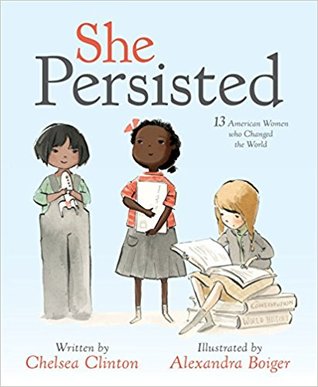
I am super excited to share a book this week that my daughter got yesterday at our extended family Christmas. We've read it so many times already and I love love love it. Props also for Claudette Colvin being included for not giving up her bus seat, a few months before Rosa Parks.

34608694

"Sometimes being a girl isn't easy. At some point, someone will probably tell you no, will tell you to be quiet and may even tell you that your dreams are impossible. Don't listen to them. These thirteen American women certainly didn't take no for an answer.

They persisted."

Let me know what you think and/or leave a line of your own to share this week.

Happy Reading!
Sarah

Thursday, December 28, 2017

The Haunted Heart of America: In-Depth Investigations of the Villisca Ax Murder House, Myrtles Plantation & Other Frightful Sites

35260169

I received a copy of this ARC free via NetGalley from Llewellyn Publications in exchange for an honest review.

Rating: 2 Stars

That cover though...

I was perusing NetGalley and once I saw this cover, I had to have it. I was also drawn to it because of the subtitle referring to Villisca. I've been to that house and can confirm 100% it is haunted. I am always interested in reading about the experiences of others who have ventured there. I visited during the day and it was creepy AF. I can't imagine what it would be like to spend the night.

The problem with this book though...is almost everything else. The subtitle itself is a bit misleading. Many of the investigations are not in-depth, and I feel like the Myrtles Plantation was placed on the cover to catch peoples' attention because it is so well-known. There was hardly more than few paragraphs about it, and not much evidence collected. That was the issue with a lot of the places the author discussed. There were some investigations he could have left out of the book entirely. I understand he likely included some of those places to show that not every investigation will yield evidence, but there were so many that it was repetitive and unnecessary.

I found it incredibly cruel during the Villisca investigation that the author would bring in an ax from the barn to try to "spark activity". Regardless of the fact that this place is now a paranormal investigator's dream, eight people were brutally murdered there, six of them children under the age of 13. I can't think of anything more terrifying than to have been murdered so brutally, stuck in the place where I'd been murdered, and then some guy comes in with an ax to get my attention. This incident bothered me quite a bit. From my own personal experience, I do believe at least a couple of the children are still there. Wouldn't that be re-traumatizing? The author also pointed out that he did not know if any of the items in the home belonged to the Moore family. When I visited in 2007 (incidentally, the same year the author did a few visits), Darwin Linn, the owner of the property, took us on the tour. Someone in the group asked this very question and Darwin said that it was always possible that something belonged to the family, but so many people lived in the home between 1912 and 1994 when he and his wife purchased it that most likely very few, if any, items had been in the family's possessions. The pieces there now had been purchased to replicate what a family home would have looked like in 1912. I would like to quickly recount my own experience, to support some of what the author mentioned. The tour consisted of spending time at the house, Darwin's museum downtown, and then the cemetery where the Moore and Stillinger families are buried. It felt very strange to be standing in the home and for a moment I considered going back outside. But curiosity got the better of me and my friend Shelly and I began exploring. We explored the first floor but it was not until we started climbing the small staircase that I began to 'feel' the house. I started to get dizzy and headachey, but continued taking pictures, hoping to catch something, anything. At the top of the stairs is the landing where Josiah and Sarah Moore slept. There are still ax marks in the ceiling and that was unnerving. To the left in the short hallway was the attic, and straight ahead, the hall opened up into the room where the Moore children slept. The attic is the only place that I experienced camera trouble. Every time I used the camera before or after the attic, I took pictures with no problem. But standing in the door to the attic, I attempted to take photos multiple times. My camera would lose focus, and then simply not take the picture. I spent nearly ten minutes trying, and ended up with only two or three before finally moving on. I do believe the murderer hid in the attic, based on the evidence of cigarette butts being found there after the murders. I also believe the trouble with my camera was perhaps the murderer's way of continuing to keep his identity hidden. At first I did not put any stock in the idea of the murderer being there too, but it does make some sense to me after my experience.

Another issue I had with this one was what seemed like a lot of unprofessionalism. The field of paranormal research is not taken very seriously a lot of the time. Skeptics look at shows like Ghost Adventures, where apparently every entity they encounter is an evil spirit who cusses at them and wants to kill them, and dismiss the field as a whole. There were several investigations where random people joined, whether it was other hotel guests, employees from the restaurant, etc. This seems like a terrible idea, especially when avoiding outside contamination is crucial to determining if something is paranormal or not. I also found it strange that he allowed it when considered in regards to a specific incident at the previously mentioned restaurant. On one investigation the author was struck by a small object and writes, "There were three other people in the basement with me, and one of them could easily be trying to make me think something was being thrown." How does that even make sense? Given the fact that we are not told who most of the people are with him most of the time, we must assume they are members of his team. And if he could make a statement like that about members of his team, why on earth was he allowing people he does not know to randomly join? We are also never given much information about team members or their qualifications. He just lists the people who are with him at certain locations and I guess we are expected to know who they are. In addition, he makes a really weird comment very early on when describing one of the females who investigated at Waverly Hills around 14%. He makes a point to mention the "...the talented Michelle (who was the most beautiful investigator I had met at the time)." Okay? How is that relevant? During another investigation, around 31%, he describes another as "...Betty (a supposed psychic)..." So, is she or isn't she? Does he know the people he is investigating with? Or is he questioning her ability after an unsuccessful investigation? It doesn't really make sense. I also found it really strange that when he and a team were investigating private homes, the residents stayed in the home, sometimes even taking part with the team. This also seems like a potential source of contamination.

A lot of the time here, not a lot of explanation was given for why the author felt or thought something. In one encounter the author says he was convinced that a shadow entity he saw was the same entity referred to by others as "Mr. Death". Yet this is the only time this Mr. Death name is mentioned. We are never told why the author thinks as such. This kind of ties into another issue I have here, in regards to the history of the places he visits. One of the things I love about many paranormal books is that the team delves deep into the history of the location, not just about the history of the hauntings. I think that part is crucial, to give the readers a good sense of the place that they are reading about. When investigators do so, it says to me that they are trying to learn everything they can that might aid them in their search. This book simply does not have much of that.

In the end, I am afraid I can not recommend this book in its current state. Those interested in the paranormal will find the same flaws I did. Skeptics would jump on those same issues and shout about how fake it is. I think this has the chance to be a good book, but there are some changes that need to be made. I would gladly read a later edition that has fixed some of these issues.

Wednesday, December 27, 2017

Norman: The Doll That Needed to be Locked Away

35260168

I received a free digital copy of this ARC via NetGalley from Llewellyn Publications in a exchange for an honest review.

Rating: 3.5 Stars

I really really wanted to love this one and I think in a final version it would be a solid four stars. But I just felt like there were too many editing errors still, even in an ARC, that escaped notice. I feel like one more good sweep with an editing pen and this will be ship-shape.

Okay, so dolls are creepy AF. A story like this is way creepier and terrifying than any Chucky nonsense because it supposedly happen in real life. The doll in question is not named Chucky, but Norman. He was originally named Matty and functioned as the mascot for Mattel Toys. I do not want to go into how his name was changed or how he even came to be in possession of the author, aside from the fact that the author and his wife found the doll in an antique shop. I will leave the backstory to be discovered by you if you choose to read it - which I think you definitely should.

Whether you believe in paranormal experiences or not, this is a good book in either case. If you do believe already, then you will have no problem accepting what happens. If you don't, but enjoy being creeped out, read this as fiction and it works just as well. I, however, do believe and have had paranormal experiences for myself. The part that I actually found unbelievable was the fact that all of this stuff is happening, yet he and his girlfriend go on to have family Christmas at their house, exposing her (grown) children and grandchildren to the potentially malevolent spirit. That was seriously the part that made me think, "What the hell is going on?!"

I also find it helpful that the author himself is a paranormal investigator, so he was able to use the proper equipment to discover all he could about this new doll of his. As such, there were surveillance cameras set up around the house and in the book was are treated to stills captured from the film. The authors discusses whether or not the actual video footage will ever be released and I can accept his reason for choosing not to release it at this time: this is his private home. It will be another reason that skeptics dismiss his story, saying because there is no footage, but think about haunted place around the country. Many of them are constantly being flocked to by professional and amateur ghost hunters alike. I can understand why he would not want his home and family subjected to random people intruding on their lives. Perhaps some day he will decide to release the footage. If that happens, I am very interested in watching it.

Even as a believer, I am also skeptical when first learning of paranormal events and experiences. In this case it was no different and I appreciated that the author did not always just assume that every bad thing that happened could be attributed to Norman. I feel like that is an important ability to have. There are some ridiculous paranormal shows that automatically say everything is the result of ghosts or demons or whatever. Those are not shows that bring any value or lend any credibility to the field. But paranormal investigators like the author help to create a more logical and reasonable image of those who investigate paranormal events. Additionally, there were people outside the family who were part of the story indirectly. While I do not want to give too much away, there are two incidents I will mention here: 911 was called several times from the family's landline phone in the middle of the night, and at another point the author attempted to mail the doll twice to someone attempting to purchase the doll. It is interesting to me that, if the author were making this up, he would not have included these people, as anyone could check and verify this information. This seems to be another confirmation that, even if some events might have been exaggerated, something paranormal certainly DID happen - and a lot of somethings at that.

I am definitely intrigued by this story and plan to look for other titles written by this author detailing his previous investigations. I also hope for his family's sake that there is nothing more from Norman, though if there is I certainly hope he writes about it. This book I read within an hour or so. it is not a terribly long volume, but I also had to keep reading to see what might happen next.

Definitely a creepy account of a creepy toy that I am glad does not have a place in my daughter's toy box.