Monday, March 22, 2021

Book Review | Murder by the Book: The Crime that Shocked Dickens' London


Rating ⭐⭐⭐

I am strangely drawn to the Victorian era for one very specific reason: their weird obsession with death and murder - by poison in particular. The way murder and death was written about in that time period is so scandalous and salacious, which seems to be a direct conflict with the 'values' and 'morals' of the era. You may have noticed I have reviewed a lot of these books lately, and there are a couple more coming.

The murder of Lord William Russell is little-known today, but in 1840 it was a HUGE story, not only because of the viciousness of the attack, but because of how it shook the very foundation of the literary circle of London.

The well-known member of parliament was found dead, a massive wound to his throat/neck/head from an ax left at the scene. It was a brutal murder and his valet was immediately suspected, though there was little physical evidence. Small items such as coins and a watch are missing, and before his murder Lord Russell had reported that the locket containing his deceased wife's picture had gone missing also. Eventually, in an unlikely turn, it is discovered Courvoisier (the valet) had done quite a bit of reading in the couple years before the murder. At a time when the publishing industry began to boom, with books being made quickly and cheaply, it wasn't hard to find true-crime stories - which no one will be surprised about because Victorians loved the lurid tales of murder.

The valet finally claims in what feels like his fifty-third confession that he was influenced by the book Jack Sheppard, written by William Harrison Ainsworth. The story tells of a criminal who manages to escape justice time and again. He actually used this as a defense, but the idea was solid enough in that time to get the likes of Dickens, Thackeray, and even Queen Victoria talking about it.

Though this was a fairly quick read, it ended up being a bit of a disappointment. I thought the literary aspect would be a lot more interesting than it was.  It is still a decent look at a horrible crime, but the connection to Jack Sheppard is tenuous at best. The parallel commentary about the works of Ainsworth and Dickens, among others, and how the criminal element of their novels is interesting at times but also felt kind of forced. It is interesting to note that the arguments being made about violent music and video games in our lifetime were made back then about books.

Recommended for those with an interest in Victorian true crime.

Sunday, March 21, 2021

Book Review | The Invention of Murder: How the Victorians Revelled in Death and Detection and Created Modern Crime


Rating ⭐⭐⭐

I had such high hopes for this one, but it ended up being somewhat of a disappointment.

The premise was fantastic. The author set out to explore some of the most sensational attention-grabbing murder cases of Victorian England. I feel like the title and subtitle were misleading because we know the Victorians did not invent murder. They did, however, invent making it salacious. Sensational newspaper accounts shouted grisly details (often inaccurate, but who cares? It's murder!) and people actually went sight-seeing to the locations of the crimes. So gross.

Side Note #1: It reminded me of the Villisca Axe Murders in Villisca, Iowa in 1912. A family of six and two girls who were friends with the children were horrifically murdered with an axe and the killers never captures. People from all over the town traipsed through the house when the murders were discovered, even HANDLING THE MURDER WEAPON. So gross, on so many levels. No respect for the dead.

Side Note #2: Okay, so I have been to the Villisca Axe Murder house on a tour given by owner Darwin Linn, who has sadly passed away since then. But we were on a tour of the restored house, not the bloody crime scene, so it is not the same.

Murder became entertainment and the author recounts all the ways in which this entertainment was produced - ballads, operas, novels, broadsides, and more. It is easy to see how this fascination with gruesome deaths paved the way for novelization of these crimes to develop - Sherlock Holmes is a product of this age.

Overall it was not a terrible book, but it became a repetitive one. The chapters were long, and followed the same format: the murder or group of murders were discussed with a good amount of detail, and then we are told how the crimes were depicted and in what medium. I skimmed at times only because the latter was indeed repetitive.

The author has researched and explains the ones you would expect of the era: Burke and Hare, Sweeney Todd, and Jack the Ripper, but also delves into some cases that are lesser-known today, but were huge when they occurred. I appreciate the variety, as many kinds of crimes were explored, though murders were always the most sensational and best-selling.

Side Note #3: When my mom and I were in Edinburgh, we went on a Burke and Hare night tour. It was November, so it ended up just being the two of us and our tour guide, Dougal. He was lovely and quite pleasant to follow around the city. We saw all the places associated with the body-snatchers and their crimes. This is kind of morbid too I suppose, but again, at least we didn't make a day of visiting a crime scene to look at dead bodies and having a picnic lunch with the kids!

I did find it distracting and unnecessary that the author would randomly insert herself in the story to make some quick little quip about the research she conducted. I really hate when authors do this.

Recommended for those with an interest in the shenanigans of Victorians  who were obsessed with murder.

Tackling the TBR Week 11: Mar 15 - Mar 21, 2021


I am now entering year three of Tackling the TBR. Slowly but surely I have made big strides in getting by TBR under control. When I first started in 2019, my TBR was topping out at over 5,000 books. I don't know that I will ever get below 500, but a #BookDragon can dream!


I will be posting on the 7th, 14th, 21st, and the last day of the month. Feel free to join in if you'd like!


+++++++++++++++


Announcement: I have added a linky to this post and will do so for future Tackling the TBRs as well. A few people expressed interest in this in one of my 'goals' posts so I thought this would be an easy way for us to all connect. I post weekly, but feel free to do whatever works for you - weekly, bi-weekly, monthly, whatever!


The link will be open the entire week.


+++++++++++++++


Previous Week's TBR Total: 2,940


Currently Reading


Books Added to TBR


Books Removed from TBR: 14


Books Read


Books DNF-ed: 0


Duplicates Removed: 1


New TBR Total: 2,925


Any of these catch your eye? Have you already read any? Let me know!


Happy Reading!

Sarah

You are invited to the Inlinkz link party!

Click here to enter

Saturday, March 20, 2021

Stacking the Shelves #138


Stacking the Shelves is a weekly feature co-hosted by Tynga's Reviews and Reading Reality. It is a chance to showcase all the goodies you've collected throughout the week, whether they're bought on-line or in-store, an ARC or a final copy, borrowed from a friend or the library, physical or digital, etc.

Library Treasures

Happy Reading!
Sarah

Friday, March 19, 2021

First Line Friday #124


First Line Friday is brought to you by Hoarding Books. Playing along is easy: open the book nearest you and share the first line. Then check out the link to see the other first lines posted this week.


"The sheriff once told me this part of Oklahoma was haunted, that once you're a part of it, you can't ever leave."

I can't even begin to imagine the utter heartbreak for these families, watching the complete negligence by those tasked with solving the murders. I'm over halfway done and the book is absolutely infuriating.

Leave a comment and let me know what you think, and leave a link to your FLF so I can stop by to see what you've posted this week.

Happy Reading!
Sarah

Monday, March 15, 2021

Book Review | The Butchering Art: Joseph Lister's Quest to Transform the Grisly World of Victorian Medicine


Rating ⭐⭐⭐⭐

It will surprise no one that surgery was dangerous in the nineteenth century (and, as a result, every century before that). Not the surgery itself, but the aftermath when infections were likely, causing death rates to soar. Here you will read about the operating theatres and can easily imagine being in the room as surgeons worked quickly and without anesthesia. I am grossed out very easily by all manner of bodily fluids, so there were definitely parts I had to skim or I would have been gagging. If you suffer from a similarly quick gag-reflex I would still recommend this highly engaging and illuminating work, and skim over certain parts like I did.

Not until Dr. Joseph Lister came along would this seemingly complex mystery be solved - what caused infections post-op, and how could they be prevented? We are fully immersed in his world from the start. In addition to front row seats in the operating theatres, we go along to the dreary and disgusting hospitals, dead houses, even graveyards to procure bodies for the med students to practice on. Hospitals were considered the last option, especially if you were wealthy, due to the filthy conditions, and were basically where one went to die instead of heal.

Surgeons in particular were a nasty bunch. They certainly did not wash their hands, nor their tools or clothing as they went from patient to patient, living or dead. At the time, the death rate post-op was a ghastly 90%. Congrats on surviving a painful and bloody surgery, your reward is a painful and less-bloody death. The idea of germs, something so small they could not be seen, being the root cause of so much death was unfathomable and it would take several long, arduous years for Lister to convince colleagues of his discoveries.

Yet this is the world Dr. Lister wanted to be part of and we should be eternally grateful for that fact. I can't even begin to count the number of lives saved due to Dr. Lister's experiments and the confidence he had in himself that he had found not only the cause of so many needless deaths, but also the cure. With the discovery of those pesky and microscopic germs, the field of medicine/healthcare was completely transformed - though not without struggle on Lister's part to get his colleagues to see the error of their ways and convince them of the merits of cleanliness.

Dr. Lister focused on the cleaning of surgical tools and operating tables, as well as cleanliness of hospitals and specifically the beds in which patients were supposed to recover. Often patients returned to lice and bedbugs, and were somehow expected to recover in such conditions.

Dr. Lister began experimenting with the best ways to rid both surgeons and patients of the germs he was certain were causing so many deaths. He conducted experiments and took extensive notes on what worked and what did not. He put his antiseptic theories to test by creating a system in which he used carbolic acid to clean both his hands and surgical equipment. He also used the acid to soak gauze, then he applied gauze to the would post-surgery.

As Dr. Lister found success with his new system, he faced extreme backlash from colleagues in the medical community - big surprise, many did not believe that germs were the root cause of the problem. This would prove to be his toughest battle, as few surgeons were willing to come around to his way of thinking.

Overall I found this to be an incredibly captivating account of the practices of medicine in the 19th century. The advances Dr. Lister made still impact us today. I admire his work greatly; it would have very easy for him to give up, given the pushback he received from others. Yet he persevered and we should be grateful for that.

Highly recommended.

Sunday, March 14, 2021

Tackling the TBR Week 10: Mar 8 - Mar 14, 2021


I am now entering year three of Tackling the TBR. Slowly but surely I have made big strides in getting by TBR under control. When I first started in 2019, my TBR was topping out at over 5,000 books. I don't know that I will ever get below 500, but a #BookDragon can dream!


I will be posting on the 7th, 14th, 21st, and the last day of the month. Feel free to join in if you'd like!


+++++++++++++++


Announcement: I have added a linky to this post and will do so for future Tackling the TBRs as well. A few people expressed interest in this in one of my 'goals' posts so I thought this would be an easy way for us to all connect. I post weekly, but feel free to do whatever works for you - weekly, bi-weekly, monthly, whatever!


The link will be open the entire week.


+++++++++++++++


Previous Week's TBR Total: 2,939


Currently Reading


Books Added to TBR


Books Removed from TBR: 0


Books Read


Books DNF-ed: 0


Duplicates Removed: 0


New TBR Total: 2,940


Any of these catch your eye? Have you already read any? Let me know!


Happy Reading!

Sarah

You are invited to the Inlinkz link party!

Click here to enter

Book Review | Conan Doyle for the Defense: A Sensational British Murder, the Quest for Justice, and the World's Greatest Detective Writer

Rating ⭐⭐⭐⭐

In 1908 Marion Cilchrist was murdered in her home; a rather unlikable woman but white, Christian, wealthy, and elderly, so the crime must be solved with the utmost speed - accuracy be damned.

With very little investigating actually going on, the police set their sights on Oscar Slater. Slater was an immigrant and Jewish, so naturally the prime suspect. The book is really commentary on the bigotry of the times (which we know still exists today), and there are many layers to the story on top of it being an excellent historical true crime drama. Slater was the perfect suspect - he made a living as a gambler who lived with a prostitute and may himself run some sort of brothel (which he denied). The one piece of evidence the police had against him was  a pawn ticket for a brooch that somewhat matched the description of one stolen from Gilchrist's home during her murder. Slight problem - the pawn ticket was written up a few weeks before the murder. But never mind actual facts; the police continued on their way, railroading Slater by coaching witnesses to identify him, despite the fact he did not remotely fit the descriptions given of the man seen lingering around Gilchrist's home. Even though Slater was clearly innocent, he was found guilty and sentenced to death. A stay of execution was granted and instead Slater found himself on his way to Peterhead Prison for a life of hard labor.

Arthur Conan Doyle took great interest in the case, unsurprisingly but did not actually become involved in solving it until he received a smuggled message from Slater in 1925 - by then Slater had been in prison for nearly twenty years. Still, Conan Doyle saw the gross miscarriage of justice and got to work right away, using the very same methods as his famous protagonist to attempt to solve the murder - and if not solve it, then at least prove Slater's innocence. Conan Doyle was relentless in his pursuit, pouring over every last bit of documentation he could get his hands on - trial transcripts, witness statements, even newspaper accounts. He worked tirelessly to note all the inconsistencies he found, and there were plenty. In the end, he was finally able to win Slater his freedom and the man was released in 1927.

The social commentary here is just a crucial as the crime and trial, because they are wholly intertwined. Slater was a German immigrant and Jewish, so he was someone to be feared. No matter that he was well-traveled and spoke English well, he was still of a lower class and thus had to be a criminal. Even Slater's champion had a rather low opinion of him to start with, referring to him as a blackguard at one point. Even so, Conan Doyle was also a champion of justice reform and his work is the only reason Slater saw freedom once again. Unfortunately Slater did not seem terribly grateful to Conan Doyle and a very public spat made him all the more unsympathetic, even to those who recognized he was innocent, after Conan Doyle's hard work in getting Slater's sentence overturned.

This is an engaging read that I could not put down. Highly recommended.

Saturday, March 13, 2021

Mini Reviews | Wild Wild West


I have kind of a strange and specific love affair with the Old West. It started when I saw Tombstone, naturally. Never mind the historical inaccuracies! My 12-year-old brain didn't care (I was only ten when it came out, Mom made me wait until it was on VHS to see it) or even recognize, actually, those inaccuracies. I was forever from that point on destined to be in love with Val Kilmer as Doc Holiday and Bill Paxton as Morgan Earp.

As I began this set of mini reviews, I wandered over to IMDB to look at the entry for both Tombstone and Wyatt Earp, movies released within a year of one another, and can not remember why I have never loved Wyatt Earp as much as Tombstone. In fact, I don't ever recall seeing it. The cast alone was fantastic and it is probably one I am going to have to watch fairly soon.

Anyway, on to the reviews!
 Rating ⭐⭐⭐⭐⭐

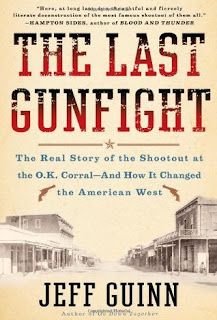
So the thing about Tombstone and the gunfight at the OK Corral is that it doesn't even matter what the true story is anymore - that the gunfight was really not that big of a deal and it didn't even happen there anyway. The myth has grown to such epic proportions that no matter what is written about it until the end of time, it will remain THE defining event that everyone associates with the Old West, even if it came at nearly the tail-end of the era it now embodies.

Guinn does a fantastic job putting together the real history and it was a page-turner like no other for me. In this sense, Guinn is 100% accurate with the subtitle in how this event "changed the American West". He does not mean that this non-event event changed the Old West itself, but changed and molded how we would perceive those days decades and now a century on. There is no question that 4 out of 5 people would say the OK Corral or Tombstone if asked to name a place in that time.

The research into this is massive, detailing everything we can possibly know about the Earps - complete with Warren and James, two Earps I did not even know existed, who had even been in Tombstone at various times when Virgil, Wyatt, and Morgan lived there. Of course there is also Doc Holiday and Big Nose Kate, plus the Clantons and McLaurys, plus Johnny Ringo and Curly Bill of course. The backstory is phenomenally told, how the cowboys came to clash with the sometimes-lawmen. The author used a plethora of sources available for the first time here, including diaries and letters of those involved - even the sketch Wyatt drew of the shoot-out and its end. I learned so much more about Johnny Behan and his connection to Wyatt.

You won't find nearly as much information about Wyatt's vendetta ride to avenge Morgan's murder here as there was the lead-up to the gunfight. For that I highly recommend Tombstone: The Earp Brothers, Doc Holiday, and the Vendetta Ride from Hell by Tom Clavin, which is also superb. Instead, once the smoke has cleared so to speak, much of the aftermath involves the inquests into the deaths that occurred that day - Billy Clanton's, as well as the McLaury brothers.

Even though I love Tombstone dearly (true story - I just ordered the DVD because of course now I want to watch it), the real story is just as interesting, if not more so. It is no secret that the Earps were not always as law-abiding as they're made out to be in popular works. The book does a good job clearing away that bit of myth. One might even say they understand why the Clantons and McLaurys were so pissed off; you can't really blame them. So, there are not straight heroes and villains here, everyone is a little bit of both. And there is so much more information here than a movie would ever have room for to explain adequately. So, I see why the story was simplified for the big Hollywood blockbuster (except it kind of wasn't, I don't think. I don't actually remember.)

Highly recommend, especially for those who enjoy a good chunk of Old West history.

 Rating ⭐⭐⭐⭐

It is very easy to feel sorry for a lot of the women who became known as a Mrs. Earp at any point in their lives. They were often common-law wives who were easy to leave - as Wyatt himself could attest to. It would seem that the father of some of the most famous lawmen in history started off with this idea himself, marrying a total of three times in his life. The author is also quick to point out that while several of the Earp sons would go on to marry multiple times, there may be even more wives that we don't know about. I would not be surprised one bit.

I really enjoyed the focus of this book. The author does a fantastic job with what I imagine would be very limited source material to bring these women to life behind their passive roles in movies like Tombstone. The book is a quick read and I like that she includes transcripts of letters written by various Mrs. Earps. Live in the West would have been hard enough, but I could not imagine trying to survive out there while also following a husband with wanderlust in his veins. This is a very special group of women who are finally having their stories told and a must-read for those interested in the history of the West.

 Rating ⭐⭐⭐⭐⭐

Just the kind of ladies I would love to read about! Much like the previous title, I was happy to find this gem and learn more about the women who populated the frontier towns aside from those who are already well-known.

Women in the West could be just as tough, if not more so, than the men they kept company with, if they chose to do so. Plenty of women were outlaws and gamblers with their own reputations, saloon owners or soiled doves. The point then, as it still is today for so many women, they did whatever they had to in order to survive. If that meant anything from prostitution to murder, then so be it.

Each woman in the book is given a certain amount of pages for her brief biography, recounting her adventures. I feel a book like this is important because in many cases, this might literally be all we know about many of these women and they deserve to have their stories told, out of the shadows of their male counterparts. Sadly, so many stories were similar in how they came to find themselves unattached in a dangerous time and place. Each chapter opened with a highlight or major event from the woman's life. The author then made great use of personal items, such as letters and diaries, or even interviews given later in life when their gun-slinging days were long behind them.

A recommended read for those with an interest in the period and/or badass women who took care of themselves.

Stacking the Shelves #137


Stacking the Shelves is a weekly feature co-hosted by Tynga's Reviews and Reading Reality. It is a chance to showcase all the goodies you've collected throughout the week, whether they're bought on-line or in-store, an ARC or a final copy, borrowed from a friend or the library, physical or digital, etc.

Author Gift

Library Treasures

Happy Reading!
Sarah