Friday, June 19, 2015

Peter, Paul and Mary Magdalene: The Followers of Jesus in History and Legend

71656

Rating: 2 Stars

Review:

I read Ehrman's books, not for his opinions but for the facts he presents in relation to the New Testament, of which he obviously knows thoroughly. However, our faiths differ greatly, again obviously.

His writing style is easy to follow, but there is so much background information here that he used word-for-word in other texts, that gets a bit tedious. And his habit of repeating himself also gets tiresome.

Here he presents Peter, Paul, and Mary Magdalene as both historical and legendary figures in an accessible fashion, giving each their due turn in the spotlight. I don't put much stock in the Gnostic Gospels, though Ehrman references them frequently. Nor can we really put a lot of faith in other gospels and writing excluded from the Canon as we know it today. But still this makes for an interesting read about three of the most important figures in Christianity - without whom it would not exist had they each not done their part after the crucifixion and in the ensuing years.

Additionally:

Could have seriously done without the trite references to the folk group Peter, Paul, and Mary. It was just kind of annoying - in between the smatterings of Ehrman being trite and condescending himself.

Wednesday, June 17, 2015

Neil Patrick Harris: Choose Your Own Autobiography


20170296
Rating: 5 Stars

Review:

I don't think the day will ever come that I stop loving Neil Patrick Harris. Really truly. This book proves that time again. He is so talented - acting, singing, magic-ing. Not to mention witty, handsome, and charming.

We all have that celebrity that we hope is just as wonderful in their everyday life as they seem to be in front of the cameras. For me, that's NPH.

Additionally:

This review is so short because I feel weird reviewing autobiographies. It's like you're reviewing their life. Just know: I dig NPH.

And just for good measure, one of the greatest opening acts from an award show, ever.


Lost Scriptures: Books That Did Not Make It into the New Testament

107277

Rating: 2.5 Stars

Review:

Firstly, I do not read Ehrman's books for his opinions on Christianity. While he is a self-proclaimed agnostic, he is well-versed in Scripture. He knows what he is talking about when he he is reciting the facts of the Bible, and I appreciate that. I have learned a lot about the Bible from reading his books. But as a Christian with a faith that is growing stronger each day, I differ when it comes to many matters of opinion.

That being said, I am fascinated by the idea of how the Bible came to be what we know today, who decided what books made it and which ones didn't. I found this one interesting, but it is not necessarily what you call exciting. It presents several texts that were excluded from he New Testament, some very rightfully so. I must confess here that I skimmed the books that were clearly Gnostic.

Unfortunately some of the books are incomplete, so we do not know all their content, length, etc. Most of the time we do not even know who actually wrote the books presented. But they are interesting reads nonetheless - I especially find the book relating events of young Jesus' childhood and his exploits. It is certainly understandable that we would want to know more about Jesus as a child, or at any point in his life, really, but I think we can agree that it is likely not accurate or true.

This is not an easy read by any means - don't let my start and finish dates fool you. Some of the books are incredibly long and it difficult to discern the exact meanings. Each book is prefaced with an introduction, where and when it was found, and when historians generally believe it was written. While many times Ehrman gives a reason for why historians believe it was written at a certain time, but there are also several instances here he does not. This is troublesome, as if there is a reason historians believe it to belong to one century and not another, this should be stated.

That said, I found myself wanting to know more about the books, not just their content. Unfortunately after nearly 2,000 years, this information will likely continue to elude us.

I wavered back and forth between 2 and 3 stars. I like reading about these Scriptures because I am interested in how our Bible came to be. I don't necessarily agree with what these books say however, thus the reason for them  being excluded from the New Testament.

Monday, June 15, 2015

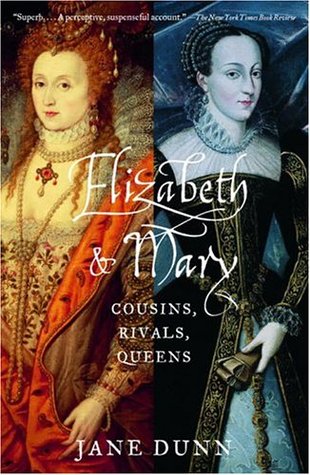
Elizabeth and Mary: Cousins, Rivals, Queens

381713

Rating: 2.5 Stars

Review:

Well, well, well, yet another book slanted completely toward Elizabeth. I had such high hopes for this one, but was sorely disappointed. And not just because of the dichotomy of how the author chose to (mis)represent her subjects.

First, I must be clear that Mary is certainly a flawed heroine. She made one poor decision after another upon returning to Scotland and pursuing the Darnley match. But she can hardly be faulted for the way she was raised - a Scottish queen from her first days, a French princess for nearly two decades, she was pampered and raised in such a way that she was always well aware of her status. But she was also often deprived of those she loved and who loved her the most - her mother, father in law, and husband all in short order. Family was important to Mary, so she naturally sought the guidance and protection of her self-serving half brother, Moray. She couldn't have know, but should have expected his treachery. And in further regards to family, one can only imagine her heartbreak at being all but abandoned by her only child, her beloved son. He too chose to protect his own ambition for the English crown, and had little motivation to help his wrongfully imprisoned mother.

As for Elizabeth, I'm not sure I even have the energy to deconstruct some of this utter nonsense. As I've maintained in other books about this topic, Elizabeth was an insecure, selfish, self-absorbed, manipulative, spoiled brat who knew full well the execution warrant would be served as fast as humanly possible; her counselors could not wait to get rid of Mary. Boo/hiss to Elizabeth. That's all the attention I care to give her.

As for the book itself, there are many issues. It jumps around for the majority of the first half or so and there's no consistency in the telling of events. This seemed to stop when Mary arrived in England. It is also beyond repetitive - this is not a complaint, it is a fact. If one needs that much information repeated time and time again, then perhaps something a little simpler to start with on the topic of these two would have been better.

Overall, highly disappointing. I'm wavering back and forth between two and three stars, how I wish goodreads allowed half stars! It had such potential but I just can't get beyond the obvious favoring of Elizabeth.

I can't say I recommend this one whole-heartedly. Perhaps for those who already have a good knowledge of the two queens and can see through the nonsense and bias in favor of Elizabeth.

Additionally:

I don't feel I have done as well with this review as others I have done on Mary before. I know there are many aspects of the relationship that I left out, the 'rivalry' so to speak, but it is just frustrating - and 400+ years later, what are we to do about it? I have so much sympathy for Elizabeth a child, but can not stomach her absurdity as queen. As much as Mary, Elizabeth is a victim of her own childhood. But this does not excuse the fact that she repeatedly looked for ways to 'be rid of' Mary, she signed the death warrant, then she laid the blame at everyone else's feet. Talk about hypocritical. She wanted Mary to be badgered into submission, promising a pardon if Mary would just admit she was guilty. But why would Mary? She had been held unjustly for YEARS. How many times was there talk of a face to face meeting, of help, and so on? Those actions never materialized and Mary had no reason to ever believe she would be free again. So, she embraced her death sentence and became a martyr. It is a tragic and unnecessary end for a queen who desired her freedom and was cruelly denied it by a government that had no right to hold her in the first place. Imagine if they had presented a united front together? How different history might have been.

Sunday, June 14, 2015

Nazi Women: The Attraction of Evil

20343950

Rating: 2 Stars

Review:

As I have stated in previous reviews of works of similar nature, I simply don't have the ability to read anymore about the Holocaust and WWII after having a child of my own. It is so hard to not imagine it could be your own child, and it makes me want to vomit.

That being said, I began this with some trepidation, not wanting to read about the specific atrocities these monstrous women committed, but more so looking for a kind of study on the type of women who were enthralled by Hitler and his Thousand Year Reich. Unfortunately, it seems that there was no type; it was about empowerment after what were honestly unfair reparations from WWI, a war Germany didn't even start. And these women apparently did not read the fine print, as Hitler and his cronies had no intention of truly empowering them to do anything more than cook, clean, and have perfect little Aryan babies.

Now, I am typically not one to support the notion of an eye for an eye, but I cannot express enough how disgusted and angry I am that so many of the women who worked in the camps especially were able to assimilate back into normal civilian life. They were murderers who escaped justice and I can only hope the rest of their lives were miserable.

The book itself reads kind of strangely. It is more like a collection of mini biographies of various women and their involvement in the Reich. There are sections devoted to Hitler's relationship to them, most fleeting, none actually important to him. I just can't understand how this pathetic, ugly (meant both inside and out) little man could have inspired such frenzies.

This is a very short volume and really is nothing more than a general look. For that I am grateful. I don't want to know any more about these women then I already do, specifically their cruelty and the acts they perpetrated on their youngest, smallest victims. However, for someone who may be able to handle this better than I without wanting to cry, it will be lacking.

One of the biggest distractions while reading were random snippets of text in bigger, bolded font throughout. It literally added nothing to the text, as it was not additional info or quotes or facts. It was simply a sentence taken from a regular paragraph and made bigger. It was not even always the most important idea from a particular page, and very early on I just quit reading them.

The pictures were interesting, but sometimes odd choices. I realize there may not be photos of some of the women anymore, but it would have been helpful perhaps if the photos were included in the section the woman was written about.

Overall, it is not a terrible work, though it is written about some of the worst people to ever live. These women were part of a regime that brutalized, tortured, and murdered millions of innocent men, women, and children. If anyone could ever be classified as sub-human, it is this group, along with their male counterparts, and most certainly not the people against whom they committed these crimes. But the work is also by no means authoritative. Additionally, there were sections at the end I just could not read due to their content regarding the camps. This would not be a terrible supplemental reading, but not one I would look to first on this topic.

Saturday, June 13, 2015

Tudor: The Family Story

17456975

Rating: 5 Stars

Review:

How refreshing to read about the Tudors from their true beginnings, and not simply Henry VIII's reign and beyond. There was so much I never knew about the family prior to Henry VII defeating Richard III at Bosworth, and I do consider myself fairly well-read on all things Tudor.

I was hesitant at first to read this however, because I've read previous books by de Lisle and found them to be rather slow moving. Not so here, I couldn't put it down even as her subject moved from Henry VII into familiar territory.

The family is fascinating, though whenever I read about Elizabeth I find myself wanting to pull my hair out and scream at her, "Get married already so your family's reign can continue!!!" Alas, no amounting of shouting at her ever works.

Speaking of Elizabeth, I've always had a soft spot for Elizabeth the child that I simply don't for Elizabeth the adult. I know part of this is because her mother is Anne Boleyn, whom I quite despise. The larger part though, is that her sister and predecessor Mary is often portrayed as the evil one, compared to Elizabeth's goodness. People seem to forget that Elizabeth had many more executed than did Mary - not to mention she had the nerve to execute a fellow monarch in her cousin, Mary Queen of Scots.

The text it not always in-depth, but for the time span it covers, one can't expect that or this one volume might have become a thousand pages. But it does its job well, weaving a story through centuries to how this great dynasty came to pass.

1066: The Year of the Conquest


770512

Rating: 5 Stars

Review:

So fantastically written, I easily could have read it cover to cover in one sitting. Even knowing the outcome ahead of time, the story is still so engrossing that you can't help but keep turning the page.

I quite agree with Howarth's assessment of the principal characters; how he'd have liked King Harold, felt sorry for Tostig, and been terrified of William. Echoing my earlier comment, I'm not sure why he disliked Edward the Confessor so, perhaps I need to read more about King Edward. Harald is quite an enigma to me still, and I'd like to read more about the "last of the great Vikings".

Here you're given a much more objective view of Harold and there doesn't seem to be much to dislike about him. Nor does there seem to be any indication that he'd have been anything but a fair and just King. You can't help but feel sorry for him, once he saw the papal banner that William carried, and given the terrible way in which he died. His behavior compared from Stamford Bridge to Hastings is so markedly different, one almost has to assume his confidence was completely gone and the he believes he'd already lost and that God was against him. You have to feel sadness too, for the numerous Englishmen who continued to suffer once William was crowned (though they certainly suffered before then as well, once Harold was defeated).

It's intriguing to think how differently England would have developed if Harold had won Hastings and William had been killed or at least been sent packing.

Jane Seymour: Henry VIII's True Love

7971464

Rating: 4 Stars

Review:

There's a reason that this is the only biography ever written about Jane - there's barely enough info known about her to fill a chapter in a book about all of Henry's wives, let alone a whole book. That aside, Norton does well with what little information she has to go on. There are a lot of assumptions and supposings, but that's to be expected, given the lack of source material. I was pleasantly surprised to find that Jane was a bit more involved in her own rise than previously presented.

I've always felt a bit sorry for Elizabeth - at least as a child. She lost her own mother at two, but surely remembered her for a short while at least and what information we do have indicates that Anne Boleyn was a devoted mother - as much as she could be, while still performing her duties as queen. That's why it's unfortunate to learn that Jane likely paid little attention to Elizabeth, and instead focused on Mary entirely. It makes sense, given Jane's devotion to Catherine, but still, Elizabeth was still a very young child who deserved to be cared for.

That tangent aside, it's a well-written book that's sheds a little more light on the queen we know the least about. At first I was annoyed by the title of Jane being Henry's true love, but discovered that is how Henry viewed her, after her death and was not just the author making grand statements. I do disagree with Norton's assumption in repeatedly saying Jane was safe once she'd given birth to a son. That is in no way true, and is only assuming the best possible outcome. If Edward had died in infancy, or at least before Henry, and Jane had lived, yet had no other sons, I have no doubt she would have been tossed aside like those who came before her.

The Trigger: Hunting the Assassin Who Brought the World to War

18300212

NOTE: I see the title has been changed. The title of my blog post is the original title of the book. I am not sure when Butcher changed the book title, but I can imagine why. The book was more about Tim's journey following in Gavro's footsteps than about Gavro himself.

Rating: 4 Stars

Review:

I must first say I was a little disappointed by parts of this book. I began reading with the hopes of it being a biography of Gavrilo Princip, but soon realized there's simply too little information about him known for a full length book dedicated solely to him. I enjoyed the history of the land he called home, the place he loved and dreamed could be free from outside rule.

What I could have done without was Butcher's interspersing of stories during his own coverage of the war in the early-mid 90s. I don't feel it added much to Princip's story. It felt unnecessary and just filler - especially since the whole premise of the book was supposed to be following Princip's path as he moved toward infamy.

The thing is, and the reason I chose this book to begin with, I'm not sure I even recall learning his name in school when learning about events leading up to WW1. Simply, an assassin shot the Archduke and his wife, and so came war.

I feel a particular sadness for Princip's descendants, carving out their existence in the small village where Gavro was born. I like that he is referred to affectionately, that at least his family still remembers to carry in his name - especially because everyone else in his country seems to prefer to forget him.

I find the last know photograph of Princip on page 286 truly haunting. Here he is not angry or defiant, as he'd been described previously. He seems resigned to the fact that despite the twenty year sentence, he will die in prison. It is a sad end for someone who dreamed of bringing about such a change for his people, for them to be free.

However, it can not be forgotten that this action spawned not one, but two world wars. There is simply no way Hitler could have come to power had Germany not been so slowly and painfully dying under the weight of the reparations she was forced to make.

Still Princip could not have known that these few bullets would ultimately mean the death of millions over the course of the next 30 years, from WW1 through WW2. He was simply doing what he had always done, as he'd been described by those who knew him: he was the little guy, standing up for those who could not stand up for themselves, standing up to the bullies.

Royal Wedding: A Princess Diaries Novel

23215471

Rating: 3 Stars

Review:

I am very torn on this one. I read The Princess Diaries ages ago and it was one of my favorites. Then I recently read the rest of the series, while most were good (except 10, it sucked, be honest), they just didn't quite have the same oomph of the original.

So, the good: everything you would want to happen and everyone you would want to read about is in this book. There are very few new characters introduced, and aside from Olivia, none of them are very important. Mia and Michael get married, JP truly 'gets his' in the end, Mia's mom and dad get back together, etc. Tina, Lilly, Boris, even Lana, the group from high school are still a group. Still. Eight years after high school ended. (Seriously? I hardly talk to anyone from high school anymore. Not because I don't like them, but because between then and now we've all met other people, moved far away from one another, etc. There's even good friends from college I don't talk to anymore. Maybe it is because I am 32, not 26, but even still. Come on.)

Anyway, that section rapidly started digressing to the not so good, so I might as well get started: everything you wanted to happen and everyone you would want to read about is in this book. Everything just magically worked out and there were no loose ends.

I know, I know. But it IS a bad thing. All of the characters are the EXACT same people they were in every other book. And of COURSE I wanted Michael and Mia to get married - but expecting twins? Seriously?

And what about this whole JP thing being the stalker? How did he go from being the random guy who screamed about corn being in the chili, to this douchebag psycho? It just doesn't make sense, because it is one thing to be a high schooler who is kind of just in it for the fame of dating a princess, to continuing to sulk and stew about it for eight years. It was pretty obvious once JP was introduced as the Lezarres-Reynolds guy that he was RoyalRabbleRouser. However, I had forgotten his last name was Reynolds, so it did not occur to me until this point.

The bummer is, Mia has not really changed. She still makes terrible decisions and by now, having been a recognized princess for 12 years, should know better than to go traipsing off to her half-sister's school when her family is already in the news non-stop. She did exactly the opposite of what she knew she should do and she always in hindsight realizes how poor her decisions are.

Mr. G dying sucks. He was a good guy and loved Mia's mom a lot. It bums me out for Rocky - who was one of the main (and only) reasons I laughed throughout the book, what with his farting/dinosaur obsession and all. No one seemed terribly upset about his death though it had only been a year. I mean, it wasn't as though it had JUST happened, but everyone seemed very blase about it. I specifically chose to not read any reviews of the book or even the summary before starting, and it was still plain as day that Mia's mom and dad would get back together by the end.

And speaking of her dad, seriously, what a mess! A constantly inebriated ruler of a small foreign country? I can't imagine for one second why he had, at one point, been losing so terribly in the polls.

I wish it would have been a straight novel, instead of Mia STILL talking about writing in her journal in the bathroom. She's an adult now, as are many of us who met her so many years ago. I get that the journal angle is her 'thing', but it just seemed awkward that it was most definitely a novel that just had dates scribbled at the top to make it SEEM like it was still a journal.

So, all in all, this was a hot mess of a book. It was exactly what I expected, because it had to have a happy ending. I just wish it had not been so predictable. And I can't shake the nagging suspicion that the only reason Cabot REALLY wrote it was to bridge to the Olivia series, which incidentally reads A LOT like the early Princess Diaries books. Though Olivia seems less high-strung than Mia.

I wanted to love this book, and maybe I can because it is exactly what I expected. But that doesn't mean it was GOOD.